

Table of Contents
- Start With the Label: How to Read Cat Food Labels
- Match Cat Dietary Requirements by Age
- Check AAFCO Cat Food Nutrient Profiles
- Wet vs Dry Cat Food Benefits: Which Texture Wins?
- Budget-Friendly vs Premium Cat Food: What Actually Matters
- Transitioning Food Safely and Spotting Allergies
- Frequently Asked Questions
Last Updated: September 16, 2026
Start With the Label: How to Read Cat Food Labels
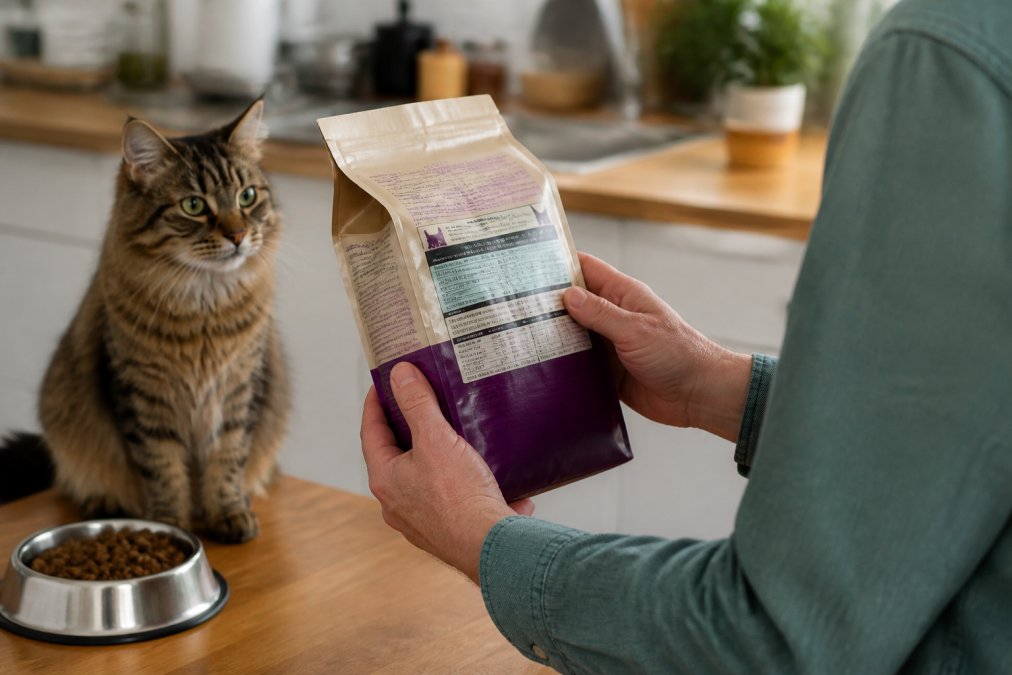
Learning how to choose the right pet food for your cat starts with the label, because the label is the only part of the bag you can verify before you buy. This guide walks through the label, the life stages, and the transition plan, so you can shop with confidence instead of guesswork.
Every bag sold in the United States carries a guaranteed analysis: minimum crude protein and crude fat, maximum fiber and moisture. Those numbers describe the food as sold, not as your cat digests it, which is why FDA guidance on pet food labeling treats the label as a statement of composition rather than a promise of quality.
Guaranteed Analysis and Dry Matter Basis
Dry matter basis is the nutrient profile of a food with all moisture removed, and it is the only fair way to compare wet and dry products. A canned food showing 10% protein sounds weak next to a dry food showing 34%, but once you account for the roughly 78% moisture in the can, the two are often closer than the labels suggest.
The math is simple: divide the nutrient percentage by the food's dry matter percentage, then multiply by 100. A dry food with 34% protein and 10% moisture has 90% dry matter, so its protein sits near 38% on a dry matter basis. Run the same calculation on the canned food and the gap narrows fast.
Ingredient List Red Flags
Ingredients are listed by weight before processing, so a named meat at the top of the list can still shrink to a modest share of the finished kibble once water is removed. Watch for these patterns:
- Split grains or starches: "corn, corn gluten meal, ground corn" are one ingredient counted three times to push meat down the list.
- Unnamed fats and proteins: "animal fat" or "meat meal" tells you nothing about the source.
- Artificial colors and preservatives that exist to please the buyer, not the cat.
- Sugar, corn syrup, or propylene glycol, which add calories without nutritional purpose.
Match Cat Dietary Requirements by Age
Cat dietary requirements by age follow three stages, and feeding the wrong one is a common mistake. Kittens need dense, calorie-rich food for growth. Adults need maintenance. Seniors need support for changing kidneys, joints, and muscle mass.
Kittens generally stay on growth-formula food until about a year old, and many vets keep them on it slightly longer for larger breeds. Adults do well on a maintenance diet with moderate protein and controlled calories. For cats over seven, look for formulas with highly digestible protein and added support for urinary and joint health.
| Life Stage | Age Range | What to Prioritize | Watch For |
|---|---|---|---|
| Kitten | Birth to 1 year | High protein, high fat, DHA | Overfeeding, rapid growth |
| Adult | 1 to 7 years | Maintenance protein, controlled calories | Weight creep, boredom |
| Senior | 7 years and up | Digestible protein, urinary support | Muscle loss, dental issues |
Check AAFCO Cat Food Nutrient Profiles
AAFCO cat food nutrient profiles are the baseline standard for commercial cat food in the United States, and a label that says "complete and balanced" should name the profile it meets. Two statements qualify: "formulated to meet" the AAFCO profile, or "feeding trial" tested under AAFCO protocols. The feeding trial is the stronger claim because it was proven on live animals, not calculated on paper.
Look for the life-stage qualifier too. A food labeled for "all life stages" must meet the toughest growth standard, which is why it often works for kittens and adults alike. A food labeled "adult maintenance only" is not appropriate for a growing kitten.
Wet vs Dry Cat Food Benefits: Which Texture Wins?
Wet vs dry cat food benefits come down to water, texture, and your cat's specific health needs. Canned food carries 75% or more moisture, which supports urinary health and helps cats who drink too little. Dry food is convenient, shelf-stable, and often cheaper per meal.
Cats evolved as desert hunters with a low thirst drive, so many do not drink enough to compensate for a dry-only diet. If your cat has a history of urinary crystals, kidney concerns, or simply refuses to drink, wet food does more work for you. If your cat grazes all day and does well on kibble, dry food is not automatically the wrong choice.
Texture matters as much as moisture. Some cats will only eat pate, others want shreds or chunks in gravy. Palatability drives intake, and a food your cat refuses helps no one.
- Pate: dense, easy to mix with water, good for cats with dental issues
- Shreds and chunks: higher moisture, appealing to picky eaters
- Kibble: convenient, supports dental abrasion, but low moisture
- Freeze-dried raw: rehydrates into a high-moisture meal, good for rotation
Budget-Friendly vs Premium Cat Food: What Actually Matters
Budget-friendly vs premium cat food is less about the sticker price and more about what each dollar buys. Premium foods typically spend more on named animal proteins, feeding trials, and quality control. Budget foods cut cost with plant proteins, byproducts, and fewer trials. Neither is automatically better for your specific cat, but the gap between them is narrower than the marketing on either side suggests.
The single most useful number is cost per day, not cost per bag. A 3-ounce can and a 16-pound bag are not comparable units, and feeding amounts vary by the food's calorie density.
When you compare, weigh four things:
- Dry matter protein and fat from a named animal source, not a category like "meat meal"
- Life-stage fit for your cat's age and health
- Calorie density (kcal/cup or kcal/kg) so you can convert price per bag into price per day
- Whether your cat actually eats it, refused food has infinite cost per day
Where budget foods earn their place: a food that meets the AAFCO nutrient profile for your cat's life stage, lists a named animal protein first, and that your cat eats reliably is a legitimate choice. Where premium earns its place: feeding-trial substantiation, published sourcing, and consistent batch quality. If a premium food fails the AAFCO statement or your cat refuses it, the premium price buys you nothing.
Transitioning Food Safely and Spotting Allergies
Most guides tell you to "transition slowly" and stop there.
The 10-Day Transition Schedule
| Day | Old Food | New Food |
|---|---|---|
| 1-3 | 75% | 25% |
| 4-6 | 50% | 50% |
| 7-8 | 25% | 75% |
| 9-10 | 0% | 100% |
Food Allergies vs. Sensitivities
Sustainability and ethical sourcing are worth a look too. Some brands publish where their proteins come from and how they are caught or raised. If that matters to you, check whether the sourcing claim is verifiable or just a logo on the bag.
Frequently Asked Questions
What should I look for on a cat food label?
Look for an AAFCO nutritional adequacy statement, a guaranteed analysis, and a named protein source like chicken or salmon first on the ingredient list. Check the life stage on the label matches your cat. Avoid foods with unnamed byproducts, artificial colors, or vague terms like 'meat meal.' The label tells you whether the food is complete and balanced, which is the most important factor for your cat's health.
Is grain-free cat food actually better for my cat?
Not necessarily. Grains like rice and oats provide fiber and energy, and most cats digest them well. Grain-free formulas swap grains for peas or potatoes, which does not automatically make them healthier. The exception is a diagnosed grain allergy, which is rare in cats. Focus on the protein source and AAFCO statement instead of whether the bag says grain-free.
Should I feed my cat wet food, dry food, or a mix?
Both work when the food meets AAFCO standards. Wet food adds moisture, which supports urinary health and helps cats who do not drink enough water. Dry food costs less and stays fresh longer. Many owners mix both to get the benefits of each. Your cat's age, weight, and any health conditions should guide the final choice.
How can I tell if my cat has a food allergy?
Common signs include itching, hair loss, vomiting, diarrhea, and ear infections. Your vet may recommend an elimination diet using a novel protein or hydrolyzed formula for 8 to 12 weeks. If symptoms improve, you reintroduce the old food to confirm the trigger. Never guess at allergies; work with your vet to identify the specific ingredient causing the reaction.
Choosing the right food for your cat takes a little label reading, a life-stage check, and a patient transition, but the payoff is a healthier, happier companion. WowHaul makes the practical side easier with everyday care products for pets, items designed for stronger routines, and a curated collection built to simplify home life. Get started with WowHaul and give your cat a feeding routine that works for both of you.