

Table of Contents
- Why Your Home Feels Chaotic (and How to Fix It)
- The Core Principles of a Functional and Organized Home
- Step 1: Start with Decluttering Checklists for Beginners
- Step 2: Categorize and Zone Your Belongings
- Step 3: Choose the Right Storage Solutions and Containers
- Small Apartment Storage Hacks 2026: Maximizing Vertical and Hidden Space
- Daily Habits for an Organized House: Maintenance Made Simple
- Designing for Different Lifestyles: Neurodivergent and Eco-Friendly Approaches
- Frequently Asked Questions
Last Updated: September 9, 2026
A functional and organized home is a living space where every item has a designated place, daily routines flow with minimal friction, and the environment supports the people who inhabit it rather than adding to their mental load. Most organization attempts fail not because of a lack of discipline, but because they skip the foundational work of decluttering and zoning before buying storage. At WowHaul, we help busy households simplify daily life, and this guide breaks down a process for creating a home that stays tidy without constant effort.
The real problem with most homes isn't mess; it's visual noise and decision fatigue. When you can't find your keys, or you trip over shoes in the hallway, your space is actively working against you. Below, we'll walk through a step-by-step system that moves from purging excess to building maintenance habits, and we'll cover how to design for different cognitive styles and eco-friendly organization.
Why Your Home Feels Chaotic (and How to Fix It)
Clutter accumulates because of a mismatch between the volume of your belongings and your available storage, combined with a lack of defined "homes" for everyday items. The chaos you feel isn't a character flaw; it's a systems problem.
Psychology plays a larger role than most people admit. When your environment is cluttered, your brain processes constant visual noise, which can increase stress and reduce focus (apa.org). The fix starts with understanding that organization is not about perfection; it's about reducing friction between you and your daily tasks.
Home maintenance becomes far easier when you stop treating tidying as a weekly event and start viewing it as a series of micro-decisions. The goal is to create a functional space where the default state is clean, not a space that requires heroic effort to reset.
The Core Principles of a Functional and Organized Home
A functional and organized home rests on three pillars: accessibility, containment, and workflow. Accessibility means you store items where you use them, not where they look best. Containment means every category of item has a boundary, whether that's a drawer, a bin, or a shelf. Workflow means your space supports your actual routines, from morning coffee to evening wind-down.
Before you buy a single bin or basket, audit how you move through your home. Where do you drop your mail? Where do you get dressed? Where do the kids do homework? These zones dictate your storage needs.
Step 1: Start with Decluttering Checklists for Beginners
Decluttering is the non-negotiable first step, and a checklist keeps the process manageable. For beginners, the key is to work in small, defined areas rather than tackling the whole house at once. A common pattern is to start with a single drawer, a single shelf, or a single category like "outerwear" or "mugs." Pull everything out, sort into keep, donate, and discard piles, and only put back what earns its place.
To make decisions easier, use a simple triage system for every item you hold:
- The Last-Used Test: When did you last use this? If it's been over a year and it's not seasonal or sentimental, it's a candidate for removal.
- The Duplicate Test: Do you own another one that serves the same purpose? Keep the best quality version and let the duplicate go.
- The 'Would I Rebuy?' Test: If you were at a store right now, would you spend money to replace this item? If not, it's not adding value to your home.
A practical method to structure your session is the Four-Box Method. Get four boxes or bags and label them: Trash, Donate, Keep, and Relocate. The 'Relocate' box is crucial, it's for items that are useful but stored in the wrong room. At the end of your session, immediately put the items from the 'Relocate' box into their correct homes, or you'll create a new pile.
For a more structured approach, try the 30-Day Decluttering Challenge. For each day of the month, you remove a corresponding number of items: one item on the first day, two on the second, and so on. By day 30, you will have evaluated 465 items. This method works well because it builds a daily habit and prevents burnout.
Once you've completed your first zone, you'll have a clearer sense of your volume and your habits. This makes the next step, categorizing and zoning, much more effective because you're working with a curated collection rather than a chaotic pile.
Step 2: Categorize and Zone Your Belongings
Once you've purged, group like items together. Categorizing is what transforms a pile of stuff into an inventory you can manage. You should be able to state, in one sentence, what lives in each drawer or on each shelf.
Zone-based organization assigns a specific area to a specific activity. The coffee station lives near the kettle. The cleaning supplies live under the sink where you use them. This systematize approach respects your home flow and makes it easier to return items to their home. Labeling is critical here: when containers are labeled, everyone in the household knows where things belong, which is the secret to getting buy-in from family members.
Step 3: Choose the Right Storage Solutions and Containers
Storage solutions should be chosen last, after you know exactly what you're storing and where. The right container does three things: it fits the space, it fits the item, and it fits your aesthetic without adding visual noise.
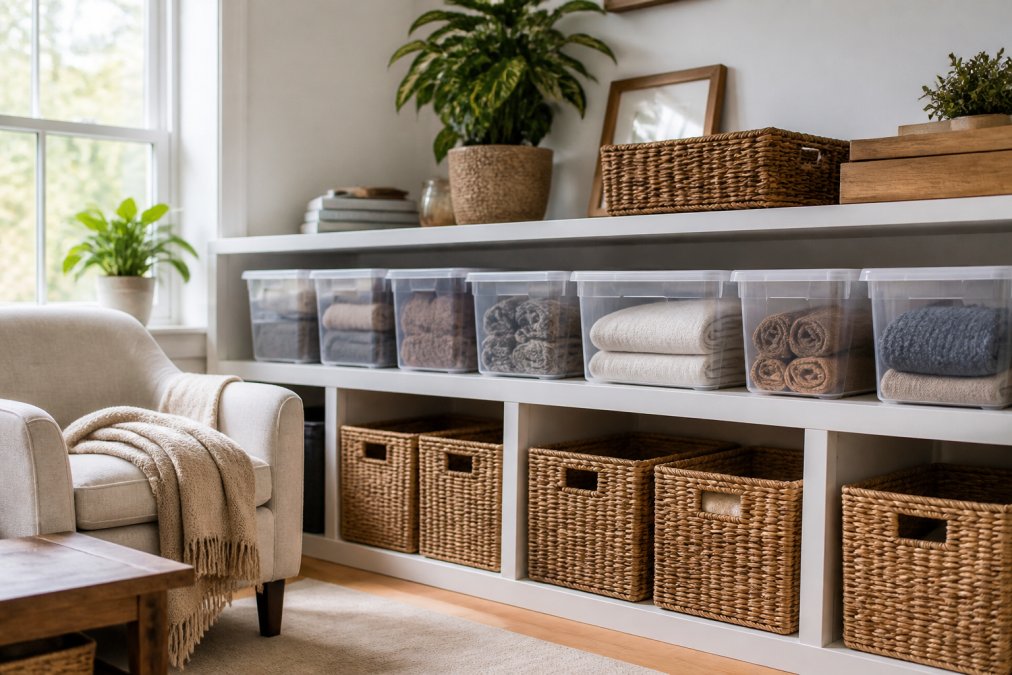
For most homes, a mix of open shelving for frequently used items and hidden storage for visual clutter works best. Clear bins allow you to see what's inside without opening them, while opaque baskets hide items that don't need to be on display. Vertical storage maximizes floor space, making it essential for smaller homes.
Small Apartment Storage Hacks 2026: Maximizing Vertical and Hidden Space
Small apartment storage hacks 2026 focus on using every inch of vertical space and finding hidden storage in plain sight. The core principle is to think upward before you think outward.
Install shelving above doorways, use the back of doors for shoe racks or hooks, and consider furniture that doubles as storage, like ottomans with interior space or beds with drawers underneath. In kitchens, use risers to double shelf capacity for dishes and canned goods. In closets, hang a second rod lower for shorter items like shirts and folded pants.
Space optimization in a small apartment also means being honest about what you need versus what you want. Minimalism isn't required, but intentional living is. Every item you bring into a small space should serve a purpose or bring you joy; otherwise, it's just taking up rent.
Daily Habits for an Organized House: Maintenance Made Simple
An organized house is maintained by daily habits, not weekly marathons. The goal is to systematize tidying so it becomes part of your natural workflow, taking only a few minutes per day. But maintenance isn't just about daily habits; it's about having a clear schedule for deeper resets. Most guides focus on the initial purge, but the real challenge is staying organized six months later. This is where a structured maintenance schedule comes in.
The Daily Reset (5-10 minutes):
- Morning: Make your bed. This single action takes two minutes and sets a productive tone for the day.
- Evening: Do a 5-minute sweep of the main living areas. Collect items that don't belong and return them to their designated "homes." Clear the kitchen counters and load the dishwasher.
The Weekly Reset (30-45 minutes):
Pick one day a week (e.g., Sunday evening) for a deeper reset. This is not a full clean; it's a system check.
- Surface Sweep: Clear all flat surfaces, kitchen counters, dining table, coffee table, of anything that has accumulated.
- Mail and Paper: Sort through the mail pile. Shred junk mail immediately, file important documents, and process any action items.
- Launch Pad Check: Clear out your entryway "launch pad" of anything that doesn't belong (e.g., items that need to go to another room).
- Trash and Recycling: Take out all trash and recycling to prevent buildup.
The Monthly Reset (1-2 hours):
This is the 'deep maintenance' that keeps systems from breaking down.
- The 'One In, One Out' Audit: Review your recent purchases. For every new item you brought home this month, identify one item to donate or discard. This prevents accumulation at the source.
- Fridge and Pantry Purge: Check for expired food and wipe down shelves. This prevents the 'science experiment' effect.
- Digital Declutter: Clear your phone's home screen of unused apps and delete old photos to reduce digital visual noise.
- Zone Focus: Pick one problem area that tends to get messy (e.g., the junk drawer, the linen closet) and spend 15 minutes resetting it.
Consistency beats intensity here. A small daily effort combined with a weekly and monthly reset will keep your home more functional than a massive clean-out every few months. The goal is to create a self-sustaining rhythm where the default state is clean, not a space that requires heroic effort to reset.
Designing for Different Lifestyles: Neurodivergent and Eco-Friendly Approaches
Many organization guides assume a one-size-fits-all approach, but a truly functional home adapts to the people living in it. For neurodivergent individuals, the key is reducing executive load: use open storage so items are visible rather than hidden behind doors, maintain a "launch pad" near the exit for keys and bags, and avoid overly complex systems that require frequent decision-making (adaa.org). Out of sight often means out of mind, so visibility is a feature, not a flaw.
Eco-friendly organization is about buying less and buying better. Before purchasing new containers, repurpose what you already have, like glass jars for pantry storage. When you do buy, choose durable materials like wood, metal, or recycled plastic over single-use options. Sustainable organization also means donating unwanted items responsibly rather than sending them to a landfill.
Creating a functional and organized home is less about achieving a magazine-perfect aesthetic and more about building a system that reduces daily friction. Start with decluttering, categorize ruthlessly, and only then invest in storage that supports your routines. For busy households looking for practical, quality tools to simplify these daily tasks, WowHaul offers a curated selection of storage and home products designed to build stronger routines. Get started with WowHaul and turn your space into one that works for you.
Frequently Asked Questions
What is the 3-3-3 rule for decluttering?
The 3-3-3 rule is a simple method to make decluttering less overwhelming. You spend three hours decluttering, during which you tackle three categories of items, and you aim to fill three bags: one for trash, one for donations, and one for items to put away. This structure helps you make a visible difference in a short time without burning out, making it a great starting point for beginners.
How do I make my house functional for daily routines?
To make your house functional for daily routines, focus on creating zones based on your activities. Place items where you actually use them, such as a key hook by the door and coffee supplies near the machine. Use storage solutions like bins and baskets to contain like items, and establish simple daily habits like a 10-minute evening tidy-up to reset each room. This reduces visual noise and makes your home flow better.
What is the 2-foot rule in home organization?
The 2-foot rule is a guideline for decluttering and organizing. It suggests that if you haven't used or needed an item within the last two feet, or roughly two years, you should consider letting it go. This rule helps you evaluate the necessity of your belongings by focusing on actual usage, which prevents you from keeping things 'just in case.' It is a practical tool for categorizing items and purging what you don't truly need.
How can I maintain an organized home with a busy schedule?
Maintaining an organized home with a busy schedule requires building small, consistent daily habits rather than weekly marathons. Focus on 'closing' a room before you leave it, which takes less than two minutes, and use a 10-minute evening reset to handle dishes, mail, and clutter. Systematize your approach by giving every item a designated home, making it easy to put things away. These habits prevent clutter from accumulating and keep your home functional.