

Table of Contents
- Signs a Dog Is Sick: What to Watch For
- Setting Up a Quiet, Comfortable Resting Area
- How to Keep a Sick Dog Hydrated
- What to Feed a Sick Dog (and What to Skip)
- Managing Low Energy and Mobility at Home
- Keeping a Sick Dog Mentally Stimulated and Calm
- Emergency Triage Checklist: When to Call the Vet
- Frequently Asked Questions
Last Updated: September 13, 2026
Signs a Dog Is Sick: What to Watch For
Knowing how to make a sick dog comfortable at home starts with recognizing the signs early. Dogs instinctively hide illness, so subtle behavior changes often signal a problem first. This guide from WowHaul covers sick dog comfort, from warning signs to setting up a recovery space.
The most reliable indicators are changes from your dog's normal baseline, a dog that usually greets you at the door but now stays on the couch is telling you something. Watch for:
- Lethargy or reluctance to move, walk, or play
- Appetite loss or refusing favorite treats
- Vomiting or diarrhea, especially if repeated
- Dehydration signs: tacky gums, loss of skin elasticity
- Fever or unusually cold extremities
- Labored breathing or persistent coughing
- Whining, pacing, or restlessness indicating pain
According to the American Veterinary Medical Association's pet owner resources, early veterinary consultation significantly improves outcomes for many conditions. If you notice multiple signs together, call your vet rather than waiting.
Setting Up a Quiet, Comfortable Resting Area
A quiet environment is the foundation of recovery. Sick or injured dogs need a dedicated space away from household traffic, other pets, and loud noises to reduce stress and support the restful sleep when healing happens.
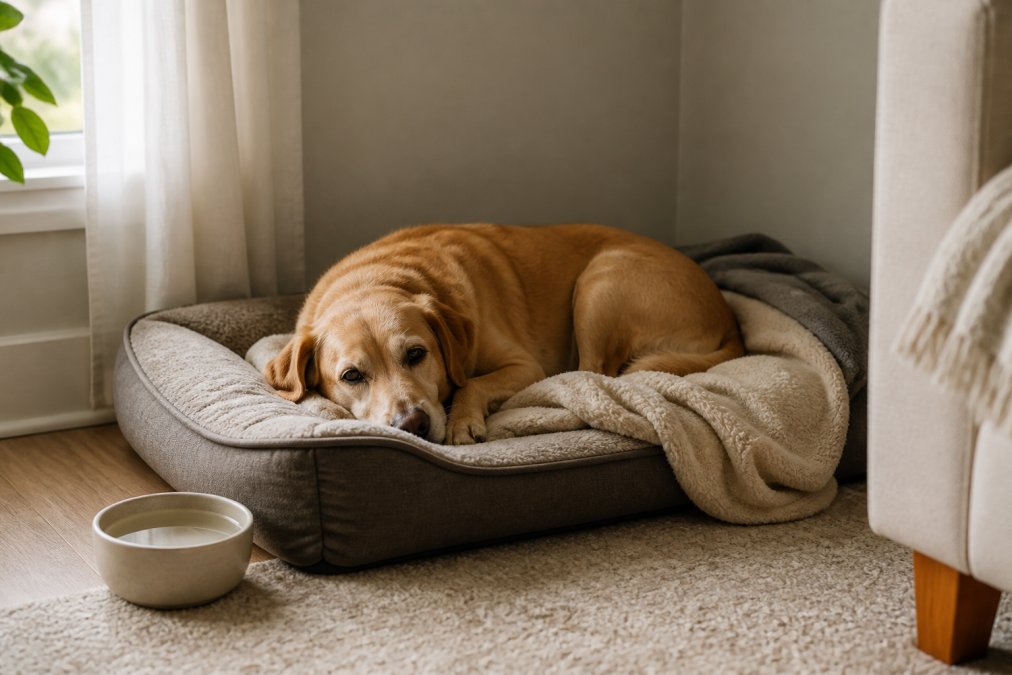
Choose a corner of a low-traffic room. Orthopedic foam or a thick blanket cushions sore joints and prevents pressure sores in dogs on crate rest. Keep the room temperature moderate, since sick dogs struggle with temperature regulation.
For mobility-limited dogs, place food and water within easy reach. A waterproof liner under the bedding protects floors during vomiting or diarrhea.
How to Keep a Sick Dog Hydrated
Hydration is the most critical element of supportive care. A sick dog that stops drinking can deteriorate quickly, so monitor water intake closely.
A common mistake is assuming a dog will drink when thirsty, nauseated or lethargic dogs often won't. Try:
- Offer small amounts of water frequently rather than one large bowl
- Add low-sodium broth to water to encourage drinking
- Provide ice chips for dogs that won't drink but will lick
- Use a syringe to dribble water into the cheek pouch if needed
Check for dehydration by gently lifting the skin between the shoulder blades. If it doesn't snap back quickly, your dog is dehydrated and needs veterinary attention. The Merck Veterinary Manual's guidance on fluid therapy notes that severe dehydration requires professional fluid replacement, not home remedies.
What to Feed a Sick Dog (and What to Skip)
What to feed a sick dog depends on symptoms, but a bland diet is the standard starting point for gastrointestinal upset: boiled chicken or lean ground turkey with plain white rice, in small portions several times a day.
Skip these during recovery:
- Fatty or fried foods
- Spicy table scraps
- Dairy products, which worsen diarrhea in many dogs
- Rich treats or rawhides
For vomiting or diarrhea, withhold food a few hours, then reintroduce bland food gradually. If your dog refuses to eat for more than 24 hours, contact your vet.
Managing Low Energy and Mobility at Home
Confinement and mobility assistance keep a recovering dog safe, a dog that feels better may jump or run before healing is complete, risking reinjury.
For arthritis or injury recovery, limit stairs and use a sling or towel under the belly to support hindquarters during bathroom breaks. Keep leashes short on potty walks, and follow crate rest when your vet recommends it post-op.
For muscle stiffness and soreness, gentle massage can help. The Electric Deep Muscle Massager offers adjustable intensity for easing muscle fatigue, though always check with your vet before using any device on a recovering dog. For your own stress relief during a demanding recovery period, WowHaul's Multifunctional Shoulder and Neck Massager provides targeted relief after long nights of nursing care.
Keeping a Sick Dog Mentally Stimulated and Calm
Most guides tell you to keep a sick dog quiet but not what to do about the boredom that creates. A dog on crate rest with nothing to do will pace, whine, chew at bandages, and work itself into a stress response that raises cortisol and slows healing. Mental engagement is nursing care, not a luxury.
The principle: drain the brain without draining the body. A recovering dog has a limited physical budget, spend it on enrichment that requires thinking, sniffing, and problem-solving rather than running, jumping, or standing.
The enrichment menu, ranked by physical cost
Lowest physical cost, do these first:
- Sniff work. Hide three or four small, smelly treats around one room and let your dog find them at a walk. Ten minutes of scent work tires many dogs as much as a walk.
- Snuffle mats. A fabric mat with folded fleece strips you scatter kibble into. The dog forages with its nose while lying or standing still, ideal for strict crate rest since you can place it inside the crate.
- Lick mats and frozen treats. Licking is a self-soothing, measurable stress reducer. Smear plain canned pumpkin, plain yogurt (if dairy is fine), or vet-approved soft food onto a silicone lick mat and freeze it, a frozen mat occupies a dog 20 to 30 minutes with almost no movement. Skip if your dog is actively vomiting or on a food-withholding order.
- Puzzle feeders. Start with the easiest tier, a sliding-cup or flip-lid puzzle, and only increase difficulty if your dog solves it in under a minute. Too-hard puzzles create frustration, defeating the purpose.
Moderate physical cost, use once your vet clears movement:
- Stationary nose-target games. Hold a closed fist a few inches from your dog's nose and reward the touch, a training game with no walking required.
- Name-the-toy. Ask your dog to pick a named toy from two or three options on the floor. Two or three repetitions is a full session for a sick dog.
- Short, calm grooming. Brushing is tactile enrichment and bonding. Keep sessions to five minutes and stop if your dog tenses or tries to leave.
Avoid during recovery:
- Fetch, tug, and anything with a sudden start-stop
- Stairs, couches, and bed-jumping
- Dog park visits or introductions to new dogs
- Long training sessions that require standing
How much is enough
A useful rule: two to three short enrichment sessions per day, five to fifteen minutes each, is plenty for most recovering dogs. Signs you have overdone it:
- Heavy panting at rest
- Refusing the next treat or turning away from the puzzle
- Whining, pacing, or trying to hide
- Increased stiffness the next morning
If you see any of these, cut the session length in half and add a rest day.
Post-surgical and post-op specifics
If your dog is recovering from surgery rather than illness, the rules tighten:
- Cone or recovery suit on? Choose enrichment that does not require the mouth to reach the floor. Chest-height lick mats or a snuffle mat inside the crate beat floor puzzles a cone will scrape.
- Incision protection. Never use a puzzle or chew that requires lying on the incision. Check the incision after every session for new redness, swelling, or discharge.
- No licking the incision. If your dog is a determined licker, the lick mat becomes a problem, swap to scent work or a stationary nose-target game.
- Follow your surgeon's activity order exactly. If the discharge instructions say crate rest with bathroom breaks only, that means no floor puzzles and no sniff walks. Enrichment happens inside the crate.
Keeping the room calm
Mental stimulation and a calm environment work together. Dogs read human stress, so anxious hovering makes a sick dog more restless, not less. Practical steps:
- Keep the recovery room in a low-traffic area and limit visitors to household members.
- Maintain feeding, potty, and medication times on a predictable schedule. Predictability lowers arousal.
- Use soft background sound, a fan, white-noise machine, or low-volume classical music, to mask doorbells and street noise.
- Speak in a low, slow voice, high-pitched, anxious tones raise arousal rather than soothing.
- Do not punish whining or pacing. Those are communication, not misbehavior, and correction adds stress on top of whatever is already wrong.
Emergency Triage Checklist: When to Call the Vet
The most useful thing during a sick-dog recovery is deciding fast whether this is a "watch at home" night or a "drive to the emergency clinic" night. This decision matrix uses thresholds you can measure at home.
Step 1: Take the four vitals before you decide
You cannot triage what you have not measured. Grab a phone timer and a digital thermometer.
- Rectal temperature. Normal is roughly 101.0°F to 102.5°F. Below 99°F or above 104°F is an emergency. Ear or forehead thermometers are not accurate enough for this decision.
- Resting respiratory rate. Count chest rises for 15 seconds while your dog is asleep or calm, then multiply by four. Normal is generally under 30 breaths per minute. A sustained rate above 40, or obvious effort (nostrils flaring, elbows out, abdominal push), is an emergency.
- Gum color and capillary refill. Gums should be pink. Press your thumb on the gum, release, and count seconds until color returns, under 2 seconds is normal. Pale, white, blue, gray, or brick-red gums, or refill over 2 seconds, means go now.
- Mental status. A dog that is dull, disoriented, head-pressing, or cannot be roused is an emergency regardless of other numbers.
Step 2: Run the decision matrix
| What you are seeing | Measured threshold | Decision |
|---|---|---|
| Struggling to breathe, blue/gray gums | Any | Go to ER now |
| Collapse, seizure, or unresponsive | Any | Go to ER now |
| Temperature under 99°F or over 104°F | Confirmed on rectal thermometer | Go to ER now |
| Suspected toxin ingestion (chocolate, xylitol, grapes, human meds, rodenticide) | Any amount, any time | Call poison control, then ER |
| Repeated vomiting (3+ in 12 hours) or vomiting blood | Any | Go to ER now |
| Bloody diarrhea, black tarry stool, or diarrhea with vomiting together | Any | Go to ER now |
| Distended, hard, painful abdomen | Any | Go to ER now |
| Straining to urinate with no output, especially in males | Any | Go to ER now, this is a blocked urethra until proven otherwise |
| Respiratory rate over 40 at rest, or labored effort | Confirmed by counting | Go to ER now |
| Refusing all food and water for 24 hours | Confirmed | Call your vet today; ER if combined with vomiting or lethargy |
| Single episode of vomiting or soft stool, still drinking and alert | Confirmed | Monitor at home, bland diet, recheck in 12 hours |
| Mild lethargy but eating, drinking, and walking to the door | Confirmed | Monitor at home, log vitals twice daily |
| Limping but weight-bearing, no swelling or wound | Confirmed | Call your vet in the morning |
| Limping with a dangling limb, open wound, or non-weight-bearing | Any | Go to ER now |
Step 3: Know the "wait until morning" traps
Three situations look mild at 10 p.m. and are emergencies by 2 a.m. Do not wait:
- A dog that is vomiting and also not drinking. Combined fluid loss plus refusal to replace it can tip a small dog into shock within hours.
- A male dog that keeps posturing to urinate with little or no output. A urethral obstruction is fatal within 24 to 48 hours and does not resolve on its own.
- A dog that ate something toxic but "seems fine." Many toxins, xylitol, grapes, anticoagulant rodenticides, have a delay before symptoms appear, and the treatment window closes before the dog looks sick.
Step 4: Have the call already prepared
Before you need it, save three things in your phone: your regular vet's number, the nearest 24-hour emergency clinic's address and number, and the ASPCA Animal Poison Control Center line. The ASPCA's poison control guidance recommends immediate contact if you suspect your dog ingested something toxic. When you call, have ready: your dog's weight in pounds, what was eaten or what symptoms you see, the time it started, and any medications your dog takes.
Frequently Asked Questions
How do I soothe my sick dog?
Keep the environment calm and quiet. Set up soft bedding away from household traffic, speak in a low voice, and limit visitors. Gentle petting and sitting nearby often helps more than talking. A warm compress or a soft massage tool can ease muscle tension, but stop if your dog pulls away. Always follow your vet's instructions for medication and rest.
What should I feed a dog that is feeling unwell?
Start with a bland diet: plain boiled chicken or lean ground turkey with white rice, in small portions several times a day. Plain canned pumpkin can help with mild gastrointestinal upset. Avoid fatty table scraps, dairy, and seasoned food. If your dog refuses to eat for more than 24 hours or vomits after eating, call your vet before trying anything else.
How long does it take for a dog to feel better after being sick?
Mild issues like a short bout of diarrhea or a mild stomach upset often improve within 24 to 48 hours with rest and a bland diet. Post-surgical recovery or more serious conditions can take one to several weeks. If your dog is not improving after 48 hours, or gets worse at any point, contact your veterinarian.
When should I take my dog to the emergency vet?
Go immediately if you see repeated vomiting, bloody diarrhea, labored breathing, pale gums, a temperature above 103°F or below 99°F, collapse, seizures, or unresponsiveness. Also treat refusal to eat or drink for more than 24 hours and any suspected toxin exposure as emergencies. Call ahead so the clinic can prepare for your arrival.
Caring for a sick dog at home is demanding, and the right supplies make it more manageable. WowHaul offers practical finds for pet care and home routines, from recovery-friendly comfort items to tools that ease your own stress during long nursing stretches. Explore WowHaul's curated collection to build a recovery setup that supports your dog's comfort and your peace of mind.