

Table of Contents
- Start With a 10-Minute Vacuum Storage Audit
- Vacuum Wall Mount Ideas That Free Up Floor Space
- Closet and Utility Room Storage for Vacuums
- How to Organize Vacuum Attachments So You Can Find Them
- Under-Bed and Vertical Storage for Cordless and Canister Vacuums
- Charging Station Placement and Battery Care
- Safety and Accessibility Rules for Vacuum Storage
- Quick Reference: Matching Storage to Vacuum Type
- Frequently Asked Questions
Last Updated: September 21, 2026
Start With a 10-Minute Vacuum Storage Audit
Learning how to store vacuum cleaners in small spaces starts with one simple step: measure what you actually have. Most people buy a wall mount or bin before they know their closet's real dimensions. Then it sits unused.
WowHaul puts together practical finds for tight homes, and we hear the same thing from renters and homeowners alike. The storage problem is almost never space. It's planning.
So grab a tape measure and a notepad. Then answer four questions:
- What type of vacuum do you own? Cordless, canister, or upright?
- How much floor space can you give up? Measure it in inches.
- Where is the nearest outlet for charging?
- Which attachments do you use weekly, and which sit in a drawer?
Write down the height, width, and depth of your storage spot. Check door swing clearance too. A broom closet that looks roomy on paper shrinks fast once a canister vacuum and its hose attachment go in. Integrating compact storage furniture into your layout provides a more efficient way to house bulky cleaning tools while maintaining the clean lines of a small room.
Ten minutes now saves you from returning a mount that doesn't fit. It also tells you whether you need vertical storage or a hidden spot under furniture.
Vacuum Wall Mount Ideas That Free Up Floor Space
Wall mounts are the fastest way to reclaim floor space in a small home. A bracket holds the vacuum off the ground, so the same square footage works twice.
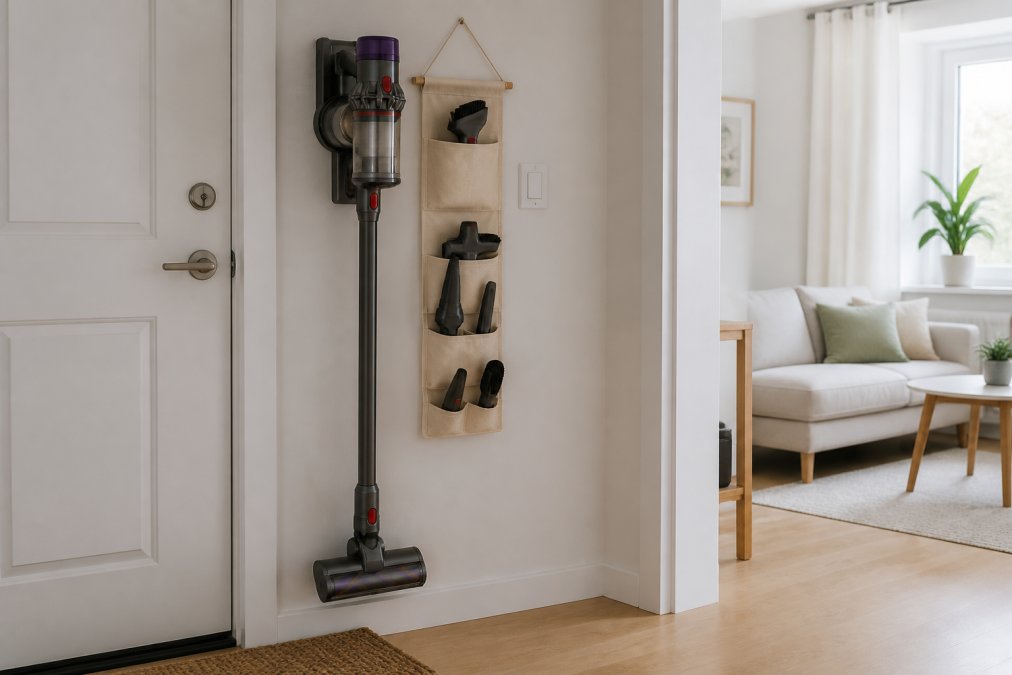
Here's what works in practice:
- Stud-mounted brackets for cordless vacuums. Strong, but you need a stud or a toggle anchor.
- Adhesive hook systems for lightweight stick vacuums. No drilling, but check the weight limit.
- Slatwall panels for a garage or utility room. One panel holds the vacuum plus tools.
- Over-the-door racks for broom closets. Zero drilling and quick to remove.
Mount height matters more than most guides admit. Hang the vacuum so the handle sits at hip level. That way you grab it without bending or reaching.
Renter-Friendly Mounts You Can Remove Without Damage
Renters need non-permanent options that leave no holes. Command-style adhesive hooks, tension rods, and over-the-door racks all come down clean.
Closet and Utility Room Storage for Vacuums
A broom closet or utility closet is the natural home for a vacuum, but most people waste the top half. Add a shelf or a second rod to double your storage nook.
How to Organize Vacuum Attachments So You Can Find Them
The crevice tool goes missing the moment you need it. The fix isn't another bin, it's giving every attachment a labeled home that travels with the vacuum, not one that lives in a drawer across the room.
- Weekly use: crevice tool, upholstery brush, dusting brush. These belong on the vacuum or on the dock.
- Monthly use: extension wands, pet-hair turbo brush, hard-floor head. These belong in a labeled bin near the vacuum.
- Seasonal or rare: spare filters, belts, HEPA cartridges. These belong in a sealed bin away from dust and moisture.
Once sorted, pick a setup that matches your space:
- Mesh hanging organizer on the closet door for brushes and small tools. Mesh breathes, so a damp brush won't mildew.
- Clear plastic storage bin for the hose attachment and extra filters. Clear beats opaque, you see what's inside without opening anything.
- Labeled zip pouches clipped to the wall mount. Good for renters because the pouches move with the vacuum.
- A small caddy that travels room to room. Best if you clean multiple floors and don't want to walk back for the wand.
Renter-Friendly Attachment Storage That Leaves No Holes
If you can't drill, adhesive-backed mesh pouches and over-the-door shoe organizers both work. A shoe organizer with clear pockets holds a crevice tool, a dusting brush, and two spare filters in about the footprint of a single pair of sneakers. Test any adhesive on a hidden patch of paint first, some finishes peel on removal, and a security deposit costs more than a perfect mount.
Store Attachments So They Don't Damage the Vacuum
Two storage mistakes shorten a vacuum's life more than any other:
- Sealing a damp filter or hose in a closed bin. Trapped moisture causes mildew, and that smell spreads through the whole closet within days. Let both air-dry fully, usually 24 hours, before they go back in a sealed container.
- Coiling the hose tightly around the wand. Tight coils crack the inner ribbing over time. Loop the hose loosely, roughly the diameter of a dinner plate, and hang it on a hook rather than wrapping it.
Label the outside of every bin with a permanent marker, not a sticky note. Sticky notes fall off within a month, and an unlabeled bin becomes a mystery box you stop opening.
Under-Bed and Vertical Storage for Cordless and Canister Vacuums
Under-bed storage is the best hidden storage in a small apartment. A low-profile bin on wheels slides under the frame and disappears.
Charging Station Placement and Battery Care
Where you charge a cordless vacuum affects how long the battery lasts, and most guides stop at "avoid heat." The real mechanism is simpler: cordless vacuums run on lithium-ion cells, and those cells degrade faster when they sit at 100% charge in a warm spot. Heat plus a full charge is the worst combination for longevity.
Good charging spots share three traits:
- Interior wall away from direct sun and exterior temperature swings.
- Near an outlet so the dock cord isn't stretched across a walkway.
- Some airflow, a closed cabinet with no vent traps heat.
Battery Habits That Actually Extend Runtime
- Charge to full, then unplug. Leaving a cordless vacuum on the charger for weeks keeps the cells at peak voltage, which wears them down.
- Run the battery down now and then. A partial discharge every few weeks is easier on the cells than constant topping off.
- Store at room temperature. A garage that swings from 40°F to 95°F across the seasons is harder on a battery than a steady 68°F closet.
- Don't store a fully drained battery long-term. If the vacuum will sit for months, charge it to roughly half before putting it away.
Renter-Friendly Charging Without Drilling
If you can't mount a dock, you still have options:
- Freestanding charging stand that leans against the wall and plugs into a standard outlet. No holes, moves with you.
- Adhesive-backed dock rated for the vacuum's weight. Check the weight limit, most stick vacuums are light enough, but a canister is not.
- Over-the-door hook plus a cord clip so the charging cable stays off the floor and doesn't become a trip hazard.
Corded Vacuums: Less Fuss, One Rule
Canister and upright models with cords need less battery care, but the cord itself is the weak point. Wrap it loosely around the hooks, not tight around the handle, and never yank it out by the plug. Pulling on the cord instead of the plug stresses the internal wiring, and that's the most common cause of a corded vacuum that stops working mid-job.
A cordless vacuum stored at room temperature, charged to full and then unplugged, will typically outlast one left on the charger in a hot garage. The storage spot matters as much as the vacuum itself.
Safety and Accessibility Rules for Vacuum Storage
A stored vacuum should be easy to grab and safe to walk past. Two rules cover most of it.
The best storage spot is the one you'll actually use. A vacuum that's easy to grab gets used weekly; one buried behind boxes gets used twice a year.
Quick Reference: Matching Storage to Vacuum Type
| Vacuum Type | Best Storage Spot | Mount Type | Watch Out For |
|---|---|---|---|
| Cordless stick | Wall dock near outlet | Adhesive or stud bracket | Battery heat |
| Canister | Broom closet floor | Freestanding rack | Hose kinks |
| Upright | Under-stairs or utility room | Wall mount or corner | Door swing clearance |
| Lightweight stick | Over-the-door rack | No-drill hooks | Weight limits |
Small-space storage comes down to planning before buying. Measure your vacuum, pick the right spot, and match the mount to your walls and your lease.
Frequently Asked Questions
Where should I store a vacuum if there is no closet?
Use a wall mount in an entryway, hallway, or the side of a kitchen cabinet. A vertical mount keeps the vacuum off the floor and out of walkways. For renters, adhesive or tension-rod mounts remove cleanly. If you have a cordless vacuum, mount the charging station at the same spot so it stays plugged in and ready. Measure the vacuum's height and the wall space first, then pick a mount rated for its weight.
Is it safe to store a vacuum cleaner in a garage?
It is safe if the garage stays dry and above freezing. Moisture and temperature swings can damage motors and batteries. Store the vacuum in a sealed plastic storage bin or a closed cabinet to keep out dust and pests. Bring cordless vacuums inside during winter, since cold reduces battery life. Avoid storing any vacuum near chemicals, paint, or gasoline fumes that can corrode parts.
What are the best vacuum wall mount ideas for small apartments?
Look for a mount that holds the vacuum body and has hooks for attachments. Place it behind a door, beside a broom closet, or in a utility closet. A charging station mount works well for cordless models. For renters, use adhesive strips or over-the-door hooks instead of drilling. Keep the mount at a height where you can lift the vacuum without strain, usually waist to chest level.
How do I organize vacuum attachments in a small space?
Group attachments by use: floor tools, crevice tools, and pet hair brushes. Store them in a hanging organizer, a clear plastic storage bin, or a mesh bag attached to the vacuum mount. Label each bin or hook so you grab the right tool fast. Keep the hose attachment and wand storage together. A wall-mounted rack or over-the-door shoe organizer works well for small spaces.