

Table of Contents
- Why Decluttering Comes Before Organizing
- Vertical Storage Ideas for Apartments
- Multi-Functional Furniture for Small Apartments
- Under-Bed and Hidden Storage Hacks
- Over-the-Door Organizers and Rolling Carts
- Rental-Friendly Minimalist Storage Solutions
- Closet Optimization for Maximum Capacity
- Choosing the Right Storage System for Your Space
Minimalist Storage Solutions for Apartments: 9 Ideas
Last Updated: August 3, 2026
When apartment living means working with limited square footage, minimalist storage solutions for apartments become less of a luxury and more of a survival strategy. At WowHaul, we offer a curated selection of practical finds designed to simplify your everyday living by focusing on what actually matters: keeping only what you use, storing it efficiently, and maintaining a visual calm that makes small spaces feel larger. According to the National Association of Home Builders, the average apartment size has decreased by 12% over the past decade, making smart organization essential for modern living.
The problem isn't that your apartment is too small, it's that you're trying to store too much. Before you buy another shelf or basket, you need to understand the psychology of decluttering and how to sort your belongings by frequency of use. Below, we'll show you exactly how to implement nine proven strategies that transform cramped quarters into organized, breathable spaces.
Why Decluttering Comes Before Organizing
Storage solutions fail because people organize clutter instead of removing it first. You can't organize your way out of too many possessions. The real work happens before you touch a single shelf.
The Psychology of Letting Go
Letting go of items is emotionally harder than most people admit. We hold onto things for three reasons: guilt (the expensive purchase we never used), obligation (the gift we felt obligated to keep), and fantasy (the person we imagine becoming who would use that item). None of these are valid reasons to occupy your limited floor space.
The breakthrough happens when you shift your perspective. Instead of asking "What if I need this someday?" ask "Have I used this in the past year?" This single question eliminates approximately 80% of unnecessary items in most apartments. You're not throwing away your future, you're protecting your present living experience.
Frequency-Based Sorting: What Actually Stays
Not all possessions are created equal. Some items you use daily, others monthly, and some collect dust indefinitely. The frequency-based sorting system divides your belongings into three categories.
Daily-use items stay accessible and visible. These are your coffee maker, phone charger, everyday clothes, and kitchen tools. They should be within arm's reach, not buried in the back of a closet.
Weekly or monthly items go in secondary storage, under the bed, on higher shelves, or in closet corners. These might include seasonal clothing, specialty kitchen equipment, or hobby supplies you use occasionally.
Rarely-used items either get donated or stored off-site. If you haven't touched something in a year and it doesn't hold genuine sentimental value, it's taking up mental real estate you don't have.
This approach eliminates the "just in case" mentality that destroys apartment organization. You're not storing for hypothetical futures; you're optimizing for your actual life right now.
| Category | Examples | Storage Location | Frequency Check |
|---|---|---|---|
| Daily-use | Coffee maker, keys, everyday clothes | Counter, hooks, front of closet | Use daily |
| Weekly/monthly | Seasonal items, specialty tools | Under bed, high shelves, closet back | Use 1-4x/month |
| Rarely-used | Formal wear, specialty equipment | Off-site storage or donation | Use <1x/year |
Vertical Storage Ideas for Apartments
Once you've decluttered, vertical space becomes your greatest asset. Apartments have plenty of wall space, most people just ignore it.
Floor-to-Ceiling Shelving and Wall Ledges
Vertical storage solutions transform dead wall space into functional storage without consuming floor area. This is the fundamental principle behind minimalist apartment organization: move storage off the ground and onto walls.
Floor-to-ceiling shelving works in any room. In bedrooms, floating shelves display books and decorative items while keeping nightstands clear. In living rooms, wall-mounted shelving creates an organized library effect that makes small spaces feel intentional rather than cramped. The key is maintaining visual breathing room, don't fill every inch of shelf space.
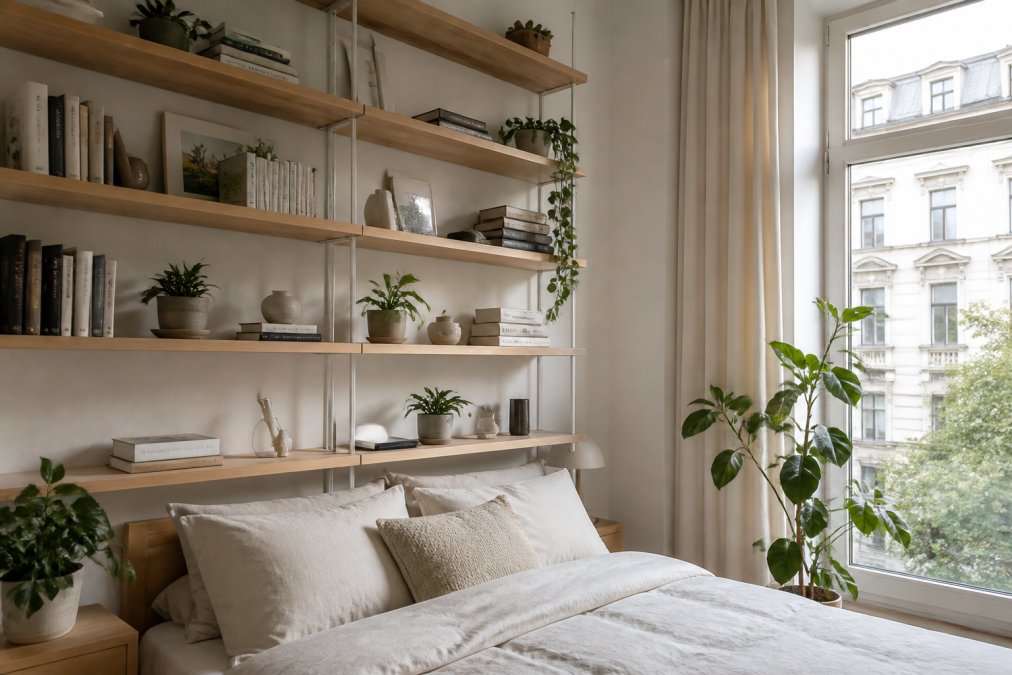
Floating shelves are particularly effective because they create the illusion of more space. Unlike bulky bookcases, they don't anchor themselves to the floor. The West Elm Volume Floating Shelves use a clean, minimalist design with no visible brackets, which maintains the visual lightness essential to small apartments. The Umbra Conceal Bookshelf takes this further by making books appear to float, the shelf becomes invisible behind stacked volumes, creating a striking visual effect while storing significant capacity.
For renters, adhesive-based wall mounting offers a damage-free alternative. Command Hooks by 3M come in various weight capacities, from 0.5 pounds to 15 pounds or more, allowing you to mount lightweight shelves without drilling. This matters because your security deposit depends on it.
Pegboards and Wall-Mounted Systems
Pegboards transform blank walls into customizable storage that adapts as your needs change. Unlike permanent shelving, pegboards let you reconfigure hook placement instantly, making them ideal for apartments where your lifestyle evolves.
The beauty of pegboards lies in their flexibility. You can organize office supplies, kitchen utensils, hobby materials, or craft supplies, all in the same system. Add hooks, baskets, and shelves wherever you need them. When your needs shift, you simply move the accessories.
Pegboards work best in home offices, kitchens, and craft areas. A 2-by-3-foot pegboard in a kitchen can replace three cabinet shelves while keeping everything visible and accessible. This visibility matters for minimalist living: when you can see everything you own, you're less likely to accumulate duplicates.
Installation depends on your rental situation. Damage-free adhesive hooks work for lightweight pegboards, while renters with landlord permission can use small nails or wall anchors. The Container Store Elfa Classic Shelving system offers a premium alternative with adjustable shelves and a steel construction that handles heavier loads without permanent installation in many configurations.
Multi-Functional Furniture for Small Apartments
In apartments, furniture should earn its space by serving multiple purposes. A storage ottoman isn't just seating, it's a place to stash blankets, seasonal items, or extra linens. A bed with drawers underneath isn't just a bed, it's a storage system hiding under your sleeping surface.
Modular Cube Storage That Adapts
Cube storage systems like the IKEA KALLAX Shelf Unit represent the gold standard for minimalist apartment organization. These modular units work horizontally or vertically, adapt to different room configurations, and accept various inserts, drawers, doors, baskets, that let you customize your storage as needs change.
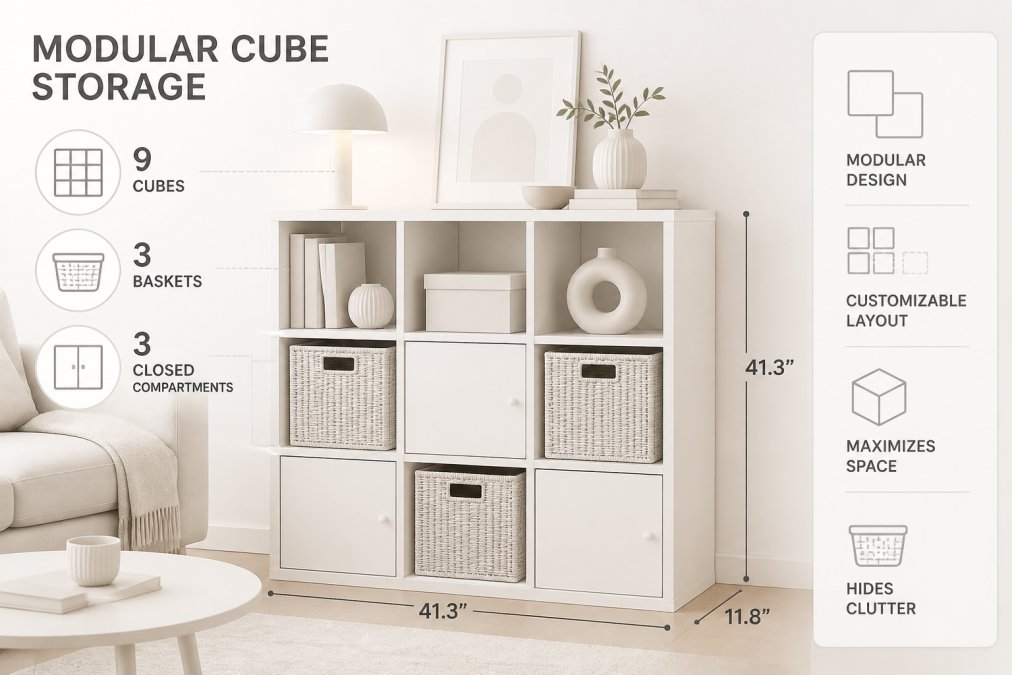
The KALLAX system costs around $37.99 per unit, making it accessible for budget-conscious renters. You can start with a single 2x2 configuration and expand horizontally or vertically as your needs evolve. The simple, minimalist aesthetic blends seamlessly with apartment décor without looking like storage, it looks intentional.
The key advantage: cube storage works as both open shelving (for display) and closed storage (for hiding clutter). A single unit can display your book collection on one side while concealing seasonal clothing in drawers on the other. This flexibility is impossible with traditional bookcases or cabinets.
Cube storage also functions as a room divider in studio apartments. A tall KALLAX unit placed perpendicular to a wall creates visual separation between sleeping and living areas without requiring permanent walls. This psychological division makes small spaces feel larger while creating functional zones.
Furniture That Doubles as Room Dividers
Multi-functional furniture solves two problems simultaneously in apartments: providing storage while defining space. A tall shelving unit, a rolling cart with enclosed baskets, or a wardrobe closet can physically separate areas while serving storage purposes.
This approach works particularly well in studio apartments where a single room serves as bedroom, living room, and sometimes home office. A floor-to-ceiling storage unit placed strategically creates a "wall" that's actually storage, maintaining the openness of the space while providing visual and psychological separation.
The Simplehuman Compact Steel Frame Dishrack demonstrates how even utilitarian furniture can be designed with minimal visual impact. While it's specifically for dishes, the principle applies to all apartment storage: choose pieces with clean lines, minimal footprint, and intentional design that doesn't visually overwhelm small spaces.
Under-Bed and Hidden Storage Hacks
The space under your bed is wasted real estate in most apartments. This hidden zone can store seasonal clothing, extra bedding, or items you use infrequently without creating visual clutter.
Stackable Bins and Drawer Systems
Under-bed storage works best with stackable, uniform bins that slide easily and protect contents from dust. MUJI Polypropylene Storage Boxes excel here because they're translucent, you can see contents without opening them, yet maintain a clean aesthetic. At $1.90 per box, they're affordable enough to buy multiple sizes.
The stackable design maximizes vertical space under the bed. A standard bed height accommodates 12-18 inches of clearance, enough for two stacked bins. Label each bin clearly: "Winter Coats," "Extra Linens," "Holiday Decorations." This labeling system means you never have to open multiple bins hunting for something specific.
Drawer systems designed specifically for under-bed storage offer another approach. These pull-out drawers on wheels make accessing items easier than sliding bins, particularly for heavier items. The trade-off: they're more expensive and take up more space, so they work better for larger apartments with generous bed clearance.
The critical rule: only store items you actually need. Under-bed storage shouldn't become a dumping ground for things you're afraid to throw away. If it's truly worth storing, it deserves proper protection and organization.
Non-Traditional Hidden Spots
Most apartments have surprising hidden storage opportunities that go unused. The space above doorways, inside cabinet doors, and behind furniture all offer potential.
Over-the-door organizers like the Umbra Estique Over the Door Organizer use the back of doors, space that serves no other purpose. At $34.99, it adds hanging capacity for accessories, scarves, bags, or lightweight items without consuming floor or wall space. The key is keeping items lightweight; heavy objects stress the door hinge.
Inside cabinet doors work for spice racks, cleaning supplies, or bathroom organization. Adhesive hooks hold lightweight items without damaging cabinet interiors. This approach keeps frequently-accessed items visible while maintaining the minimalist aesthetic of closed cabinet faces.
The space between wall studs (typically 16 inches apart) can accommodate shallow shelving in some apartments, though this requires landlord permission and more advanced installation. For renters, focusing on movable, damage-free solutions makes more sense.
Corners and wall edges often go unused. A tall, narrow rolling cart fits perfectly in corners, providing storage without blocking traffic flow. These utility carts work in bedrooms, kitchens, or home offices, offering multiple tiers for organizing supplies while remaining mobile, you can move them when needed.
Over-the-Door Organizers and Rolling Carts
Over-the-door solutions and mobile storage address a critical apartment challenge: doors take up wall space but the back of the door remains unused. Maximizing this vertical real estate requires minimal installation and zero permanent changes.
Over-the-door organizers come in many configurations. The Umbra Estique model features hooks for hanging items and a basket for smaller accessories. This single organizer can hold scarves, bags, belts, and lightweight shoes, effectively replacing a dresser drawer's worth of storage in a footprint that doesn't exist.
Rolling utility carts offer flexibility that fixed storage can't match. A three-tier cart fits in a bedroom corner, kitchen nook, or home office, providing accessible storage that moves when you need it. This mobility matters in apartments where you might rearrange furniture seasonally or when hosting guests.
The Rubbermaid Reveal Spray Mop demonstrates how even cleaning equipment can be designed for minimal storage impact. Its compact footprint and vertical orientation mean it takes up far less space than traditional mop-and-bucket setups, which is particularly valuable in apartments with limited closet space.
The advantage of mobile storage: you're never committed. If a rolling cart doesn't work in one location, move it. This flexibility is impossible with wall-mounted or built-in solutions, making mobile storage ideal for renters testing different configurations.
Rental-Friendly Minimalist Storage Solutions
Renters face a unique constraint: you can't drill, paint, or make permanent changes. This limitation actually forces better minimalist decisions because you can't rely on built-in solutions. You must choose portable, damage-free systems that work anywhere.
Damage-Free Installation Methods
Command Hooks by 3M represent the foundation of renter-friendly storage. These adhesive hooks remove cleanly without leaving residue or damaging paint. Available in weight capacities from 0.5 pounds to 15 pounds, they handle everything from lightweight picture frames to moderate-weight shelves.
The critical installation step: clean the wall surface thoroughly with rubbing alcohol before applying the adhesive strip. This ensures maximum adhesion and clean removal later. Allow 24 hours before hanging anything, giving the adhesive time to set fully.
For shelving, adhesive-based mounting systems work on painted drywall, tile, and glass. The Umbra Conceal Bookshelf and floating shelves from West Elm both offer adhesive-mounting options, though you'll want to verify weight capacity matches your intended load. A shelf holding 20 pounds of books requires stronger adhesive strips than one holding decorative items.
Tension rods offer another damage-free solution, particularly in closets and between walls. These rods expand to fit the space without fasteners, creating instant hanging storage for clothes, bags, or lightweight items. They work in closets, under sinks, and even between shelves to create additional hanging capacity.
Temporary Storage Systems You Can Take With You
The best renter-friendly storage moves with you. Modular cube systems like the IKEA KALLAX disassemble and reassemble in minutes, making them portable between apartments. Stackable bins are inherently movable. Rolling carts roll into your next place unchanged.
Freestanding shelving units that don't require wall mounting offer maximum flexibility. The Container Store Elfa Classic Shelving can be configured as a freestanding unit, making it portable while maintaining the professional appearance of built-in storage. This matters because your apartment should feel intentional, not temporary.
Over-the-door organizers move instantly, they hang on any door, in any apartment. This portability means your storage system adapts to different room configurations without requiring new purchases.
The minimalist principle here: choose storage systems that are investments in your life, not your current apartment. When you move, your storage moves with you, ready to organize your next space.
Closet Optimization for Maximum Capacity
Closets are the most-underutilized storage spaces in apartments. Most people use only 40% of available closet capacity, leaving significant organization potential untapped.
Vertical closet space often goes unused. Install a second rod 3-4 feet above the existing rod, doubling your hanging capacity. This works for shorter items like t-shirts, blouses, or folded pants. Longer items like dresses or coats use the lower rod.
Shelf dividers prevent stacked items from toppling, letting you stack sweaters and folded clothing higher without worry. This simple addition dramatically increases closet storage without requiring new furniture.
Tension rods installed vertically create hanging organizers for scarves, belts, or lightweight bags. These rods cost under $10 and install without permanent changes, making them ideal for renters maximizing closet space.
The critical closet decision: what actually lives in your closet? Seasonal items you're not wearing should move to under-bed storage or off-site storage. Your closet should contain only items you wear regularly. This frequency-based approach makes getting dressed faster and your closet feel more organized.
Slim hangers reduce closet width by approximately 40% compared to standard plastic hangers. This seemingly small change creates surprising additional hanging space while making your closet look more intentional and organized.
Choosing the Right Storage System for Your Space
The best storage system for your apartment depends on three factors: your rental status, your space constraints, and your actual storage needs.
For renters, prioritize damage-free, portable systems. Adhesive hooks, tension rods, freestanding shelving, and modular units let you organize without losing your security deposit. The IKEA KALLAX system and Command Hooks form the foundation of renter-friendly minimalist storage.
For owned spaces, you have more flexibility. Wall-mounted shelving, built-in closet systems, and permanent installations become viable. The Container Store Elfa Classic Shelving offers professional-grade organization that justifies investment in owned apartments.
For very small spaces (under 400 square feet), prioritize vertical storage over horizontal. Floor-to-ceiling shelving, wall-mounted systems, and over-the-door organizers maximize usable space. Multi-functional furniture, storage ottomans, beds with drawers, becomes essential.
For spaces with limited wall space, rolling carts and freestanding units offer flexibility. These pieces move as your needs change, adapting to different room configurations without requiring permanent installation.
The fundamental principle remains constant across all situations: store only what you use, organize by frequency, and choose systems that match your rental status and lifestyle. This approach transforms minimalist storage solutions for apartments from a challenge into a system that actually works.
Small apartments don't require expensive renovations or complex storage systems. They require honest decisions about what deserves space in your life. WowHaul offers a curated selection of practical storage solutions designed to simplify your everyday living, from modular systems that adapt to your changing needs to damage-free organizing tools that work in rental spaces. Start by decluttering ruthlessly, then implement the storage strategies that match your space and lifestyle. Your apartment will feel larger, more organized, and genuinely livable.
Frequently Asked Questions
How do I organize a small apartment with minimal storage without it looking cluttered?
Start by decluttering ruthlessly, keep only items you use regularly or genuinely love. Use vertical space with floating shelves and wall-mounted organizers to pull storage off the floor. Choose clear, stackable bins so you see what's inside without opening them. Adopt the 'one in, one out' rule to prevent accumulation. Minimalist storage solutions work best when you have fewer items competing for space, so the decluttering step is non-negotiable.
What are the best minimalist storage furniture pieces for small apartments?
Multi-functional furniture maximizes square footage. Modular cube storage units like the IKEA KALLAX can be configured horizontally or vertically and work as shelving, room dividers, or display units. Floating shelves create visual lightness while storing books and decor. Over-the-door organizers use dead space efficiently. Utility carts on wheels provide portable storage and can be tucked away when not needed. Choose pieces in neutral finishes to maintain a clean aesthetic and avoid visual clutter.
Are rental-friendly storage solutions as effective as permanent installations?
Yes, when chosen correctly. Damage-free adhesive hooks from brands like Command hold surprisingly well for lightweight items. Freestanding modular units don't require drilling and can be reconfigured or moved. Over-the-door organizers require zero installation. The trade-off is that permanent wall-mounted solutions hold more weight, but rental-friendly options cover 80% of typical storage needs. Focus on stackable, portable systems that maximize vertical space without requiring wall anchors.
How do I maximize closet space in a small apartment?
Use tension rods to create double hanging space for shorter items like shirts and pants. Install floating shelves above hanging rods for folded items or seasonal storage. Add adhesive hooks inside closet doors for belts, scarves, or bags. Use stackable bins on shelves to organize smaller items by category. Hang slim, velvet hangers instead of plastic ones to reduce bulk. Consider a rolling cart that fits in the closet for frequently accessed items. These changes dramatically increase storage capacity without requiring permanent modifications.
What should I store under the bed versus in visible storage?
Store under-bed items you access seasonally or infrequently: winter clothes, holiday decorations, extra bedding, or luggage. Keep frequently used items in visible storage so you don't have to bend down repeatedly. Use clear, stackable polypropylene boxes under the bed so you can identify contents without opening them. Label each box clearly. This separation keeps your daily-use items accessible while hidden storage handles seasonal overflow, maintaining both function and the minimalist aesthetic.
This article was written using GrandRanker