

Table of Contents
- Why Kids' Clothing Organization Saves Time Every Morning
- What You'll Need Before You Start
- Step 1: Declutter and Decide What to Keep, Donate, or Discard
- Step 2: Organizing Children's Clothes by Size
- Step 3: Kids' Closet Organization Ideas That Work in Small Spaces
- Step 4: How to Store Outgrown Kids' Clothes for Later
- Step 5: Choosing Kids' Clothes Storage Bins and Labels
- Step 6: The Laundry-to-Closet Workflow and Weekly Outfit Planning
- Step 7: Keeping the System Going
- Frequently Asked Questions
Last Updated: October 8, 2026
Why Kids' Clothing Organization Saves Time Every Morning
Organizing children's clothes to save time means sorting, storing, and rotating kids' clothes by size and season so getting dressed takes two minutes instead of twenty.
Below are seven steps that fix this for good: fewer morning meltdowns, faster laundry days, and kids who dress themselves.
A quick word on why this matters beyond the clock. The American Academy of Pediatrics guidance on child routines notes that predictable routines help children feel secure and independent.
What You'll Need Before You Start
Gather your tools first so you are not running to the store mid-project. The first pass takes one weekend afternoon, then minutes per week to maintain.
You will need:
- Storage bins in two or three sizes, clear if possible
- Labels (sticker labels, masking tape, or a label maker)
- Storage bags for outgrown clothes
Step 1: Declutter and Decide What to Keep, Donate, or Discard
Start by pulling everything out. You cannot sort what you cannot see, and half the battle is the clothes buried at the back of the closet.
Make three piles as you go:
- Keep: fits now, in good shape, kid actually wears it
- Donate: fits now or soon, good shape, kid never wears it
- Discard: stained, torn, stretched, or missing its match
Be honest about the "maybe" pile. If your child has not worn something in a month, donate it.
For discard items, check your local rules on textile recycling. Many areas run clothing collection programs, and the Environmental Protection Agency's textile recycling information explains how donated and recycled textiles are handled.
Step 2: Organizing Children's Clothes by Size
Organizing children's clothes by size is the biggest time-saver in this process. When every bin and drawer is tied to one size, you never dig through a pile to find what fits.
Here is how to do it:
- Read the size label on each garment.
- Group clothes into size piles (for example, 2T, 3T, 4T).
- Within each size, split into "fits now" and "next size up."
- Store "fits now" where the child can reach it.
- Store "next size up" in labeled bins out of the way.
Sizes vary between brands, so trust the fit, not the tag: if a 3T runs small, treat it as a 2T.
Keep one small "current size" zone in the closet and everything else stored. That single zone is what your child sees and uses every day.
Step 3: Kids' Closet Organization Ideas That Work in Small Spaces
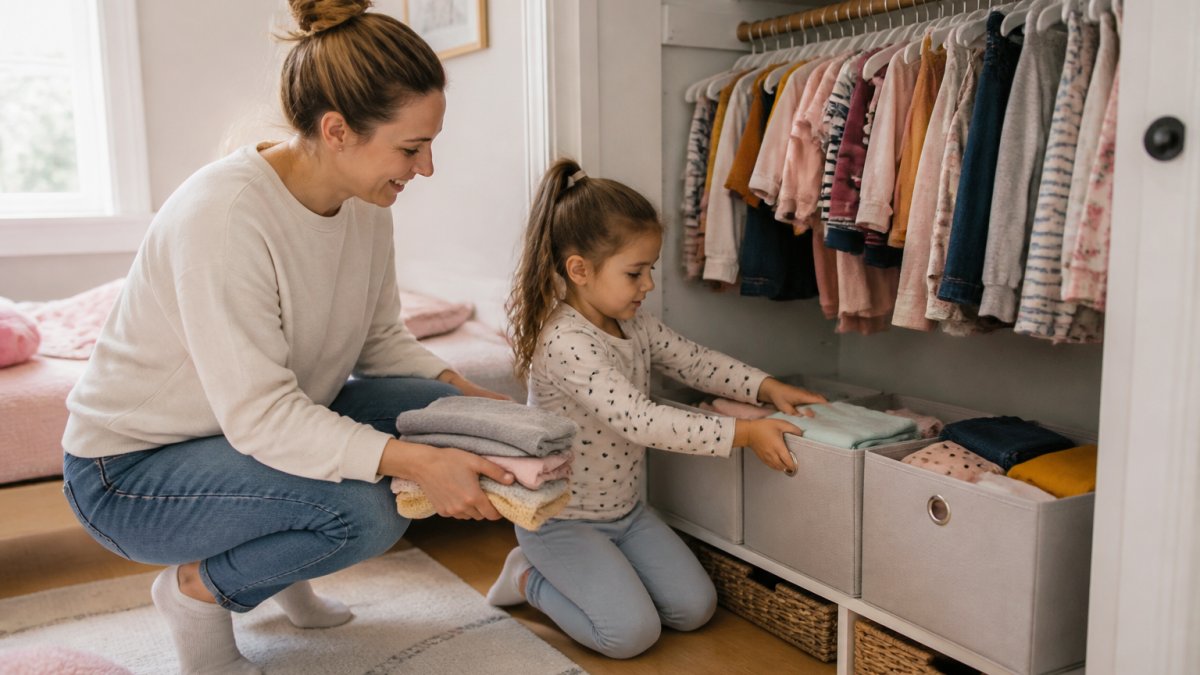
Small spaces reward simple systems. You do not need a walk-in closet or big budget, just zones at your child's height.
The best small-space setup uses three levels:
- Low: bins or a bottom drawer for everyday clothes the child can grab
- Middle: a child-height rod for hanging items like dresses or uniforms
- High: out-of-reach shelves for outgrown clothes and next-size bins
Making Everyday Clothes Easy for Children to Reach
Lower everything your child uses daily. A reachable rod and floor-level bins turn getting dressed into something they do alone; if they cannot reach it, they call you and you lose the time you saved.
Keep the daily set small. Five tops and five bottoms within reach is plenty. Too many choices slow kids down.
Drawer Systems for Toddlers, School-Age Kids, and Siblings
Match the system to the age: toddlers need open bins and pictures, school-age kids can handle labeled drawers, and siblings need clearly separated space.
| Age Group | Best System | Why It Works |
|---|---|---|
| Toddlers | Open bins at floor level | Easy to reach, no drawers to jam |
| School-age kids | Labeled drawers | Teaches sorting and independence |
| Siblings | One bin or drawer per child | Ends "that's mine" arguments |
Use file folding in drawers. Stand clothes up so your child sees every option at a glance instead of digging through a stack.
Step 4: How to Store Outgrown Kids' Clothes for Later
How to store outgrown kids' clothes comes down to three rules: clean, label, and seal. Wash everything first, since dirty clothes attract pests and stains set over time.
Then follow this routine:
- Wash and fully dry each item.
- Sort by size into storage bags or bins.
- Label each bag with the size and season.
- Store in a cool, dry spot away from sunlight.
- Note the bin's location so you can find it fast.
Hand-me-downs get the same treatment: wash, check for wear, and fold into the right size bin. When a younger sibling reaches that size, you pull one labeled bin instead of digging.
Step 5: Choosing Kids' Clothes Storage Bins and Labels
The right kids' clothes storage bins make the system last. Pick clear bins so you can see contents without opening them, sized to hold one clothing size, not everything.
What to look for:
- Clear sides so you can see what is inside
- Stackable shape to save floor and shelf space
- Latching lids to keep out dust and pests
For labels, write the size in big letters and add a season if it matters. Put labels on the front and lid so you can read them from any angle.
Step 6: The Laundry-to-Closet Workflow and Weekly Outfit Planning
The fastest families do not organize once; they build a laundry-to-closet workflow that moves clean clothes straight to their home without a stop in a pile. Every garment that lands in a floor basket must be picked up, re-sorted, and re-folded later.
Run it like this:
- Wash by child, not all together. One load per child means the dryer empties into one person's zone. If you must combine loads, use mesh laundry bags per child so sorting happens in the wash, not after.
- Fold or roll straight out of the dryer. Set a basket on top of the dryer and fold into it. The dryer is the sorting table; the floor is not.
- Sort into each child's current-size zone. Tops to the top drawer, bottoms to the bottom drawer, socks and underwear to the bin. Same order every time so your hands learn the route.
- Pull outgrown items immediately. If it does not fit, it goes into the size bin right then, not back in the drawer "for now." The drawer is not a holding pen.
- Return empty baskets to the laundry room. An empty basket is the signal that the job is done. A basket left in a bedroom becomes a pile by Thursday.
Many families run one load per child per week on a fixed day, giving a predictable window to fold and put away and keeping each current-size zone stocked without a midweek scramble.
The one-touch rule
The rule is simple: a clean garment gets touched once between the dryer and the drawer. Anywhere else adds a second touch and a second decision. The one-touch rule alone removes most recurring effort, because the work happens in one sitting.
Planning the week's outfits
On Sunday, lay out five outfits, one per school day, including activity days and uniforms. A few specifics that make it stick:
- Hang or stack each day's outfit as a set, top, bottom, socks, underwear, so nothing is missing at 7 a.m.
- Use a hanging organizer or a row of hooks with one slot per weekday. Your child can see the whole week and pick without opening a drawer.
- Plan around the calendar, not the weather guess. If Tuesday is gym day, Tuesday's outfit is the one that meets the dress code. If Thursday is picture day, that outfit is decided in advance, not in the mirror.
A fast daily routine keeps it going: each night your child puts tomorrow's outfit on a chair or hook, and in the morning they dress themselves in minutes. This turns a good system into real time saved.
Step 7: Keeping the System Going
A system only saves time if it lasts, so set a simple maintenance schedule. This is the part most families skip, and the reason most organizing projects collapse within a month.
The maintenance schedule
- Weekly (10 minutes): during laundry, pull anything that no longer fits and drop it in the size bin. Do not wait for a dedicated sorting day.
- Monthly (15 minutes): check the current-size zone for too-small clothes. Try on the two or three items your child wears least; if they are tight, they are out.
- Seasonally (one afternoon): swap sizes and store what no longer fits. Pull the next labeled bin, move the old one to storage, and update the label if the size changed.
Age-specific triggers
Growth does not follow the calendar, so tie size checks to events you already track:
- Toddlers: check fit at every well-child visit. Growth spurts cluster around these checkpoints, and a visit is a natural reminder.
- School-age kids: check fit at the start of each school year and again after winter break. Uniforms and shoes are the first to go.
- Siblings sharing storage: check the younger child's bin whenever the older child moves up a size. That is the moment hand-me-downs become current-fit clothes.
Measuring whether it is working
A system that saves time should show it. Time the getting-dressed routine one morning a week: families typically start around fifteen to twenty minutes and settle near five once the current-size zone is stocked and outfits are pre-planned. If the number creeps up, the cause is almost always the current-size zone drifting out of date, the outfit plan stopping, or outgrown items back in the drawer.
The weekly reset
Set a ten-minute reset on the same day each week: empty the donation box, return stray clothes to the right zone, and check the coming week's outfit plan is laid out.
The real difference between a system that sticks and one that fails is maintenance, not setup. If you want bins, labels, and storage bags that fit this workflow, WowHaul carries practical finds made for daily routines.
Frequently Asked Questions
What is the best way to organize kids' clothes by size?
Pull everything out and sort into three piles: current fit, next size up, and outgrown. Keep only the current-fit clothes in the closet, with a small basket of next-size-up items nearby for growth spurts. Store outgrown clothes in labeled bins by size so hand-me-downs are easy to find. This size sorting cuts morning decision time because kids only see clothes that actually fit them today.
How can I organize children's clothes to save time in the morning?
Set up a daily routine the night before: lay out one complete outfit per child, including socks and shoes. Keep current-fit clothes at child height so kids can dress themselves. Use a laundry-to-closet workflow where clean clothes go straight into labeled drawers instead of a pile. Planning outfits for the week on Sunday takes about 15 minutes and removes the morning scramble entirely.
How should I store outgrown kids' clothes for younger siblings?
Wash everything first, then sort by size and season. Place items in clear, labeled storage bins or vacuum-sealed storage bags and note the size range on the label. Store bins in a dry, climate-appropriate spot away from damp basements. Keep a small 'next size up' bin in each child's closet so you can swap items in as they grow, rather than digging through long-term storage.
Do kids' clothes storage bins really help with hand-me-downs?
Yes, if you label them by size and season. Clear bins let you see contents at a glance, and size labels mean you grab the right bin during a size transition instead of emptying five containers. Keep one bin per size per child, and add a clothing inventory note taped inside the lid. When a younger sibling reaches that size, the pass-down clothes are already sorted and ready to hang.
The morning rush does not have to run your household. With the right bins, labels, and a laundry-to-closet workflow, organizing children's clothes to save time becomes a habit your whole family can keep. WowHaul offers practical storage bins, labeled containers, and everyday care products designed to simplify your routines and support a calmer home. Explore our collection and build a system that gives you your mornings back.