

Table of Contents
- Why Organizing Laundry for Busy Parents Matters
- Build a Laundry Routine for Working Parents That Sticks
- Master Laundry Sorting Systems for Kids
- Choose the Best Laundry Baskets for Families
- Time-Saving Laundry Hacks for Parents That Actually Work
- Laundry Room Organization Tips for Efficiency
- Manage High-Volume Laundry Without Burnout
- Common Mistakes to Avoid When Organizing Laundry
Last Updated: July 22, 2026
Why Organizing Laundry for Busy Parents Matters
Organizing laundry for busy parents reclaims time and mental space consumed by endless washing, folding, and searching for missing socks. The mental load extends far beyond machine time, it's the constant awareness that someone needs clean clothes, decision fatigue around sorting, guilt when loads sit in the dryer, and coordinating different fabric care needs.
A practical organizing system transforms this invisible burden into a predictable, delegable process. When you establish clear sorting methods, create a realistic schedule, and involve your family, laundry becomes something you manage deliberately rather than something that happens to you.
Build a Laundry Routine for Working Parents That Sticks
Creating a laundry routine requires matching your system to your actual life, not an idealized version. The most common mistake is designing a routine that works in theory but collapses when life gets chaotic.
Start by identifying your natural laundry rhythm. Some households generate enough dirty laundry for a full load daily; others accumulate throughout the week. Neither is wrong, build your routine around what actually happens in your home.
A realistic routine for most working parents: designate 2-3 specific days for laundry. On those days, run one full wash-and-dry cycle in the morning and another in the evening. This prevents laundry from becoming a constant mental task while ensuring clean clothes are available.
The Delayed Wash Cycle Strategy
The delayed wash cycle eliminates the most common bottleneck: forgetting a load in the washer. Fill your machine in the evening, set it to run on a delayed timer (2-8 hours), and wake to clean, damp clothes ready for the dryer. This prevents damp clothes from sitting for days and developing mildew.
The delayed cycle also creates natural breakpoints in your routine. Instead of juggling washing and drying throughout the day, you have predictable moments, morning coffee or evening wind-down, when you move clothes to the dryer.
Creating a Weekly Schedule That Reduces Mental Load
A structured weekly schedule eliminates daily decisions. For a family of four: Monday evening load (delayed cycle), Tuesday morning dry and fold; Wednesday evening load, Thursday morning dry and fold; Friday evening load, Saturday morning dry and fold.
The mental load decreases dramatically when laundry becomes predictable. Family members learn when clean clothes will be available, and the constant background anxiety quiets down. Document your schedule visually, post it on the laundry room door or send it as a calendar invite so everyone understands expectations.
Master Laundry Sorting Systems for Kids
Most households do well with three sorting baskets: whites and light colors, dark colors, and delicates. Place baskets where people naturally undress and label each with clear text and color-coded visuals so children can sort independently.
Color-Based and Fabric-Based Sorting
The whites-and-colors approach prevents color bleeding and laundry disasters. Whites and very light colors go in one basket, dark colors (blacks, dark blues, dark purples) in another, and delicates in a third. This three-basket system covers approximately 95% of household sorting needs.
Label baskets clearly with both words and colors. When you wash, run whites on hot water with regular detergent, darks on cold water with regular detergent, and delicates on gentle cycle with cold water. This standardized approach eliminates decisions about water temperature and cycle for each load.
Delegation: Making Sorting a Family Affair
Children as young as five can sort laundry into color-coded baskets. By age eight or nine, most kids can handle the full sorting process independently. By age twelve, they can manage their own laundry entirely.
The key to successful delegation is removing decision-making. They don't decide whether something is white or dark, the rule is simple: if it's light enough to show dirt easily, it goes in whites; otherwise, darks. Start by having your child sort one basket per week and give specific, positive feedback.
Choose the Best Laundry Baskets for Families
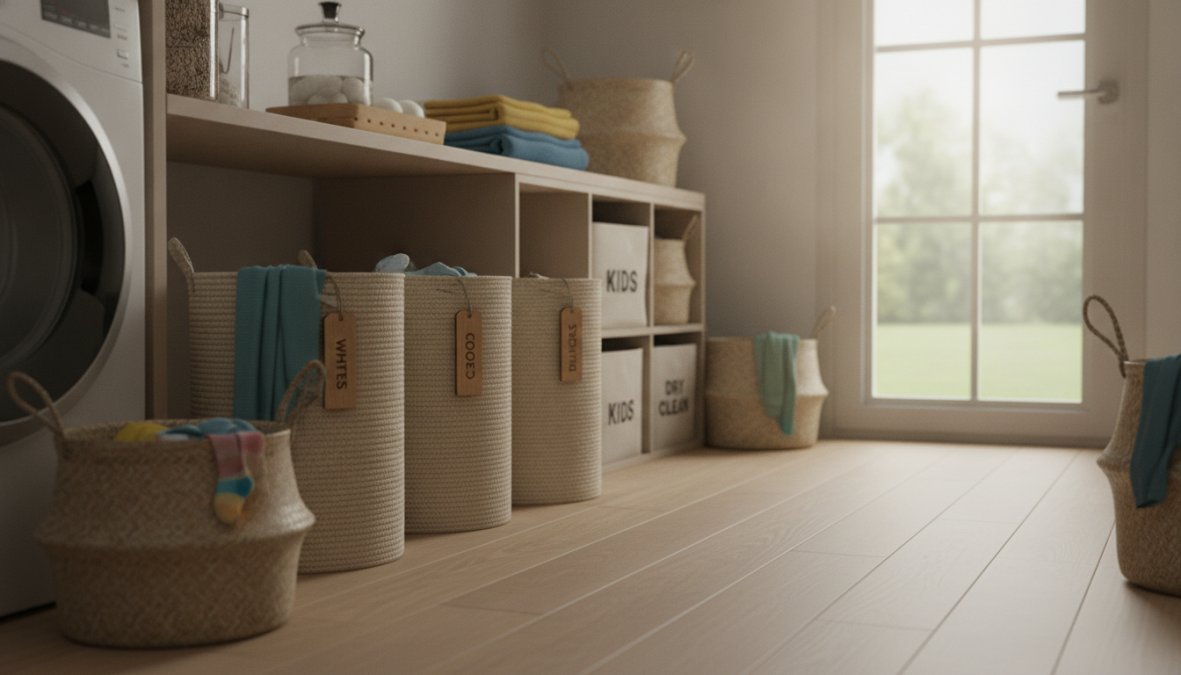
You need baskets large enough for a full load, durable enough for years of use, and easy for children to carry. Avoid flimsy baskets that collapse under wet clothes. Look for sturdy handles, reinforced bottoms, and 40-50 liter capacity.
Budget-Friendly Storage Solutions for Laundry Rooms
You don't need expensive custom systems. Three sturdy plastic baskets (under $30 total), clear labeling, and wall-mounted shelving create a functional space for years.
Consider these budget-friendly additions:
- Three sorting baskets ($20-35) for color-based sorting
- One large hamper ($15-25) for items waiting to be sorted
- Wall-mounted shelving ($30-60) for detergent and supplies
- Tension rod ($10-15) for hanging clothes that shouldn't be folded
- Clear storage containers ($15-30) for delicate items
This complete setup costs under $100. Start with basic sorting baskets and wall space, then add storage solutions as you identify specific gaps.
Time-Saving Laundry Hacks for Parents That Actually Work
The most effective time-saving hacks eliminate unnecessary steps and prevent common delays. The delayed wash cycle is the single most impactful approach. Beyond that:
Folding Techniques and Stain Removal Shortcuts
The "hanging method" eliminates folding for 40-50% of your laundry. Immediately after drying, hang items directly onto hangers without folding. T-shirts, button-ups, pants, and dresses go straight to closets. Only underwear, socks, pajamas, and items that genuinely need folding go to the folding basket. This cuts folding time by nearly half.
For stain removal, treat stains immediately or don't treat them at all. Stains that set require aggressive treatment taking far more time than immediate attention. Keep a stain stick near your laundry baskets and treat items immediately before they dry.
Cold water washing works for almost everything except heavily soiled items. It saves energy and reduces fabric wear, meaning clothes last longer. Most detergents work effectively in cold water.
Laundry Technology and Automation Tools
Modern machines offer features that genuinely simplify management. Moisture sensors in dryers prevent over-drying, which damages fabrics and wastes energy. Automatic dispensers release detergent at optimal times, eliminating dosing decisions. Smart notifications alert you when cycles complete, preventing clothes from sitting in machines for hours. Sanitize cycles kill 99.9% of bacteria without requiring bleach.
These features don't replace a solid system, but they remove friction points that cause systems to fail.
Laundry Room Organization Tips for Efficiency
Establish zones: sorting, washing, drying, and folding. Keep frequently used items at arm's reach, detergent, stain remover, dryer sheets, and lint rollers should be stored directly above or next to the washer. Store specialty items higher or in less accessible locations.
Install a tension rod above your washer or dryer for hanging items that shouldn't go in the dryer. Label everything, clear labels on detergent containers, sorting baskets, and storage shelves eliminate guesswork and make it easy for family members to maintain the system independently.
Accessible Systems for Neurodivergent Parents and Kids
Neurodivergent individuals often struggle with laundry management due to executive function challenges or sensory sensitivities. Organizing for these needs requires specific accommodations.
Visual systems trump memory-based systems. Set phone alarms or use smart home reminders instead of relying on remembering to check the washer. Posted schedules are more effective than mental calendars.
Reduce decision points. Use the three-basket sorting system without variations. Wash all darks together regardless of fabric type. These simplified rules reduce executive function required.
Create external accountability. Some neurodivergent parents find success doing laundry with a partner or scheduling it when someone else is available.
Acknowledge sensory needs. Choose unscented detergent if sensitive to smell. Wear gloves if sensitive to texture. Adapt the system to your needs to make it sustainable.
Batch everything. Do all laundry in one concentrated session rather than spreading it across multiple days.
Manage High-Volume Laundry Without Burnout
Families with multiple children or athletes face different challenges: sheer volume. Scale your system rather than changing it fundamentally. Use larger or additional sorting baskets and run two or three cycles per day.
Establish a rule that everyone does their own laundry starting at age thirteen or fourteen. This reduces the parent's workload while teaching valuable life skills. Some families create a laundry schedule where each child has a designated day.
For high-volume households, consider a second washer and dryer if space and budget allow. Running two loads simultaneously cuts total time in half.
Create a "clean clothes bin" system where folded items go into individual bins labeled with each family member's name rather than directly into closets. Family members retrieve their own clean clothes, reducing parent work and giving children responsibility.
Some high-volume households use a "wear it once, wash it" rule for athletic shorts and performance wear, preventing excessive laundry accumulation.
Common Mistakes to Avoid When Organizing Laundry
Mistake 1: Creating a system too complex for your family. Simpler systems that actually get used beat complex systems that create decision fatigue.
Mistake 2: Leaving clothes in the washer overnight. Damp clothes develop mildew, requiring rewashing. Use the delayed wash cycle to prevent this.
Mistake 3: Accumulating a "sort later" pile. Items needing special treatment should be processed immediately or not at all.
Mistake 4: Not involving family members. When everyone contributes, the work is manageable. When one person bears the entire burden, burnout is inevitable.
Mistake 5: Expecting perfection. Some weeks, laundry doesn't get folded promptly. A system that tolerates imperfection is more sustainable.
Mistake 6: Using the wrong water temperature. Cold water works for most loads and saves energy, but heavily soiled items need hot water.
Mistake 7: Overloading machines. Stuffing too much laundry means clothes don't get clean and dry unevenly.
Mistake 8: Ignoring stains immediately. A stain treated within hours requires minimal effort. A stain that sets for days requires aggressive treatment or causes permanent damage.
| Common Mistake | Why It Happens | How to Fix It |
|---|---|---|
| Clothes sit in washer | Forgetting to move them to dryer | Use delayed wash cycle to create natural transition points |
| Sorting system fails | Too many categories; kids can't remember | Simplify to three baskets: whites, darks, delicates |
| Folding never happens | Overwhelming pile accumulates | Fold immediately after drying or skip folding for hanging items |
| Stains set permanently | Delaying treatment | Treat stains immediately or accept they won't come out |
| System becomes invisible | No visual reminders or labels | Post schedule and label all baskets and storage |
| Family doesn't help | Unclear expectations or overly complex tasks | Assign specific, simple tasks with clear instructions |
| Burnout occurs | One person managing everything | Distribute laundry work across all family members |
| Clothes wear out quickly | Over-drying or using hot water unnecessarily | Use moisture sensors and cold water for most loads |
Organizing laundry for busy parents is fundamentally about creating a system that works with your life rather than against it. The most successful approaches acknowledge that you have limited time, energy, and attention, and design around those constraints.
WowHaul's laundry storage solutions are specifically designed for families managing high-volume laundry. Their durable sorting baskets, accessible hampers, and organizational tools eliminate friction points that cause systems to fail. With clear labeling, reinforced construction, and thoughtful design, WowHaul helps you build a laundry system your entire family can maintain consistently. Start with their sorting baskets and wall-mounted storage, and laundry transforms from an overwhelming burden into a manageable household task.
Frequently Asked Questions
How do busy parents manage laundry without it taking over their life?
The key is building a laundry routine for working parents that fits your schedule, not fighting against it. Use a delayed wash cycle strategy, set specific days for washing, drying, and folding rather than spreading it throughout the week. Delegate sorting and folding to kids as age-appropriate chores. Most importantly, accept that perfection isn't the goal; consistency and systems are. Many working parents find success by doing one laundry load per day rather than marathon laundry sessions.
What's the best way to organize laundry sorting systems for kids?
Create a color-based or fabric-based sorting system using labeled baskets that kids can understand and use independently. Whites and colors are the minimum; add delicates if needed. Place sorting baskets in each child's room or a central location. Make it a family affair by assigning each child responsibility for their own hamper. Use visual labels (pictures plus words) for younger children. This reduces your mental load and teaches accountability. Keep it simple, too many categories will overwhelm both you and your kids.
How can laundry technology and automation tools help busy parents save time?
Modern laundry technology includes smart washers and dryers that send notifications when cycles complete, preventing clothes from sitting and wrinkling. Delayed start features let you program wash cycles to run during off-peak hours or overnight. Some machines have built-in stain removal settings for sports gear and heavily soiled items. While these tools require upfront investment, they reduce the mental load by automating reminders and allowing you to batch tasks. Consider your budget and laundry volume before investing in automation.
What are budget-friendly laundry room storage solutions for small spaces?
You don't need expensive systems. Use clear plastic bins, fabric hampers, or repurposed baskets labeled by category (whites, colors, delicates, sports gear). Wall-mounted shelving above your washer and dryer maximizes vertical space. Over-the-door organizers hold detergent, stain removal products, and dryer sheets. Tension rods in cabinets create hanging space for air-drying delicates. The goal is visibility and accessibility so your system stays functional. WowHaul offers curated storage solutions designed for efficiency without clutter.
This article was written using GrandRanker