

Table of Contents
- Why Simplifying Morning Routines for Families Matters
- Evening Routine to Simplify Mornings: Prep-Ahead Strategy
- Create a Family Morning Routine Checklist That Sticks
- Morning Routine for Kids by Age: Tailored Approaches
- Use a Printable Morning Routine Chart for Consistency
- Manage Time Buffers and Transition Time Effectively
- Parental Self-Regulation: Your Role in the Morning Flow
- Digital Tools and Apps to Support Your Routine
Last Updated: July 26, 2026
Why Simplifying Morning Routines for Families Matters
Getting your family out the door on time shouldn't feel like herding cats. For most households, mornings are chaotic, kids can't find their shoes, breakfast takes longer than expected, and everyone leaves stressed. At WowHaul, we understand that mornings set the tone for everything that follows. When your family starts the day calm and organized, you're more likely to handle challenges throughout the day with patience and clarity.
Research shows that families with structured morning routines experience less stress and better emotional regulation. The problem isn't that you're doing too much, it's that you're doing things without a clear system. Below, we'll show you exactly how to build a morning routine that actually sticks, tailored to your family's unique needs and ages.
Evening Routine to Simplify Mornings: Prep-Ahead Strategy
The real secret to a smooth morning starts the night before. When you invest 15 minutes in evening preparation, you eliminate dozens of decisions your family will face when they're tired and rushed.
Night-Before Checklist Essentials
Your evening routine should address three categories: clothing, meals, and logistics. Lay out tomorrow's clothes for each family member, including socks and underwear. Prepare breakfast items and set out bowls, cereal, milk, and toppings. Review the next day's schedule and set out any sports gear, permission slips, or special items needed.
Create a laminated checklist that lives on the kitchen counter. Each evening, walk through it as a family. Kids as young as four can help check items off, which builds accountability and reduces morning negotiations.
Setting Up for Reduced Decision Fatigue
Decision fatigue is real. Every small choice depletes mental energy, which is why many parents feel exhausted before work even starts. Your evening prep directly combats this.
Reduce decisions by creating defaults. If your child always eats the same breakfast, you've eliminated one choice. If you rotate through three outfit combinations that are already laid out, you've eliminated another. For older kids, involve them in creating these systems. Let them pick three acceptable breakfast options or choose between two outfit combinations. This gives them agency while keeping the morning moving.
Create a Family Morning Routine Checklist That Sticks
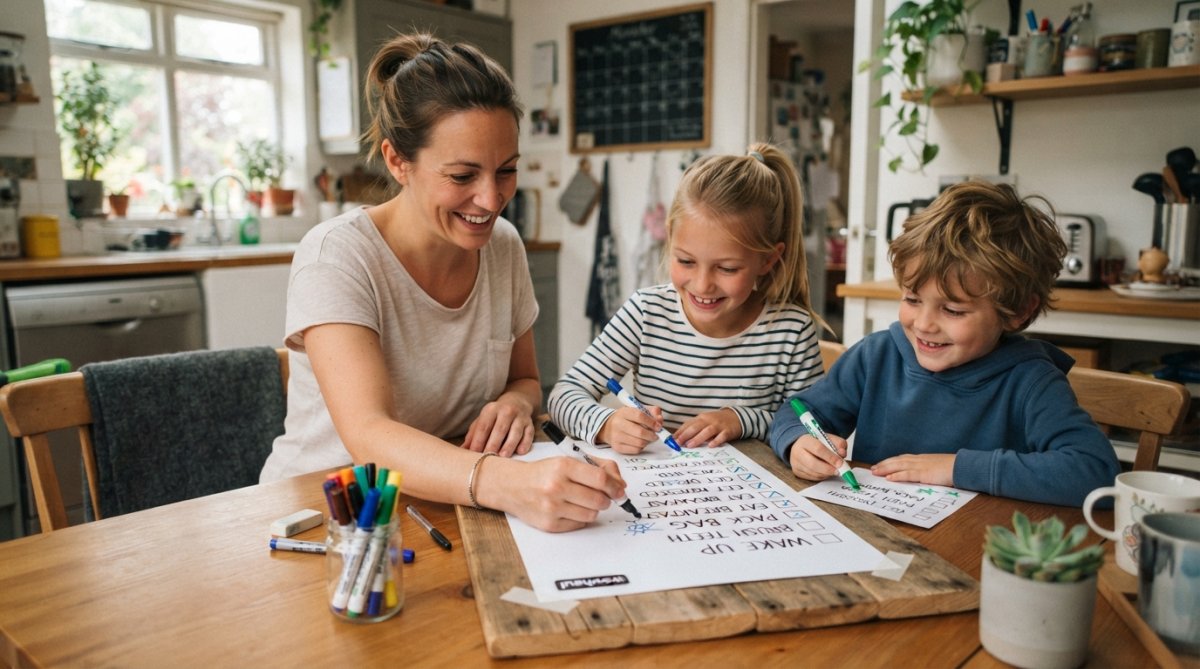
A family morning routine checklist that works is visual, simple, and achievable. Most families fail because checklists are too detailed. Your checklist should contain 5-8 items maximum per person, taking 15-20 minutes total to complete.
The best format combines words and pictures. For young children, use simple icons: a picture of a toothbrush, clothes, breakfast. For older kids, use action-oriented words: "Brush teeth," "Get dressed," "Eat breakfast," "Pack backpack."
Post the checklist at eye level where your child can see it without asking. Use a dry-erase marker or reusable stickers so kids can check off items themselves. This builds independence and reduces reminders.
Visual Aids and Accountability
Visual aids work because they remove the need for constant reminders. Instead of you saying "Time to get dressed," your child sees the checklist and knows it's time. This shift from external reminders to internal accountability is transformative.
Consider using a combination of tools: a printed checklist on the wall, a timer on the kitchen counter, and a reward chart for the week. Timers are particularly effective because they make time concrete. Color-coding helps too, if each family member has a different color, they can quickly identify their items and their section of the launch pad.
Using Positive Reinforcement and Habit Formation
Habits form through repetition and reward. The reward doesn't need to be expensive, a sticker, extra screen time on Friday, or a special breakfast choice works. The key is consistency. Track progress visually with a simple chart where kids color in a square for each day they complete their routine. After 21 consecutive days, the routine becomes automatic.
Morning Routine for Kids by Age: Tailored Approaches
Every age group has different capabilities and needs. A routine that works for a seven-year-old will frustrate a three-year-old and bore a teenager.
Toddlers and Preschoolers (Ages 2-4)
Toddlers and preschoolers need maximum structure and minimal choices. Their mornings should follow the same sequence every single day. Your routine should take 30-40 minutes and include: wake-up, bathroom, getting dressed, breakfast, and final prep. Use a visual schedule with pictures and walk through it each morning, narrating what comes next.
Physical prompts work better than verbal ones. Instead of saying "Go get dressed," walk them to the dresser and lay out two outfit options. Keep mornings calm, toddlers pick up on parental stress, which makes them more resistant. Aim to wake up 15 minutes earlier than you think you need.
Elementary School Children (Ages 5-10)
Elementary-aged children can follow multi-step routines and understand time concepts better. Your routine should take 25-35 minutes and can include: wake-up, bathroom, getting dressed, breakfast, teeth brushing, backpack check, and shoes. Use a combination of words and pictures with a timer so they understand how much time each task should take.
This age group responds well to ownership. Instead of you managing the checklist, they manage it. Ask "What's next on your checklist?" instead of telling them. Involve them in creating the routine, if they help design it, they're more invested in following it.
Tweens and Teens (Ages 11+)
Tweens and teens need autonomy and natural consequences. Create a routine together and ask what they think a realistic timeline is. If they say 20 minutes but it actually takes 35, let them experience the consequence of being late. This teaches time management better than any lecture.
Use a simple checklist they create themselves. Your role is to hold them accountable without nagging. For this age group, the real issue is often sleep deprivation. Teens' circadian rhythms naturally shift later, so they're genuinely tired in the morning.
Use a Printable Morning Routine Chart for Consistency
A printable morning routine chart removes the need for constant reminders and creates a visual reference your child can follow independently. The chart should be simple, colorful, and posted where your child sees it first thing in the morning.
Your chart should list tasks in order, with pictures for younger kids and words for older ones. Keep it to 5-8 items. Laminate your chart or cover it with clear plastic to allow dry-erase markers for checking off items each day.
Designing Charts for Different Learning Styles
Not all kids learn the same way. For visual learners, use bright colors, pictures, and icons. For kinesthetic learners, create a physical checklist they can move along or use a clothesline with clips. For auditory learners, create a simple song or rhythm to the routine. Test different formats, what matters is finding the system that works for your specific child.
Neurodivergent-Friendly Routine Design
Children with ADHD, autism, or sensory sensitivities need routines designed with their specific needs in mind. For kids with ADHD, build in movement breaks. For kids with autism, keep the routine exactly the same every single day, predictability is essential. For kids with sensory sensitivities, adjust the environment accordingly.
Manage Time Buffers and Transition Time Effectively
Time buffers are the difference between a calm morning and a chaotic one. Add 15 minutes to your estimated departure time. This buffer isn't wasted time, it's insurance against stress.
Transition time is equally important. Kids need time to shift from one activity to another. Build in a 5-minute transition between activities. Use visual countdowns: "We have 10 minutes until we need to leave. That's time for breakfast and getting your shoes on."
Parental Self-Regulation: Your Role in the Morning Flow
Your own regulation determines your family's morning. If you're stressed, rushed, and frustrated, your kids will be too. Start by waking up earlier than your kids, even 15 minutes alone gives you time to settle into the day. Manage your own expectations. Kids are slower and need reminders. This isn't a character flaw, it's their developmental stage.
Practice speaking calmly, even when frustrated. If you find yourself yelling, pause and take a breath. Your kids don't need you to be perfect, they need you to be regulated.
Digital Tools and Apps to Support Your Routine
Digital tools can add another layer of support. Apps can send reminders, track habits, and make routines more engaging. Consider apps that let kids check off items and earn rewards through gamification. Timers and alarms are straightforward tools that work across all ages.
However, be cautious with screen time in the morning. If your child gets distracted by their phone or tablet, a digital tool will backfire. The best approach is a hybrid: use a physical checklist for the main routine and add a digital tool only if it genuinely helps. WowHaul recognizes that families need practical solutions that work with their actual lives. Whether you use a printed chart, a phone app, or a combination, the goal is the same, removing friction from your morning so your family can start the day calm and connected.
Getting your family out the door smoothly is possible, but it requires a system tailored to your specific kids, schedule, and home. Start with one change, perhaps the evening prep routine or a simple visual checklist, and build from there. Most families see noticeable improvements within two weeks of consistent implementation. According to research on habit formation from the Journal of Behavioral Medicine, establishing routines typically takes 21-66 days depending on complexity, so give yourself grace as your family adjusts. The investment in building a strong morning routine pays dividends every single day, less stress for you, more confidence for your kids, and a calmer start to whatever comes next.
Frequently Asked Questions
How do I create a simple morning routine that my whole family will actually follow?
Start by identifying your family's non-negotiable tasks, getting dressed, eating breakfast, brushing teeth. Build a family morning routine checklist with clear, sequential steps. Use visual aids like printable charts or color-coded tasks for each child. Set consistent wake-up times and establish a predictable order so everyone knows what comes next. Keep expectations realistic for your children's ages, and use positive reinforcement when they complete tasks independently. Consistency matters more than perfection; practice the routine for at least two weeks before expecting it to feel automatic.
What should I include in an evening routine to simplify mornings?
An evening routine to simplify mornings should include laying out clothes, packing school bags and gear, preparing breakfast items, and setting a consistent bedtime. Review tomorrow's schedule with your family so there are no surprises. Organize school supplies in a designated spot and confirm any special items needed. Establish a predictable bedtime routine 30-60 minutes before sleep to support good sleep hygiene. When kids sleep well, morning cooperation improves significantly. This prep-ahead strategy reduces morning decision fatigue and eliminates last-minute scrambling.
How can I adapt morning routines for kids of different ages?
A morning routine for kids by age requires tailoring tasks to their developmental stage. Toddlers need simple, one-step instructions and hands-on help. Elementary-age children can handle 2-3 sequential tasks with visual reminders. Tweens and teens benefit from ownership, give them their own checklist and let them manage their morning flow with less supervision. Older kids often respond better to digital tools and apps. Adjust your expectations: younger children need more transition time and adult guidance, while older kids can build independence and accountability. Use a printable morning routine chart customized for each age group.
What's the best way to use a printable morning routine chart to reduce morning chaos?
A printable morning routine chart works best when it's visual, age-appropriate, and posted where everyone sees it, usually the kitchen or bathroom. Use pictures for non-readers, words for older kids, and include time estimates so children understand pacing. Let kids check off or move tasks as they complete them; this builds accountability and gives them a sense of progress. Laminate the chart so you can use dry-erase markers for reusable daily tracking. Pair the chart with positive reinforcement, praise effort, not just completion. Update the chart seasonally or when your routine changes to keep it relevant and prevent it from becoming background noise.
This article was written using GrandRanker