

Table of Contents
- Smart Laundry Appliances: What Actually Matters in 2026
- Smart Washer and Dryer Features That Earn Their Price
- Energy Efficient Laundry Appliances: Reading the Labels Correctly
- How to Choose a Smart Washing Machine for Your Home
- Noise, Vibration, and Steam: Comfort Features Buyers Underrate
- What Retailers Don't Tell You: Privacy, Maintenance, and Accessibility
- Mistakes to Avoid When Buying Smart Laundry Appliances
- Conclusion: Build a Laundry Setup That Fits Your Routine
- Frequently Asked Questions
Last Updated: October 3, 2026
Smart Laundry Appliances: What Actually Matters in 2026
Smart laundry appliances for modern homes are washers and dryers that connect to Wi-Fi, run sensors that adjust cycles automatically, and report status to your phone. That definition matters because the label gets slapped on machines that only offer a timer delay. At WowHaul, we think the smartest purchase is the one that removes a chore, not the one with the longest feature list. This guide breaks down what earns its price and what you can skip. Evaluating the underlying technology behind these connected systems remains the most reliable way to identify quality smart home gadgets that actually simplify your daily routine.
The category has matured fast. Manufacturers now build load sensing, automatic detergent dispensing, and remote start into mid-range front-load machines rather than reserving them for flagship models. Firmware updates arrive over the air. Voice control through a smart speaker is common on new releases.
Here is the catch most buyers miss: a connected machine is only as useful as the routine it fits into.
Below, we cover the features worth paying for, how to read energy labels correctly, and the privacy and maintenance questions retailers rarely raise.
A 60-Second Comparison: Smart vs. Standard Machines
| Feature | Smart Machine | Standard Machine |
|---|---|---|
| Remote start and monitoring | Yes, via app | No |
| Cycle optimization | Sensor and AI-driven | Manual dial settings |
| Diagnostics | Smart diagnostics, alerts | Error codes only |
| Detergent dispensing | Often automatic | Manual |
| Firmware updates | Over the air | None |
| Typical best fit | Busy households, remote routines | Simple, low-maintenance use |
A standard top-load machine still washes clothes perfectly well. The difference is control and feedback, not cleaning power.
How We Evaluated These Appliances
We judged machines on four criteria: whether a feature saves real time, how well it integrates with systems people already own, what it costs to maintain over years, and whether the manufacturer supports it with updates. Features that only exist to justify a higher price tag got marked down.
U.S. Department of Energy appliance standards
Smart Washer and Dryer Features That Earn Their Price
Two features separate genuinely useful machines from marketing checklists: connectivity that works reliably and sensing that actually adjusts the wash.
Wi-Fi Connectivity, Remote Start, and Real-Time Notifications
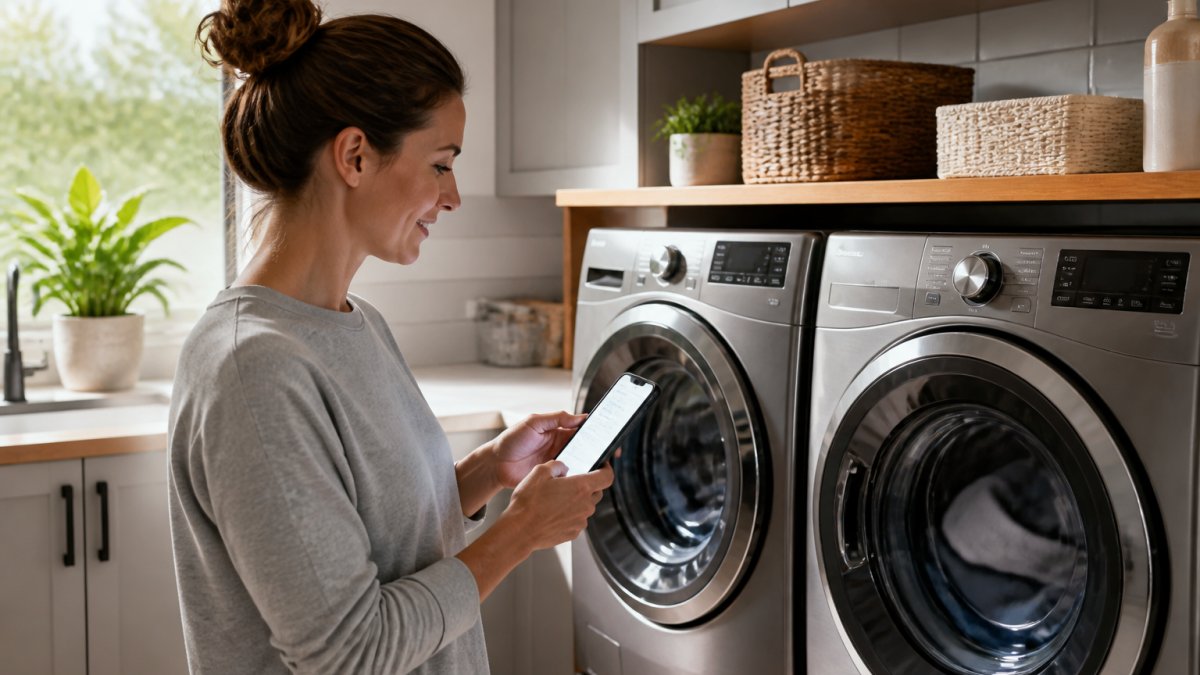
Wi-Fi connectivity is the foundation. Without it, nothing else works. With it, you get remote start, real-time notifications when a cycle finishes, and remote monitoring so you can check progress from another room or another state.
The practical value shows up in small moments. You start a load before leaving for work. You get an alert when it finishes. You move clothes to the dryer without a trip to check.
One caveat: remote start on some machines requires the door to be latched and a specific mode enabled. Test this in the store or read the manual before buying.
AI-Powered Cycle Optimization and Load Sensing
AI-powered cycle optimization uses sensors to weigh the load, detect fabric type, and adjust water, temperature, and time. Load sensing is the mechanical version of the same idea. Both reduce the guesswork.
Automatic detergent dispensing pairs well with these systems. The machine doses based on load size, which cuts waste and prevents the oversudsing that plagues high-efficiency machines.
Energy Efficient Laundry Appliances: Reading the Labels Correctly
Energy efficient laundry appliances cut running costs through better motors, smarter cycles, and water management. The label tells part of the story. Your habits tell the rest. The problem is that most shoppers read the yellow tag, see a logo, and stop there.
What the ENERGY STAR Label Actually Measures
The ENERGY STAR program is run jointly by the U.S. Department of Energy and the U.S. Environmental Protection Agency. For clothes washers, qualification is built on the Integrated Modified Energy Factor and the Integrated Water Factor, two test-based metrics that estimate energy and water use per cubic foot of drum capacity across a representative mix of cycles. A machine that qualifies uses meaningfully less energy and water than a standard model of the same capacity.
Two things the label does not tell you:
- It does not reflect how you run the machine. A qualified washer run on hot, heavy-duty cycles every day can consume more than a standard washer run on cold, normal cycles.
- It does not account for dryer energy. The washer and dryer are rated separately, so a highly efficient washer paired with an old dryer still leaves savings on the table.
Where the Energy Actually Goes
Heating water is the single largest energy draw in a wash cycle, commonly the majority of the energy a washer uses per load. That is why cold-water cycles matter more than almost any other setting. Modern high-efficiency (HE) detergent is formulated to dissolve and clean at low temperatures, so cold washing handles most everyday loads without a performance penalty.
Smart features change this math in two ways:
- Load sensing and AI cycle optimization reduce water and heat by matching the cycle to the actual load instead of defaulting to a full-tub setting.
- Automatic detergent dispensing prevents the oversudsing that forces extra rinse cycles, and extra rinse cycles mean extra water and energy.
A common pattern is that households see the biggest efficiency gains not from the machine's rating but from changing two habits: switching the default to cold, and letting the sensors run the cycle instead of overriding them.
When High-Energy Cycles Are Worth It
Steam cleaning and the sanitize cycle use more energy and water, but they matter for specific needs: allergies, illness in the house, or heavily soiled items. The mistake is running them as a default. Reserve them for the loads that need them and let cold, sensor-driven cycles handle everything else.
Efficiency Over the Life of the Machine
Efficiency is a long-term number, not a sticker. A machine that qualifies today can drift out of peak performance as sensors foul, dispensers clog, and filters load up. Keeping the machine clean, running a cleaning cycle monthly and wiping dispenser parts, is part of maintaining the efficiency you paid for. That maintenance point connects directly to the smart-sensor care covered later in this guide.
How to Choose a Smart Washing Machine for Your Home
Start with your space and your routine, then match the machine to both. The features come second.
Space, Stackability, and Front-Load vs. Top-Load
Stackable front-load units solve small-space problems. A stacked washer and dryer pair fits where side-by-side units cannot. Modular design and combo units that wash and dry in one drum go further in tight apartments.
Front-load machines generally use less water and stack more easily. Top-load machines are simpler to load and often cheaper to repair. Neither is universally better.
Measure your space, including door swing and hose clearance, before you shop.
App Compatibility and Smart Home Integration
App compatibility varies widely. Some brands support one ecosystem well and others poorly. Smart home integration matters if you already run a hub or use voice control daily.
Appliance syncing between a matched washer and dryer lets the dryer read the wash cycle and set itself. That is a genuine convenience, not a gimmick.
Noise, Vibration, and Steam: Comfort Features Buyers Underrate
Noise reduction and vibration control matter more than most buyers expect. A machine on a second floor or near a bedroom can disrupt the whole house during a spin cycle.
Look for direct-drive motors, which have fewer moving parts and run quieter than belt-driven designs. Anti-vibration technology and a solid, level install reduce the walking and thumping that older machines develop.
Steam cleaning doubles as a wrinkle reducer, which can cut ironing time. If your household irons regularly, this feature earns its place.
What Retailers Don't Tell You: Privacy, Maintenance, and Accessibility
Three gaps show up in almost every showroom conversation.
Data privacy and security. A connected machine collects usage data and sends it to the manufacturer. Check the privacy policy for what is shared and whether you can opt out. Change the default app password and keep firmware updates current, since updates often patch security flaws.
Long-term maintenance of smart sensors. Load sensors, turbidity sensors, and detergent dispensers need cleaning. Mineral buildup and detergent residue degrade accuracy over time, which quietly erodes the efficiency you paid for. Run a cleaning cycle monthly and wipe dispenser parts.
Accessibility features. Remote start, app-based controls, and voice control help people with mobility limitations or vision impairments run laundry independently. Ask specifically about these if they matter to your household.
Federal Trade Commission guidance on connected device privacy
Mistakes to Avoid When Buying Smart Laundry Appliances
- Buying connectivity you will not use. If you never check your phone for laundry, skip the premium.
- Ignoring the install requirements. Some smart machines need a dedicated outlet, a specific drain height, or a level floor.
- Skipping the return window terms. Confirm the policy before delivery, especially for large appliances.
- Assuming all apps are equal. Read recent reviews about the app, not just the machine.
- Overlooking noise ratings. A quiet machine is worth more than a marginal efficiency gain in most homes.
Conclusion: Build a Laundry Setup That Fits Your Routine
Choosing smart laundry appliances for modern homes comes down to fit, not features. The right machine saves time, runs quietly, and holds up over years.
WowHaul curates practical finds for everyday living, including products that simplify daily routines and support a well-run home. Our collection focuses on functional items chosen for real households, not spec sheets.
Browse the WowHaul collection and build a laundry setup that works with your life, not against it.
Frequently Asked Questions
Are smart washers worth the extra investment?
It depends on how you use them. Smart laundry appliances cost more upfront, but features like load sensing, automatic detergent dispensing, and AI-powered cycle optimization can cut water and energy use over time. If you routinely run partial loads, forget laundry in the drum, or want remote start, the convenience adds up. If you only wash full loads on one setting, a standard high-efficiency machine may serve you just as well.
How do smart laundry machines improve energy efficiency?
Most savings come from three features: load sensing that adjusts water to the size of the load, cycle optimization that shortens wash time when clothes are lightly soiled, and app alerts that prompt you to move laundry to the dryer instead of re-washing it. Pair these with an ENERGY STAR rating, high-efficiency detergent, and cold-water cycles, and the machine uses noticeably less water and electricity than a basic top-load model.
Do smart laundry appliances require special maintenance?
Yes, but it is simple. Smart sensor technology, including moisture and turbidity sensors, works best when the drum and sensor area stay clean, so wipe them monthly. Run a sanitize cycle or drum-clean cycle every 30 days to prevent detergent residue and odor. Check for firmware updates through the app, since manufacturers push fixes for connectivity and cycle bugs. Skipping updates is the most common reason remote monitoring stops working.
Can smart washers be controlled via smartphone apps, and is my data safe?
Most smart washers and dryers connect through a manufacturer app that supports remote start, real-time notifications, and smart diagnostics. Data privacy varies by brand, so review the app's permissions before setup. Limit location access if it is not required, use a unique password, and enable two-factor authentication where available. If the app asks for more personal data than the machine needs to run, that is a signal to read the privacy policy closely.