

Table of Contents
- Cordless vs Corded Vacuums: The Core Trade-Off for Pet Owners
- Suction Power and Deep Cleaning: Where Corded Models Excel
- Cordless Vacuum Battery Life for Pet Owners: Real Runtime Limits
- Weight, Maneuverability, and Your Home Layout
- Maintenance, Clogging, and Hair-Wrap Prevention
- How to Remove Pet Hair from Upholstery and Stairs
- Filtration Systems and Allergen Containment for Pet Dander
- Finding the Best Vacuum for Pet Hair: Your Decision Checklist
- Frequently Asked Questions
Last Updated: September 8, 2026
Cordless vs Corded Vacuums: The Core Trade-Off for Pet Owners
The cordless vs corded vacuums debate comes down to what you are willing to trade for convenience. Pet owners face a unique challenge because shedding, dander, and tracked-in debris demand consistent cleaning, and the choice directly impacts how often you will actually run the machine.
The best vacuum for pet hair depends on your home’s square footage, flooring types, and tolerance for maintenance. Corded models deliver relentless, consistent performance, while cordless models offer the freedom to grab and go without wrestling a plug.
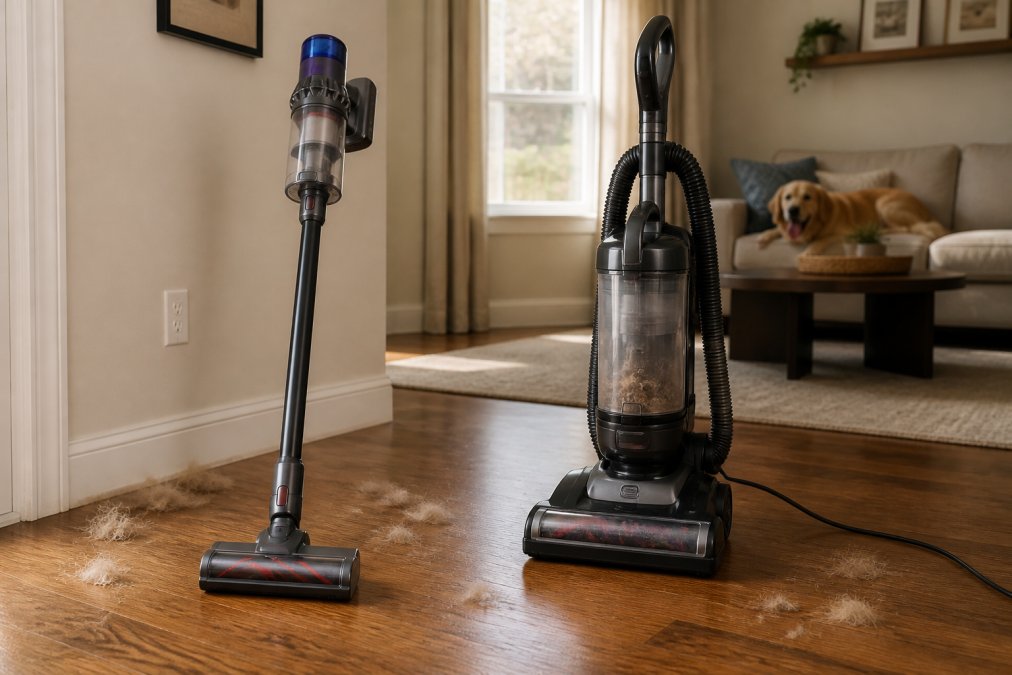
Suction Power and Deep Cleaning: Where Corded Models Excel
Corded vacuums hold a clear advantage in raw suction power and deep cleaning performance. Drawing continuous electricity from the wall, they don’t ration battery output, maintaining higher airflow and stronger carpet agitation for an entire cleaning session.
This matters most for wall-to-wall carpet and high-pile rugs where pet hair embeds deep into fibers. A corded upright with a powered brush roll lifts embedded fur and dander that a cordless stick cannot match at the same price point.
The trade-off is the cord itself. You’ll plug and unplug as you move between rooms and manage cord length to avoid yanking it from the wall. For homes larger than 1,500 square feet, this becomes a genuine annoyance.
Cordless Vacuum Battery Life for Pet Owners: Real Runtime Limits
Cordless vacuum battery life for pet owners is the single biggest limitation to understand before buying. Most cordless models offer 15 to 40 minutes of runtime on a full charge, but that number drops significantly at maximum suction, exactly the setting you need for pet hair on carpet (consumerreports.org).
Runtime figures are usually measured on hard floors with the brush roll off. Running on high power over carpet with the brush roll engaged can cut advertised runtime by nearly half, leaving you mid-clean with a dead battery.
The Battery Degradation Curve That Nobody Mentions
Lithium-ion batteries lose capacity with every charge cycle, but degradation is not linear. Most cordless vacuums use 18650 or 21700 cells rated for 300 to 500 full charge cycles before capacity drops below 80 percent (batteryuniversity.com). For daily cleaning, noticeable runtime loss begins around the 10- to 14-month mark; by month 18, expect roughly 30 percent less runtime.
Heat accelerates degradation faster than normal use. Running at maximum suction for extended periods generates heat inside the battery pack, and sustained temperatures above 113°F permanently damage lithium-ion cells. This creates a vicious cycle: high power for carpet hair generates heat, and heat shortens battery lifespan.
The Replacement Cost Reality
Battery replacement costs vary widely by brand. Some manufacturers, including Dyson and LG, sell replacements in the $80 to $150 range. Others, particularly budget brands, may not offer replacements at all, making the entire vacuum disposable when the battery dies.
Before purchasing any cordless vacuum, verify three things: (1) the battery is user-replaceable without special tools, (2) a replacement is currently available from the manufacturer or authorized retailer, and (3) the replacement cost is less than 40 percent of the vacuum’s original price. If any condition fails, the cordless vacuum has a hidden expiration date.
The Two-Battery Strategy
A practical pattern among pet owners with larger homes is purchasing a second battery and keeping it on the charger. This doubles your cleaning window and eliminates the mid-clean dead battery problem, but only works if the vacuum has a swappable battery design. Some models, particularly older designs, have permanently sealed packs that require a service center visit.
Charging Habits That Extend Battery Life
Avoiding full discharge cycles extends battery life. Lithium-ion batteries prefer partial discharge and frequent top-ups over deep drains. If you clean for 10 minutes daily, plug it in after each use rather than waiting for a dead battery. Also avoid leaving it on the charger after it reaches 100 percent, as trickle charging can generate unnecessary heat.
The Long-Term Cost Comparison
When comparing cordless and corded vacuums for pet hair, factor battery replacement into your five-year cost calculation. A corded vacuum at $250 costs $250 over five years. A cordless vacuum at $300 with one $120 battery replacement at month 18 and another at month 36 costs $540. That $240 difference often covers the price gap between a mid-range corded model and a premium cordless model.
For pet owners who plan to keep a vacuum for more than two years, battery replacement cost should be part of the purchase decision from day one. If the cordless model lacks a reasonably priced replacement battery, the corded alternative becomes the more economical choice.
Weight, Maneuverability, and Your Home Layout
Weight and maneuverability are where cordless vacuums win for most pet owners. A typical cordless stick weighs 5 to 7 pounds, while a corded upright can reach 15 to 18 pounds. That difference changes how willing you are to clean under furniture, carry the machine up stairs, and reach high corners.
In a multi-story house, hauling a heavy corded upright up and down stairs is exhausting, and the cord becomes a hazard on staircases. A lightweight cordless model makes stair cleaning and quick daily pickups practical enough that you’ll actually do them.
Consider the weight-to-suction ratio rather than weight alone. A cordless vacuum that feels light but lacks sufficient suction forces multiple passes over the same spot, wasting battery and time. The ideal machine balances enough weight to stay planted on carpet with enough agility to glide under a coffee table.
Maintenance, Clogging, and Hair-Wrap Prevention
Pet hair is uniquely punishing on vacuum mechanics, and maintenance is where many machines fail their owners. The most common failure point is the brush roll, where long pet fur wraps around the axle and stops the brush from spinning, dropping suction dramatically until you cut the hair free.
Manufacturers solve this problem mechanically in three distinct ways, and understanding the difference will save you hours of maintenance.
Self-Cleaning Brush Rolls with Active Hair Removal
The most advanced systems use a comb or set of fins mounted along the brush roll housing. As the brush spins, these combs sit between bristle rows and physically strip hair off the roll before it completes a full revolution. Dyson’s Anti-Tangle technology, Shark’s Self-Cleaning Brush Roll, and LG’s AeroBrush all use variations of this active comb approach, creating a continuous shearing action that pushes hair toward the dust cup intake.
These systems work remarkably well for pet fur up to about 2 inches in length, but they are not infallible. If a clump is wet or matted, it can still slip past the comb and begin wrapping. Self-cleaning brush rolls reduce maintenance frequency by roughly 80 percent, but they do not eliminate it entirely.
Passive Bristle Patterns
A less expensive alternative uses a helical or V-shaped bristle pattern that channels hair toward the center or edges of the brush roll, where it can be pulled into the airflow path. This works adequately for short, stiff pet hair but struggles with long, fine fur from breeds like Golden Retrievers or Persian cats, as hair slides along the bristles and accumulates at the bearing points.
Manual Removal Brush Rolls
Budget corded vacuums still use traditional straight-row bristle rolls with no anti-tangle features. With these, expect a hair-removal session every two to three cleaning cycles if you have a heavy shedder, roughly 10 minutes per session removing the base plate and cutting the wrapped hair free.
Clogging Patterns Specific to Pet Households
Clogging is the second major issue, and it follows predictable patterns. Pet hair mixes with dust and litter to form dense clumps that block the hose or the base of the dust cup. The most common clog point is the transition where the hose meets the dust cup, because the airflow path narrows there; a second common point is the wand connection on cordless stick vacuums.
Look for a vacuum with a straight, wide airflow path and a dust cup that opens from the bottom for tool-free emptying. Also check whether the hose detaches at both ends; a hose that only detaches at the handle makes clearing a mid-hose clog significantly harder.
The Maintenance Cost Calculation
A common pattern among pet owners is underestimating the cumulative time cost of maintenance. Cleaning a manual brush roll every three days for 10 minutes adds up to roughly 20 hours per year; a self-cleaning brush roll reduces that to about 4 hours annually. Over five years, that 80-hour difference often justifies an extra $50 to $100 upfront for the anti-tangle feature.
For long-haired pets specifically, prioritize the active comb style of self-cleaning technology over passive bristle patterns. The mechanism matters more than the marketing label. If you cannot confirm the specific design from the manufacturer’s documentation, assume it is passive and budget your maintenance time accordingly.
How to Remove Pet Hair from Upholstery and Stairs
Learning how to remove pet hair from upholstery requires a different tool strategy than floor cleaning. Your floor vacuum, whether cordless or corded, is often too bulky for furniture, and the standard floorhead won’t create enough suction on fabric to pull embedded fur.
A dedicated upholstery attachment with a rubber or silicone edge is the most effective tool for couches and chairs, as the rubber creates friction that lifts hair more effectively than bristles alone. Many pet owners also keep a small handheld vacuum or rubber grooming mitt for quick touch-ups.
For stairs, the weight of your main vacuum matters enormously. A cordless stick with a crevice tool is ideal because you can carry it in one hand while you work. Corded uprights are awkward on stairs, and cord management becomes a safety concern when moving between levels.
Filtration Systems and Allergen Containment for Pet Dander
Pet dander is a major allergen trigger, and the filtration system determines whether your vacuum traps it or blows it back into the air. A HEPA filter is the gold standard because it captures 99.97% of particles down to 0.3 microns, including pet dander, dust mites, and pollen (the EPA). If anyone in your home has allergies or asthma, a HEPA filter is non-negotiable.
The critical difference between corded and cordless models is how they handle filtration under sustained load. Corded vacuums maintain consistent airflow, keeping the filter effective for the entire session. Cordless vacuums, as battery power fades, may experience reduced airflow that compromises filtration of fine particles.
You also need to consider the dust cup seal. A vacuum with a poorly sealed dust cup will leak fine particles back into the air even with a HEPA filter installed. Look for models with a gasketed seal and washable filters, and plan to clean or replace the filter every few months depending on how many pets you have.
Finding the Best Vacuum for Pet Hair: Your Decision Checklist
Choosing the best vacuum for pet hair ultimately means matching the machine to your specific home and habits. There is no universal winner between cordless and corded; there is only the right tool for your flooring, your home’s size, and your willingness to maintain it.
| Decision Factor | Choose Corded | Choose Cordless |
|---|---|---|
| Flooring type | Wall-to-wall carpet, high-pile rugs | Hardwood, tile, low-pile rugs |
| Home size | 1,500+ sq ft, single story | Multi-story, smaller spaces |
| Cleaning frequency | Weekly deep cleaning sessions | Daily quick pickups |
| Pet hair volume | Multiple pets, heavy shedders | One pet, light shedding |
| Maintenance tolerance | Low; set-and-forget operation | High; battery and filter care |
The practical guidance is simple. If your home is mostly carpet and you want a single machine that delivers consistent performance every time, a corded upright with a powered brush roll and HEPA filter is the safer investment. If you have hard floors, stairs, or a multi-story layout and struggle to find time for daily cleaning, a cordless stick with a tangle-free brush roll and replaceable battery will fit your routine better.
Whichever direction you choose, focus on the features that directly address pet hair: tangle-free brush rolls, HEPA filtration, sealed dust cups, and easy access for maintenance. These details determine whether your vacuum remains a reliable tool or becomes another piece of equipment that doesn’t solve the problem.
Frequently Asked Questions
Do cordless vacuums work as well as corded vacuums for pet hair?
Modern cordless vacuums handle daily pet hair pickups on hard floors and low-pile carpets well, but they generally provide less sustained suction than corded models. For deep cleaning thick carpets or large homes, a corded vacuum's consistent power and longer runtime make it more effective. If your primary need is quick, convenient cleanup of surface pet hair, a high-end cordless model works well. For weekly deep cleans, a corded upright is often the stronger choice.
What are the main disadvantages of a cordless vacuum for pet owners?
The main drawbacks are limited runtime, battery degradation over time, and smaller dust cup capacity. Most cordless vacuums run 30 to 60 minutes on a full charge, which may not cover a large home in one pass. Lithium-ion batteries also lose capacity after a few years, and replacing them adds cost. Cordless models often require more frequent emptying, especially with heavy-shedding pets, and some lack the raw suction needed for deep carpet agitation.
How much suction power do I need to remove pet hair from carpets?
For effective pet hair removal from carpets, look for a vacuum with strong airflow and a motorized brush roll. Corded vacuums typically offer 100 to 150 air watts or more, which provides the sustained power needed for deep carpet agitation. Cordless models with at least 100 air watts can handle surface pet hair on low-pile carpets. For high-pile or thick carpets, prioritize a corded model or a premium cordless vacuum with a dedicated pet hair setting.
How long does a cordless vacuum battery last for pet owners?
Runtime varies by model and power setting. Most cordless vacuums provide 20 to 40 minutes on standard mode and as little as 8 to 15 minutes on max suction. Pet owners cleaning multiple rooms should factor in this limit. Battery degradation is also a consideration: lithium-ion batteries lose capacity after 300 to 500 charge cycles, meaning a 40-minute runtime may drop to 25 minutes after two years of regular use. Check if the battery is replaceable before buying.
Owning pets means committing to regular cleaning, and the right vacuum makes that commitment sustainable rather than exhausting. At WowHaul, we understand that a practical home routine depends on tools that work as hard as you do. Our curated selection focuses on quality solutions that support happy pets and simpler daily routines, helping you keep your home clean without the guesswork. Get started with WowHaul and find the right cleaning tools for your home.