

Table of Contents
- Quick Comparison: Cordless vs Corded Vacuums for Small Apartments
- Suction Power and Cleaning Efficiency: How Much Do You Actually Need?
- Cordless Vacuum Battery Life: Runtime Limits in Small Spaces
- Noise, Air Quality, and Shared Walls: What Apartment Dwellers Should Know
- Vacuum Storage Ideas for Small Apartments
- Long-Term Costs: Battery Replacement, Filters, and Total Ownership
- How to Choose the Best Vacuum for a Small Apartment
- Frequently Asked Questions
Last Updated: September 19, 2026
Quick Comparison: Cordless vs Corded Vacuums for Small Apartments
Choosing between cordless vs corded vacuums for small apartments comes down to one trade-off: cordless models win on convenience and storage, while corded models deliver steady suction and unlimited runtime. This guide breaks down suction, battery life, noise, storage, and long-term costs so you can pick the right machine for a tight space.
Small apartments punish the wrong vacuum choice. A heavy upright eats closet space you don't have. A weak stick vacuum quits halfway through a rug. And a cord that's too short means unplugging and replugging across three rooms.
Below, we'll show you exactly how to match a vacuum to your floor plan, your noise limits, and your storage reality. The common advice to "just buy the most powerful vacuum" misses the point entirely for apartment living.
Suction Power and Cleaning Efficiency: How Much Do You Actually Need?
For most small apartments, 100 to 150 air watts of suction handles hardwood, low-pile carpet, and pet hair without trouble. Corded vacuums typically sustain higher suction because they draw continuous power from an outlet, while cordless models trade peak power for portability.
Suction power is the vacuum's ability to pull dirt and debris off a surface. It's measured in air watts or pascals, and it matters most on carpet and for pet hair removal.
Here's what actually drives cleaning efficiency in a small space:
- Airflow moves debris into the bin; higher airflow clears floors faster
- Motorized brush roll lifts embedded pet hair from carpet and rugs
- Cyclonic technology separates dust from air so filters don't clog mid-clean
- Floorhead design determines how well the vacuum seals against carpet vs hardwood
A common mistake is chasing the highest suction number on the box. In a 600-square-foot apartment, a mid-range cordless with a good brush roll often cleans faster than a bulky corded upright because you spend less time wrestling it around furniture.
Cordless Vacuum Battery Life: Runtime Limits in Small Spaces
Cordless vacuum battery life usually runs 20 to 60 minutes per charge, depending on power mode. The catch: max-power mode can cut that runtime in half, and batteries degrade over time.
For a small apartment, 20 to 30 minutes of real runtime is often enough to clean the whole unit in one pass. Larger homes and heavy carpet cleaning push you toward longer runtime or a spare battery.
| Mode | Typical Runtime | Best For |
|---|---|---|
| Eco / low | 40-60 minutes | Quick hardwood touch-ups |
| Standard | 20-40 minutes | Whole-apartment routine clean |
| Max / boost | 8-15 minutes | Deep carpet and pet hair |
Most cordless vacuums use a lithium-ion battery, which holds a charge well but loses capacity after a few hundred charge cycles.
Noise, Air Quality, and Shared Walls: What Apartment Dwellers Should Know
Noise is the hidden dealbreaker in apartments, and almost no buying guide treats it as a spec you can compare. Corded vacuums tend to run at a steady, sustained pitch because the motor spins at a constant speed off wall power. Cordless vacuums vary more: a stick vac in eco mode can sit near the level of a running refrigerator, while the same vacuum in boost mode jumps toward the level of a blender.
What actually drives how loud a vacuum sounds:
-
Motor type and RPM, higher-speed brushless motors in premium cordless models often run quieter than cheap brushed motors in budget corded uprights
-
Power mode, boost or max mode on a cordless can add several decibels versus standard mode; corded vacuums usually have one volume level
-
Airflow path, a sealed, straight path with sound-dampening foam around the motor cuts noise more than raw wattage does
-
Floorhead contact, a brush roll grinding on carpet or rattling on hardwood adds its own noise on top of the motor
-
HEPA filtration captures fine particles instead of recirculating them; look for a filter rated to capture particles at the HEPA standard rather than a vague "HEPA-like" claim
-
Sealed system keeps dust inside the vacuum rather than blowing it out through gaps in the housing or floorhead
-
Bagged vs bagless affects how much dust escapes during emptying, bagged models contain debris better, while bagless bins release a dust cloud when you dump them
-
Filter maintenance matters more in small spaces because a clogged filter both reduces suction and forces dust past the seals
Emptying a bagless bin indoors releases a cloud of fine dust that can hang in the air of a small, unventilated room for a while. Do it over an outdoor trash can or into a bag, especially if anyone in the apartment has allergies or asthma.
If shared-wall noise is your top concern, prioritize a cordless model with a published quiet or eco mode and a sealed HEPA system. You get the low-noise quick-clean option and the air-quality benefit in one machine, which is exactly the combination a small apartment needs.
Vacuum Storage Ideas for Small Apartments
The best vacuum for a small apartment is one you can store without sacrificing living space. Wall-mounted docks, closet hooks, and under-bed storage turn a bulky appliance into a nearly invisible one.
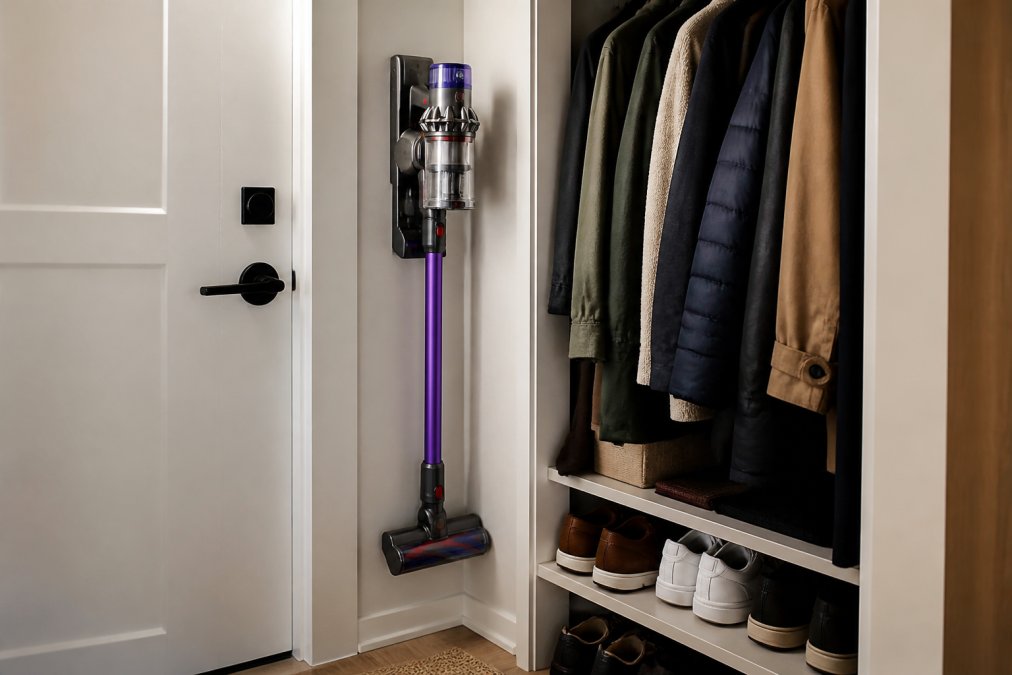
Practical storage options for tight apartments:
- Wall-mounted dock in a closet or entryway keeps the vacuum charged and off the floor
- Under-bed storage works for flat stick vacuums and slim canisters
- Over-the-door hooks hold lightweight cordless models in a utility closet
- Vertical corner stands use dead space beside a fridge or washer
Long-Term Costs: Battery Replacement, Filters, and Total Ownership
Total cost of ownership favors corded vacuums on paper, but the gap narrows or flips depending on how long you keep the vacuum and how much you clean. The single biggest long-term expense for a cordless vacuum is battery replacement, and most buying guides skip it entirely.
What that means for budgeting:
- Replacement batteries are a recurring cost corded vacuums never have. Prices vary widely by brand and whether the battery is proprietary or swappable, but plan on at least one replacement over a five-year ownership window for a heavily used cordless.
- Swappable batteries change the math. A model that uses a standard, tool-agnostic battery platform lets you rotate two packs instead of replacing the whole vacuum, which extends usable life and spreads the cost.
- Sealed batteries in slim stick vacuums are harder to replace and sometimes push owners toward buying a new vacuum instead of a new battery.
Other ongoing costs to plan for:
- Filters need cleaning monthly and replacing periodically, more often with pets or heavy dust. A clogged filter reduces suction and forces the motor to work harder, which shortens battery life.
- Brush rolls wear down and need replacement, faster with long hair and pet fur wrapped around the roller.
- Bags add up for bagged models; bagless models skip the bag cost but need more frequent filter care and careful emptying.
- Belts and seals on corded uprights are cheap but do fail; cordless sticks usually have fewer wear parts.
Cordless vacuums cost more over time because of battery and filter replacements. Corded vacuums cost less to maintain but limit your reach and storage options. If you plan to keep a cordless vacuum more than three years, budget for at least one battery replacement and factor that into the upfront price comparison.
How to Choose the Best Vacuum for a Small Apartment
Pick cordless if convenience, storage, and quick daily cleanups matter most. Pick corded if you have wall-to-wall carpet, pets that shed heavily, or you want maximum suction without battery worries.
Use this decision framework:
- Mostly hardwood, small space, daily quick cleans → cordless stick vacuum
- Wall-to-wall carpet, heavy pet hair → corded upright or canister
- Mixed floors, limited storage → cordless with a wall dock and a spare battery
- Shared walls, noise-sensitive building → quieter cordless model, cleaned at reasonable hours
- Allergies or poor ventilation → HEPA filtration on either type
Frequently Asked Questions
Are cordless vacuums as powerful as corded models?
Modern cordless vacuums can match corded models for everyday cleaning on hard floors and low-pile carpet, but corded vacuums still deliver stronger, sustained suction for deep-pile carpets and heavy debris. For a small apartment with mostly hard floors and area rugs, a cordless vacuum with at least 100 air watts handles daily messes well. If you have wall-to-wall plush carpeting, a corded upright remains the stronger choice.
Do cordless vacuums have enough battery life for a full apartment clean?
Most cordless vacuums run 20 to 60 minutes per charge, depending on power mode. A 600-square-foot apartment typically takes 15 to 25 minutes to vacuum, so a mid-range cordless vacuum covers it on one charge. Keep a spare battery if you use max power often, since boost modes can cut runtime to under 15 minutes. Corded vacuums never run out, but you trade cordless convenience for unlimited runtime.
How much storage space do corded vacuums require?
Corded uprights and canisters take up far more closet or floor space than cordless stick vacuums. A typical upright needs about 12 by 12 inches of floor space plus height for the handle, while a canister plus hose can demand even more. In a small apartment, that footprint often means sacrificing a closet shelf or hallway corner. Cordless models with a wall-mounted dock free up floor space entirely, which matters when every square foot counts.
Which vacuum type is easier to maintain in a small living space?
Cordless stick vacuums are generally easier to maintain in tight quarters because the bin empties directly into the trash, filters rinse clean, and there is no cord to untangle or store. Corded vacuums often hold more dust, so you empty them less often, but bagged models require buying replacement bags. For apartment dwellers, a bagless cordless vacuum with a washable HEPA filter keeps maintenance simple and avoids recurring supply costs.
The real challenge with cordless vs corded vacuums for small apartments isn't picking the "best" machine. It's matching the vacuum to your floor plan, your noise limits, and your storage reality. WowHaul offers a curated selection of practical finds for everyday living, including home organization tools and pet care products that support cleaner, calmer routines. Explore the WowHaul collection and find practical solutions built for small-space living.