

Table of Contents
- Define Your Farmhouse Aesthetic: Modern vs. Rustic
- Set a Room-by-Room Budget and Sourcing Plan
- Affordable Farmhouse Decor Ideas: Where to Find Budget Pieces
- Modern Farmhouse Decorating on a Budget: Key Materials and Colors
- Farmhouse Living Room Ideas on a Budget: Furniture and Layout
- DIY Farmhouse Decor: Repurposing and Refreshing What You Own
- Curate, Don't Accumulate: Building Cohesion and Avoiding Clutter
- Rental-Friendly and Reversible Farmhouse Updates
- Frequently Asked Questions
Last Updated: October 13, 2026
Define Your Farmhouse Aesthetic: Modern vs. Rustic
Modern farmhouse blends clean lines with warmth: neutral colors, minimal clutter, square-edged furniture.
Rustic farmhouse leans into aged charm: weathered wood, distressed finishes, layered textures. It embraces visible wear and feels collected over time.
Modern farmhouse costs less to start, fewer pieces, easier to source new.
Pin rooms you love: do they feel airy and minimal, or rich and layered? That answer guides everything.
Set a Room-by-Room Budget and Sourcing Plan
The biggest budget mistake is treating your whole home as one project. Prioritize rooms by impact, assign each a real number, and work in phases.
Start With a Total Number, Then Split It
Decide what you can realistically spend over 6-12 months. A common split:
- Living room: 40%, most-used space and first impression for guests.
- Bedroom: 25%, your personal space, no compromises.
- Kitchen and dining: 20%, a few key pieces: wooden table, open shelving, simple accessories.
- Hallways, bathrooms, secondary spaces: 15%, minimal investment that ties the look together.
On $800, that's $320 living room, $200 bedroom, $160 kitchen/dining, $120 elsewhere; $2,000 scales the same. The point: every room has a ceiling before you shop.
Realistic Price Ranges by Category
- Sofa (neutral fabric, new mid-range): $500-$1,200. A used solid-frame sofa from a marketplace listing often runs $100-$300.
- Solid wood coffee table: $40-$150 used; $150-$400 new.
- Accent chair (thrifted or marketplace): $25-$120.
- Wooden dining table: $75-$250 used; $300-$800 new.
- Dresser or nightstand (thrifted, solid wood): $30-$120.
- Chalk paint + topcoat per piece: $25-$40.
- Textiles (linen pillows, burlap runner, throw): $10-$40 each.
- Decorative accents (vintage scale, wooden ladder, galvanized bucket): $5-$45 each.
Phase the Work So Cash Flow Matches Progress
Don't finish every room in one month. A workable sequence:
- Month 1: Living room anchors (sofa if needed, coffee table, one accent chair).
- Month 2: Living room finishing layer (textiles, lighting, accents).
- Month 3: Bedroom furniture and paint.
- Month 4: Bedroom textiles and accents.
- Month 5: Kitchen and dining key pieces.
- Month 6: Secondary spaces and cohesion pass.
This lets you sell or donate what you're replacing before buying more, offsetting cost and preventing clutter.
Decide What Stays Before You Shop
For each room, tag every piece: keep, refresh, or release. Repurposing what you own cuts costs dramatically. If a piece has good bones, solid wood, sturdy joinery, no structural damage, refresh it with paint or new hardware instead of replacing.
Build a Sourcing Plan Before You Spend
Match each item to a source and know the trade-off:
- Thrift stores: Lowest prices, unpredictable inventory, regular visits required. Best for solid-wood furniture, frames, ceramics, vintage kitchen items.
- Online marketplaces (Facebook Marketplace, Craigslist, OfferUp): Searchable, often negotiable, but pickup and in-person inspection required. Best for specific and larger furniture.
- Local buy-sell and free groups: Strong during moves and redecorating. Best for decor, small furniture, free materials.
- Estate sales: Higher-quality vintage, previewable online, competitive. Arrive early.
- Salvage yards and architectural salvage shops: Authentic old doors, windows, hardware impossible to replicate new. Prices vary widely.
- Retail (big-box and online): Predictable stock and returns, higher prices. Reserve for anchor pieces where durability matters most.
Affordable Farmhouse Decor Ideas: Where to Find Budget Pieces
The farmhouse aesthetic relies on texture, natural materials, and intentional layering, you need the right pieces, not expensive ones.
Key materials: wood (any finish), galvanized metal (buckets, basins, trays), linen and burlap, and natural greenery (potted herbs, dried grasses, branches).
Cheap accents that define the look: old windows, vintage scales, wooden ladders, metal pulleys, weathered shutters.
Secondhand and Thrift Shopping
Thrift stores are your secret weapon. Solid-wood furniture, even with outdated upholstery, can be refreshed completely.
Look for:
- Wooden dressers, nightstands, side tables
- Chairs with good frames (reupholster or refinish later)
- Picture frames in various sizes (paint white or leave natural)
- Glass jars, ceramic pitchers, metal containers
- Vintage kitchen items (scales, grinders, utensil holders)
Shop regularly, inventory changes constantly. When you find a solid piece, buy it even without an immediate use; good bones are hard to find at thrift prices.
Online Marketplaces and Local Sources
Facebook Marketplace, Craigslist, and OfferUp let you search by item and price, and you can often negotiate on larger furniture. Local buy-sell groups are goldmines, people give away items when moving or redecorating.
Salvage yards carry authentic old doors, windows, and hardware impossible to replicate new.
Estate sales happen constantly; arrive early, and preview items and prices on estate sale websites first.
Modern Farmhouse Decorating on a Budget: Key Materials and Colors
The modern farmhouse palette stays simple: neutrals, whites, creams, soft grays, warm taupes, natural wood tones. These make small spaces feel larger and create a calm backdrop.
Avoid bold colors on large furniture. Introduce color through potted herbs, vintage-inspired textiles (linen pillows, burlap runners), and small accents (pottery, wooden signs).
Texture is everything: layer smooth linen against rough wood, shiny metal against matte ceramic.
Focus on materials that age well: real wood improves, linen softens, metal develops patina.
Farmhouse Living Room Ideas on a Budget: Furniture and Layout
Your living room should feel most complete. Start with one good neutral-fabric sofa, worth the investment as the room's anchor.
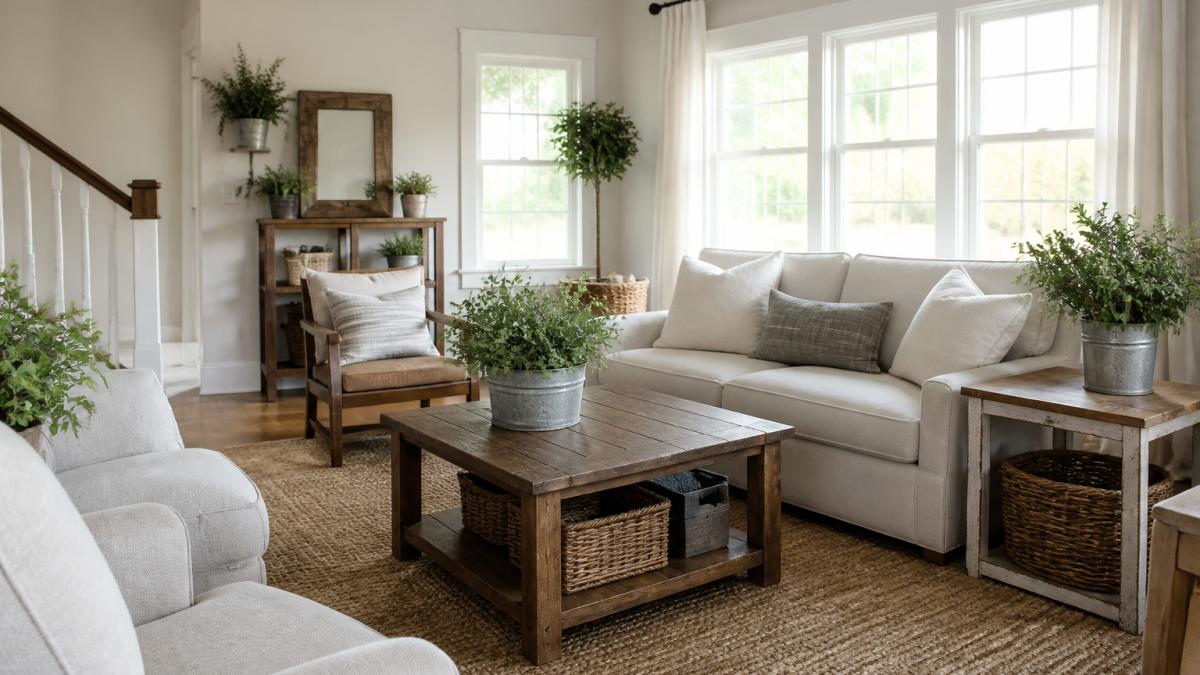
Add a solid wood coffee table; simple straight lines work perfectly.
Arrange furniture to encourage conversation, pull pieces away from walls and orient seating toward a focal point (fireplace, large window, statement wall).
For lighting, pair a simple wooden or metal floor lamp with table lamps.
DIY Farmhouse Decor: Repurposing and Refreshing What You Own
The most budget-friendly farmhouse updates come from transforming what you already own.
Chalk Paint and Furniture Transformation
Chalk paint is your secret weapon: it adheres to almost any surface without sanding, dries quickly, and costs little. Paint old wooden furniture white, cream, or soft gray to modernize it instantly.
Steps for a basic refresh:
- Clean the surface thoroughly
- Apply thin coats (usually 2-3)
- Let dry between coats
- Seal with a matte or satin topcoat
- Replace hardware with simple wooden or metal knobs
This takes a weekend.
Upcycled Accents and Vintage-Inspired Pieces
Transform everyday items: mason jars become candle holders or vases, wooden crates stack into shelving, and thrifted vintage scales become focal points.
Create a gallery wall with mismatched frames painted white or left natural, filled with botanical prints, family photos, or line drawings, nearly free, and it transforms a blank wall.
Make farmhouse signs from wooden plaques and stencils for a few dollars.
Curate, Don't Accumulate: Building Cohesion and Avoiding Clutter
Many farmhouse projects fail here: people buy lots of farmhouse items and end up with a cluttered space that looks like a thrift store exploded. The fix isn't buying less, it's curating with a system.
Lock a Palette Before You Buy Anything
Pick three to five colors and write them down. A modern farmhouse palette: white, warm cream, soft gray, natural wood tone, and one muted accent (sage, dusty blue, or terracotta).
Test every purchase against the palette. If it doesn't fit those colors or natural materials (wood, linen, metal, ceramic), it doesn't come home, no matter how cheap. This one rule prevents a mismatched collection.
Use the Rule of Three for Every Surface
On any shelf, mantel, coffee table, or console, group items in threes with varying heights and textures: a tall item (wooden ladder, dried branches), a medium item (books, ceramic pitcher), and a low item (bowl, candle, galvanized tray).
Three items read as intentional; seven read as clutter. If a surface feels busy, remove items until only the strongest three remain.
Run the Four-Question Test Before Every Purchase
Before buying anything, ask:
- Does this match my style, modern or rustic, and my palette?
- Do I already own something that does this job?
- Where exactly will this live? If you can't name the surface or wall, don't buy it.
- Would I still want this at three times the price? If no, you're buying the price, not the piece.
All four yeses means curation; any no means accumulation.
Edit With the One-In-One-Out Rule
Every time a decorative piece enters, one leaves, sold, donated, or stored. This keeps object volume flat and forces a real comparison: is the new piece better than what it replaces, or just newer?
Create Visual Zones, Not Scattered Objects
Books, pottery, and greenery grouped together feel curated; the same items spread across four shelves feel random. Group related objects into zones, a reading corner, kitchen display, mantel vignette, and leave breathing room between them. Empty space is part of the design.
Rotate Instead of Accumulate
Keep a storage bin of off-season accents and swap them a few times a year. Rotating what you own keeps the space fresh without new purchases and forces you to re-evaluate each piece.
Spend Where It Shows, Save Where It Doesn't
Quality over quantity saves money only if you spend in the right places. Put budget into pieces you touch daily and that define the room: the sofa, dining table, primary rug. Save on accents, seasonal decor, and anything rotated or replaced. One good wooden table beats three cheap ones; one linen pillow beats five mediocre ones. Fewer, better pieces last longer and are easier to edit later.
Rental-Friendly and Reversible Farmhouse Updates
If you rent, you can still build a farmhouse aesthetic without losing your deposit. Focus on reversible changes.
Removable options:
- Removable wallpaper in neutral patterns
- Peel-and-stick shiplap for accent walls
- Temporary wall decals (farmhouse quotes, botanical designs)
- Furniture arrangement and styling
- Textile accents (throw pillows, blankets, rugs)
- Removable shelving systems
Avoid permanent changes:
- Painting walls (unless landlord approves)
- Installing new light fixtures
- Removing existing fixtures
- Drilling into walls for shelving
Spend on pieces you'll take with you, furniture, accessories, and textiles are portable and create the look without landlord conflicts. Layer throws, pillows, and rugs to define a space for far less than furniture.
Building a farmhouse aesthetic budget takes patience and intention, but it's achievable. Clarify your style, source strategically, and focus on quality basics over extras.
Frequently Asked Questions
What is the difference between modern farmhouse and rustic farmhouse style?
Modern farmhouse blends clean lines and contemporary elements with traditional farmhouse materials like wood and metal, creating a lighter, more streamlined look. Rustic farmhouse emphasizes aged finishes, weathered textures, and vintage pieces with heavier, more ornate details. Modern farmhouse works better on tight budgets because it uses fewer decorative pieces and focuses on neutral colors and open space, while rustic farmhouse often requires more vintage finds and layered accents.
Where can I find affordable farmhouse decor without spending a fortune?
Thrift stores, estate sales, and online marketplaces like Facebook Marketplace and Craigslist offer secondhand farmhouse pieces at a fraction of retail cost. Dollar stores carry affordable galvanized metal buckets, baskets, and simple accessories. Discount home retailers stock budget-friendly wooden furniture and neutral textiles. Check local antique malls for reasonably priced vintage-inspired items. Repurposing pieces you already own through DIY projects like chalk paint also eliminates the need to buy new.
Can I create a farmhouse aesthetic in a rental apartment or small space?
Yes. Focus on reversible updates like removable wall decals, peel-and-stick wallpaper, and rearrangeable furniture instead of permanent changes. Use neutral-colored textiles, potted herbs and greenery, and wooden accessories to build the aesthetic without altering the space. Lean shelving, freestanding bookcases, and vintage-inspired mirrors add visual interest without requiring installation. Small spaces actually benefit from the farmhouse style's emphasis on open layouts and fewer, more intentional pieces.
How do I avoid turning my farmhouse decor into clutter?
Curate pieces intentionally rather than accumulating every farmhouse item you find. Choose a cohesive color palette of 3-4 neutral tones and stick to it. Limit decorative accents to high-impact areas like mantels, shelves, and entryways. Ask yourself whether each piece serves a purpose or fits your chosen aesthetic before bringing it home. Rotate seasonal decor instead of displaying everything at once. Quality over quantity ensures your space feels intentional and calm, not overcrowded.