

Table of Contents
- What Actually Matters When Choosing a Vacuum for Allergy Relief
- HEPA Filter Vacuum Benefits: Why Filtration Efficiency Changes Everything
- Bagged vs Bagless Vacuums for Allergies: Which Contains Dust Better?
- Sealed System Technology and Exhaust Air Quality
- Vacuum Cleaner Maintenance Tips for Dust Reduction
- Managing Pet Dander and Hair: A Cleaning Schedule That Works
- Vacuuming Techniques for Maximum Dust Reduction
- Frequently Asked Questions
Last Updated: September 24, 2026
What Actually Matters When Choosing a Vacuum for Allergy Relief
If you're figuring out how to choose a vacuum for allergy relief, the answer comes down to three specifications: a sealed system, a HEPA filter, and strong suction at the floorhead. Everything else is marketing.
The Three Specifications That Decide Everything
Sealed system, HEPA filtration, and sustained suction are the three specifications that determine whether a vacuum removes allergens or redistributes them. Miss any one and the other two can't compensate.
- Sealed system: gaskets and joints that keep every particle inside the machine until you empty it
- HEPA filtration: a filter rated to capture 99.97% of particles at 0.3 microns
- Sustained suction: airflow that holds up as the bag or bin fills, not just on the first pass
HEPA Filter Vacuum Benefits: Why Filtration Efficiency Changes Everything
The core HEPA filter vacuum benefit is particle retention. A HEPA filter traps 99.97% of particles at 0.3 microns, the size range where dust mite waste and smoke particles sit and where a standard filter simply passes them through.
What HEPA Captures That Standard Filters Miss
Standard filters catch visible debris: hair, crumbs, fibers. What they miss is the fraction that triggers symptoms. Micro-particles under 10 microns stay suspended for hours after vacuuming, which is why a cheap vacuum can leave a room feeling worse than before.
Bagged vs Bagless Vacuums for Allergies: Which Contains Dust Better?
Bagged vacuums contain dust better than bagless models, and for allergy sufferers that's usually the deciding factor. The reason isn't the bag itself, it's the moment of disposal: emptying a bagless bin releases a cloud of fine dust back into the room, right when you're closest to it and breathing the most. Maintaining indoor air quality extends beyond floor care, as proper air conditioning for allergy sufferers provides a necessary secondary defense against the airborne particles that escape even the most efficient filtration systems.
Disposal Mechanics: Why the Dust Cloud Happens
The dust cloud isn't a design flaw in one brand, it's physics. When you open a bagless bin, the fine fraction you collected, particles under 10 microns, has been sitting in a loosely packed, aerated pile. The instant the lid comes off and the bin tips, air rushes in, lifts the lightest particles, and carries them upward.
Practical Mitigation If You Already Own a Bagless Vacuum
You don't have to replace a working bagless vacuum to reduce disposal exposure. A few habits cut the dust cloud substantially:
- Empty outdoors or in a garage, never in a carpeted room where particles can settle into fibers.
- Empty into a sealed bag, not an open trash can. A plastic bag you can tie off contains the plume.
- Wear an N95 or similar mask during emptying, and step away for a minute after.
- Empty right after vacuuming, before the dust has time to compact and cling to the bin walls, which makes it harder to shake loose cleanly.
- Wipe the bin interior with a damp paper towel after emptying to catch the film of fine dust that clings to plastic.
The Cost and Convenience Trade-Off
Bagged vacuums carry an ongoing cost: replacement bags, roughly one every four to eight weeks depending on floor type and pet load. Bagless vacuums eliminate that line item but shift the cost to filter maintenance, since they rely more heavily on pre-motor and post-motor filters to protect the motor from fine dust.
| Factor | Bagged | Bagless |
|---|---|---|
| Dust release on emptying | Minimal, sealed disposal | Moderate to high, open-air plume |
| Ongoing cost | Replacement bags | Replacement filters, more frequent |
| Convenience | Must stock bags | Empty anytime |
| Filter load | Bag captures most debris | Filters capture most debris |
| Best for | Allergy sufferers | Low-sensitivity homes |
Sealed System Technology and Exhaust Air Quality
Sealed system technology is the most overlooked specification in allergy vacuum shopping. A vacuum can have a perfect HEPA filter and still leak unfiltered air through poorly fitted seams, joints, and the bin connection.
Vacuum Cleaner Maintenance Tips for Dust Reduction
The most effective vacuum cleaner maintenance tips for dust reduction come down to one rule: replace filters on schedule, not when they look dirty. A clogged filter forces air around the media instead of through it, dropping filtration efficiency and pushing dust out through the seams.
Filter Replacement Schedules by Filter Type
| Filter Type | Replacement Interval | Notes |
|---|---|---|
| HEPA cartridge | Every 6-12 months | Sooner in homes with pets |
| Washable HEPA | Rinse monthly, replace yearly | Must dry fully before reuse |
| Pre-motor foam | Every 3 months | Protects the main filter |
| Post-motor filter | Every 6-12 months | Handles exhaust air quality |
A common mistake is rinsing a washable filter and reinstalling it damp. Moisture breeds mold inside the housing, and mold spores are their own respiratory trigger. Let it air dry for a full 24 hours.
Managing Pet Dander and Hair: A Cleaning Schedule That Works
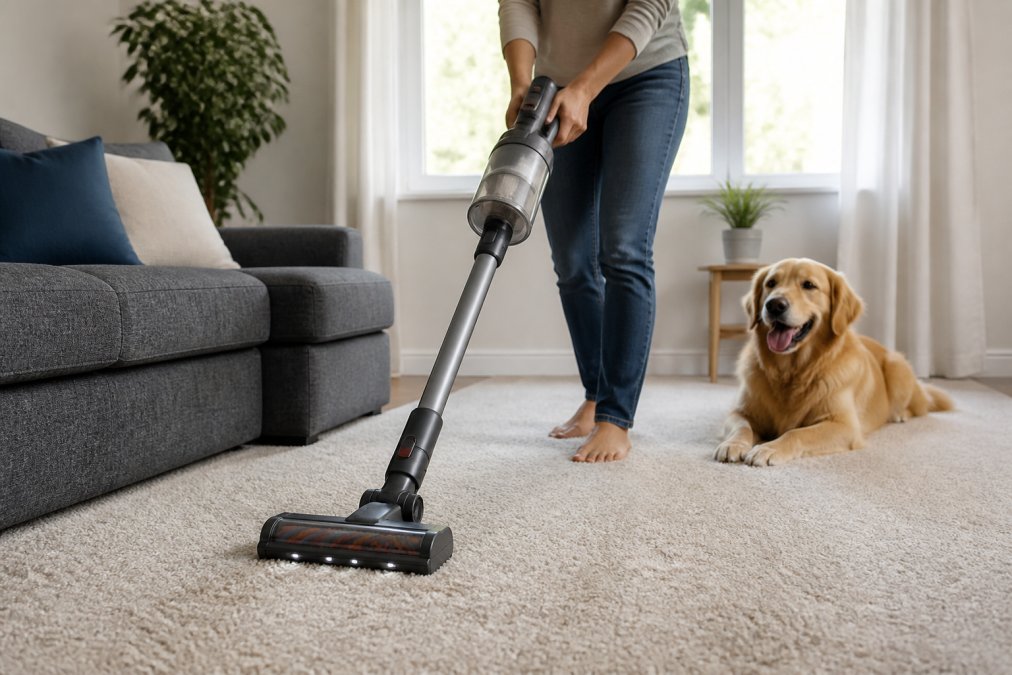
Pet dander and hair need a cleaning schedule, not a single weekly pass. Dander is a protein shed continuously by cats and dogs that sticks to soft surfaces long after the animal leaves the room. It's also light enough to stay airborne for hours, so the dander you can't see does most of the work on your symptoms.
Why Dander Needs a Different Approach Than Dust
Dander particles are small, typically 2.5 to 10 microns, and carry a sticky protein coating that clings to fabric. That's why a quick pass with a suction-only tool leaves most of it behind. The mechanical action of a brush roll, plus enough airflow to carry loosened particles into the airstream, is what actually removes it.
An Allergy-Specific Cleaning Cadence
Most generic cleaning schedules are built for appearance, not allergen load. An allergy-focused routine front-loads frequency on the surfaces where dander accumulates fastest.
- Daily: quick pass over high-traffic areas, the pet's favorite spots, and any upholstered furniture the pet uses. Two to three minutes with a brush roll attachment is enough to knock down the day's accumulation.
- Every other day: vacuum the rooms the pet sleeps in. Dander concentration is highest where the animal spends the most time.
- Weekly: full vacuum of carpets, rugs, and upholstery with the brush roll engaged. Include under beds and along the edges of furniture where dander drifts and settles.
- Monthly: vacuum under furniture, along baseboards, inside closets, and behind curtains. These are the reservoirs that re-seed the room between weekly passes.
- Seasonally: wash pet bedding, curtains, and any washable covers in hot water. Dander that has bonded to fabric won't come out with vacuuming alone.
The Order of Operations Matters
Dusting before vacuuming is a common mistake. Dusting lifts particles into the air, and if you vacuum afterward, some of that dust gets pulled into the vacuum while the rest settles back onto surfaces you just cleaned. Vacuum first, then dust with a damp cloth.
Post-Vacuuming Air Quality Monitoring
Post-vacuuming air quality monitoring tells you whether the vacuum actually helped. Most people finish cleaning, feel their symptoms ease or worsen, and never connect the two. A basic indoor air quality monitor that tracks particulate matter gives you a number instead of a guess.
Vacuuming Techniques for Maximum Dust Reduction
Technique determines how much dust you actually remove. Slow, overlapping passes beat fast coverage, because the floorhead needs contact time to pull particles out of carpet pile.
- Move the vacuum at roughly half your normal walking pace
- Overlap each pass by about half the floorhead width
- Make two passes over high-traffic zones
- Use hard floor settings on hard surfaces to avoid scattering debris
- Empty or change the bag when it reaches two-thirds full, since airflow drops as it fills
Frequently Asked Questions
What type of vacuum is best for allergies?
A vacuum with a sealed system and true HEPA filtration is the most effective for allergy relief. Look for models that capture 99.97% of particles at 0.3 microns, include a motorized brush roll for carpet agitation, and have gaskets or seals that prevent air from escaping before it passes through the filter. Bagged models often contain dust better during disposal, which matters if you have severe sensitivities.
Are bagged vacuums better for allergies?
Bagged vacuums generally contain dust better because you remove the entire bag without releasing particles back into the air. Bagless models require you to empty a canister, which can send fine dust and allergens airborne. If you choose bagless, empty it outdoors and wear a mask. Either way, a sealed system and HEPA filter matter more than the bag itself for overall allergen containment.
Do HEPA filters really help with allergies?
Yes. HEPA filters capture 99.97% of particles at 0.3 microns, which includes dust mites, pollen, pet dander, and many airborne contaminants that trigger respiratory symptoms. The key is that the filter must be part of a sealed system. A HEPA filter in a leaky vacuum lets unfiltered air escape around the seams, reducing filtration efficiency significantly.
How often should I replace or clean vacuum filters?
Washable filters should be rinsed every 3 to 4 weeks and replaced every 3 to 6 months depending on use. HEPA filters typically need replacement every 6 to 12 months. If you notice reduced suction, musty odors, or visible dust on the filter, replace it sooner. Pet owners and homes with high dust levels may need to follow the shorter end of these ranges.
Choosing a vacuum for allergy relief is really a decision about indoor air quality, and that decision continues long after the purchase. WowHaul carries practical finds for everyday living, including pet care essentials and home products built for stronger routines, so the maintenance side of allergy management stays simple. Browse the WowHaul collection to find tools that support a cleaner, easier home, and check the product pages for current availability and details.