

Table of Contents
- Signs of Separation Anxiety in Dogs and Other Pets
- Build a Predictable Routine to Reduce Pet Anxiety
- Best Interactive Toys for Anxious Pets
- How to Crate Train a Dog for Long Hours
- Natural Calming Aids for Pet Anxiety
- Technology and Professional Support for Long Work Days
- Frequently Asked Questions
Last Updated: September 15, 2026
Signs of Separation Anxiety in Dogs and Other Pets
Separation anxiety is a distress response that occurs when a pet is left alone, and it affects a significant share of household dogs.
The tell-tale signs cluster into a few recognizable patterns:
- Vocalization: barking, howling, or whining that starts within minutes of your departure
- Destructive behavior: chewing door frames, digging at carpets, or scratching exits
- House soiling: accidents in a pet that is otherwise fully house trained
- Pacing: repetitive walking in fixed paths near the door or windows
- Escape attempts: clawing at crates or windows, sometimes causing injury
Not every dog that chews a shoe has separation anxiety. Boredom looks similar but responds to different fixes. The distinguishing factor is timing: true separation anxiety shows up almost immediately after you leave and stops when you return. The American Veterinary Medical Association guidance on behavioral issues notes that a proper diagnosis matters because treatment differs for each condition.
Cats show it differently, often through excessive grooming or refusing food. One important rule applies across species: never punish anxious behavior after the fact. A dog cannot connect your anger at 6 p.m. with something it did at 9 a.m.
Build a Predictable Routine to Reduce Pet Anxiety
The single most effective change most owners can make is a consistent daily schedule. Dogs and cats are pattern learners, and unpredictability raises baseline stress.
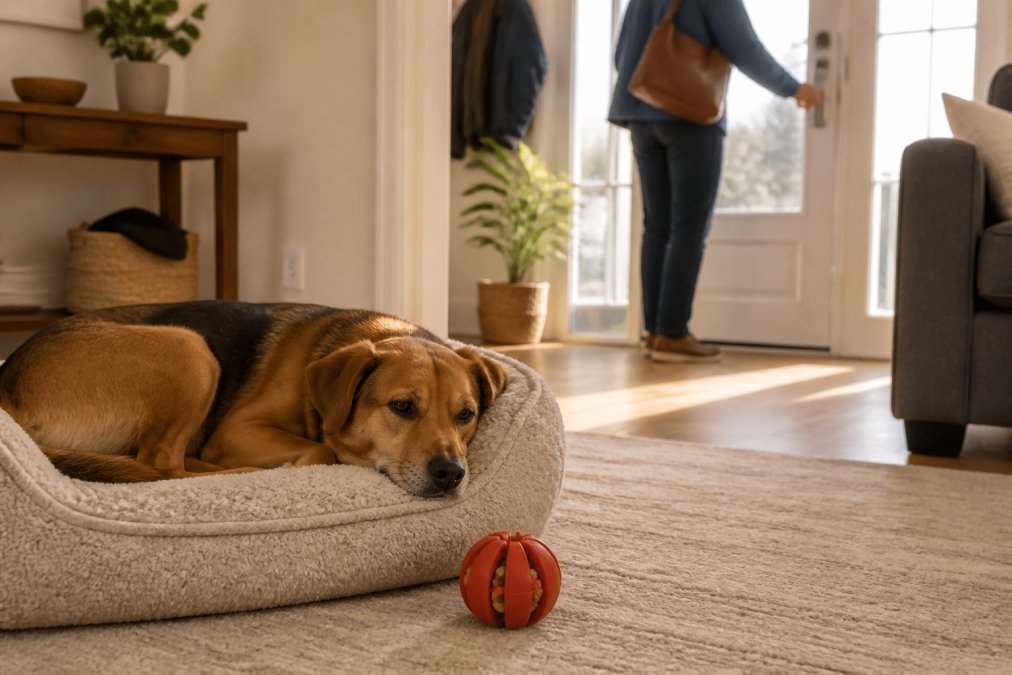
Build the day around fixed anchors:
- Morning walk at the same time (exercise before you leave, not after)
- Feeding at set hours so your pet knows when food arrives
- A calm departure ritual that signals "this is normal"
- Consistent return time where possible
A common mistake is the emotional goodbye. Long hugs and apologetic tones tell your pet something is wrong. A neutral exit, keys and coat with no drama, communicates the opposite. Pair the routine with a high-value treat or puzzle toy so departure becomes a cue for something good, a technique called counter-conditioning.
Best Interactive Toys for Anxious Pets
The best interactive toys for anxious pets are puzzle feeders and treat-dispensing toys that extend mealtime and redirect nervous energy into problem-solving. Mental stimulation tires a dog as effectively as a walk.
Options worth rotating:
- Puzzle feeders: kibble drops out as the pet solves the puzzle, stretching a meal to 20 minutes
- Frozen stuffed toys: pack with wet food and freeze overnight for a long-lasting distraction
- Snuffle mats: mimic foraging and engage the nose, which calms many dogs
- Treat balls: roll unpredictably, keeping a pet moving and engaged
Rotate toys weekly so novelty holds. The goal is to give your pet a job while you're gone. The Humane Society's enrichment guidance points out that environmental enrichment reduces stress signals like pacing and vocalization in many pets. Pair toys with a predictable routine and you address both the mental and emotional sides of pet anxiety.
How to Crate Train a Dog for Long Hours
Crate training works for long work days only when the crate is a safe haven, never a punishment zone. Done right, it gives an anxious dog a den it seeks out on its own, and it gives you a contained space where destructive behavior can't escalate into a veterinary emergency.
The process takes patience and, realistically, three to six weeks of consistent work:
- Feed meals inside the crate with the door open for the first week. The crate should predict food, not confinement.
- Toss high-value treats in during calm moments throughout the day so the crate keeps paying out.
- Close the door for seconds, then minutes, then longer stretches, always while you're in the room at first.
- Leave the room while your dog is crated, then return calmly. No dramatic reunions.
- Extend absences gradually in increments of 10 to 15 minutes, tracking what your dog tolerates without distress.
- Add your departure cues, keys, coat, shoes, only after the crate is neutral, so those cues don't become predictors of panic.
How long is too long in a crate?
A common rule of thumb among trainers and veterinarians is that an adult dog should not be crated longer than its age in months, up to a cap of about four to six hours during the day. That means even a healthy adult dog needs a break in the middle of a standard eight-hour workday. Puppies, senior dogs, and dogs on certain medications need shorter stretches.
For a full workday, build the break into your plan before you build the crate schedule:
- Midday dog walker who lets the dog out, walks it, and refills water
- Neighbor or family member on a standing schedule so the timing is predictable
- Doggy daycare two or three days a week to break up the longest absences
- A pet sitter drop-in booked through an app for your heaviest days
If none of those are possible, a pen or a dog-proofed room is often a better option than a crate for the full day. Confinement anxiety and crate anxiety are different problems, and a dog that panics in a crate may do fine in a small gated area with a bed, water, and a puzzle toy.
Track your departures and returns for one week. If your dog is calm for the first two hours and then starts vocalizing, the crate isn't the problem, the length of the absence is. That's a signal to add a midday break rather than to keep extending crate time.
Natural Calming Aids for Pet Anxiety
Calming aids do not replace training, but they lower the stress baseline so training can take hold. Think of them as a floor, not a fix, they buy you a calmer dog to work with, not a cured one.
What each option actually does
- Pheromone diffusers and collars: release a synthetic analog of the appeasing pheromone a nursing mother produces. Most owners who see a response notice it within the first few days of continuous use. Diffusers cover a single room; collars travel with the dog.
- L-theanine and calming chews: an amino acid found in green tea, sold in pet-safe doses. Onset is typically 30 to 60 minutes, so timing matters, give it before your departure cues, not after you're already out the door.
- Thundershirt-style wraps: gentle, constant pressure that soothes some dogs and does nothing for others. There's no harm in a two-week trial; if you see no change, stop.
- Auditory enrichment: calming music or white noise left playing can mask the sounds that trigger alert barking, delivery trucks, neighbors, the mail slot.
How to sequence them
When to involve your veterinarian
Technology and Professional Support for Long Work Days
For scheduled long days, build a support system:
| Problem | Fix | Frequency |
|---|---|---|
| Vocalizing at departure | Neutral exit + treat toy | Every departure |
| Destructive chewing | Puzzle feeder + exercise | Daily |
| House soiling | Midday walker or sitter | Weekdays |
| Pacing and stress signals | Pheromone diffuser + enrichment | Ongoing |
Frequently Asked Questions
How can I tell if my pet has separation anxiety?
Look for signs like pacing, whining, barking, destructive chewing, house soiling, or drooling when you prepare to leave or after you're gone. These behaviors often peak within the first 30 minutes of your departure. A pet camera can help you confirm whether your pet settles or stays stressed. If symptoms persist, consult your veterinarian to rule out medical issues and get a behavioral assessment.
What are the best toys to keep pets occupied while I'm at work?
Puzzle feeders, treat-dispensing balls, and frozen stuffed toys work well for many pets. These toys provide mental stimulation and can extend mealtime, which helps reduce boredom and anxiety. Rotate toys weekly to maintain novelty. For dogs, consider a snuffle mat or a durable chew toy. For cats, try a motion-activated laser toy or a treat maze. Always supervise initially to ensure safety.
Should I consider a dog walker or pet sitter for long hours?
Yes, if your dog struggles with being alone for more than 6-8 hours, a midday walker or sitter can break up the day and provide a bathroom break and social contact. This is especially important for puppies, senior dogs, and breeds with high exercise needs. A consistent visitor also adds a predictable routine, which can reduce anxiety over time. Budget for this as part of your pet care plan.
Are there natural supplements or calming aids for anxious pets?
Some pet owners use L-theanine, chamomile, or melatonin supplements, as well as pheromone diffusers and calming chews. These can help take the edge off mild anxiety but are not a cure for severe cases. Always talk to your veterinarian before starting any supplement, especially if your pet takes medication. Pair supplements with behavior modification for the best results.
Pet anxiety when working long hours rarely resolves with a single fix. It takes a predictable routine, the right toys, patient crate training, and often a support system for the hours you can't be home. WowHaul offers practical finds for everyday pet care, including products designed to build stronger, more efficient routines that support happy, healthy pets. Get started with WowHaul and give your pet a calmer, more predictable day.