

Table of Contents
- What a Potty Training Visual Schedule Is and Why It Works
- Potty Training Routine Steps to Put on Your Schedule
- Choosing Pictures, Photographs, or Symbols for Your Child
- How to Get a Free Potty Training Visual Schedule Printable
- Autism Potty Training Visual Schedule: Personalization Tips
- Displaying the Schedule and Walking Through It Before Using the Toilet
- Troubleshooting Resistance, Accidents, and When to Seek Advice
- Fading Prompts and Measuring Progress
- Frequently Asked Questions
Last Updated: October 12, 2026
What a Potty Training Visual Schedule Is and Why It Works
Visual schedules for potty training are simple picture charts that show each step of the bathroom routine in order, so a child can see what comes next instead of relying on spoken instructions alone.
Here's why it works. The American Academy of Pediatrics guidance on toilet training notes that children learn best when routines are predictable and broken into small, clear steps.
How Visual Schedules Reduce Power Struggles
Most potty battles aren't about the toilet, they're about control. A visual schedule shifts the authority from you to the chart, so you're no longer the one saying "it's time to go" for the tenth time.
When a child points to the next picture and does it themselves, they feel in charge, and many parents find resistance drops once the routine belongs to the child.
Potty Training Routine Steps to Put on Your Schedule
The best potty training routine steps are short, repeatable, and always in the same order. Keep the sequence to six steps or fewer. Longer routines lose a toddler's attention fast.
Put the steps in the order your child actually does them, and use the same words every time.
The Core Six Steps
- Walk to the bathroom
- Pull down pants
- Sit on the toilet or potty
- Wipe
- Flush
- Wash hands
Resist the urge to add extras. If your child needs a step like "pull up pants," add it after wiping, not in the middle of the sequence.
| Step | What the Child Does | Adult Support |
|---|---|---|
| 1 | Walks to the bathroom | Walks alongside |
| 2 | Pulls down pants | Helps with waistbands |
| 3 | Sits on the potty | Stays close, no rushing |
| 4 | Wipes | Hands over the paper |
| 5 | Flushes | Lets the child press it |
| 6 | Washes hands | Turns on the water |
Choosing Pictures, Photographs, or Symbols for Your Child
Photographs usually work best for toddlers, while simple line drawings suit older children who can read symbols.
If your child is very young or has speech delays, real photos of your own bathroom and your own child are clearest. Line drawings work once a child can connect a simple image to an action, and some children do best with a mix: photos for big steps, symbols for small ones.
Ask yourself three questions:
- Does my child recognize this image right away?
- Can my child point to it to show what's next?
- Is it clear enough to follow without me explaining?
If the answer to any of these is no, swap the picture.
How to Get a Free Potty Training Visual Schedule Printable
You can find a free potty training visual schedule printable from several trusted sources, or make one at home in about twenty minutes. The homemade version often wins because it uses your child's own bathroom and face.
For a printable, look for charts that match the six steps above and leave room for a sticker after each success. For a DIY version, take six quick photos, print them, and tape them in a column on the bathroom wall.
Autism Potty Training Visual Schedule: Personalization Tips
An autism potty training visual schedule often needs more detail, more control, and a more deliberate match to how your child communicates than a standard chart.
Start by choosing the right representation for each step. There is no universal best format, only the best fit for your child right now.
- Real photographs work best for most toddlers and concrete, literal thinkers. A photo of your own bathroom, potty, and child removes every layer of abstraction, making this the strongest starting point for children on the spectrum who struggle to generalize from a drawing to the real object.
- Simple line drawings suit children past needing photographic realism who benefit from less visual clutter, and let you strip a scene to one action per card.
- Symbols and icons (as used in picture-exchange systems) fit children who already use symbol-based communication, because the schedule speaks the same visual language they use to request and comment.
A practical rule: if your child cannot point to the correct picture when you name the step, the image is too abstract, swap it for something more concrete.
Adapting the Schedule to Age, Language, and Support Needs
The same routine can be built at very different levels of complexity. Match the build to your child, not a template.
- Age 18-30 months: two to four steps, one large photo per card, no text. Focus on the physical sequence: walk, sit, wipe, wash.
- Age 2-4 years: the full six-step sequence with photos plus a single word label under each picture. Add a "finished" card so the routine has a clear endpoint.
- Pre-readers with strong visual skills: symbols or drawings with consistent color coding (for example, every bathroom step in blue) so the sequence is recognizable at a glance.
First-Then vs. Full Sequence
Some children do best with a first-then format: first potty, then a preferred activity. This works when the child needs a clear reason to start and can hold only one contingency in mind. Others need the full sequence laid out at once so they can see where the routine ends. Watch which one calms your child rather than agitates them.
Keep the schedule up long after your child seems trained. For children who rely on routine, the chart is a quiet anchor during changes like a new sibling, a move, or a new classroom.
Displaying the Schedule and Walking Through It Before Using the Toilet
Place the schedule where your child can see it at their own eye level, not yours. A chart at adult height is decoration; at toddler height it's a tool.
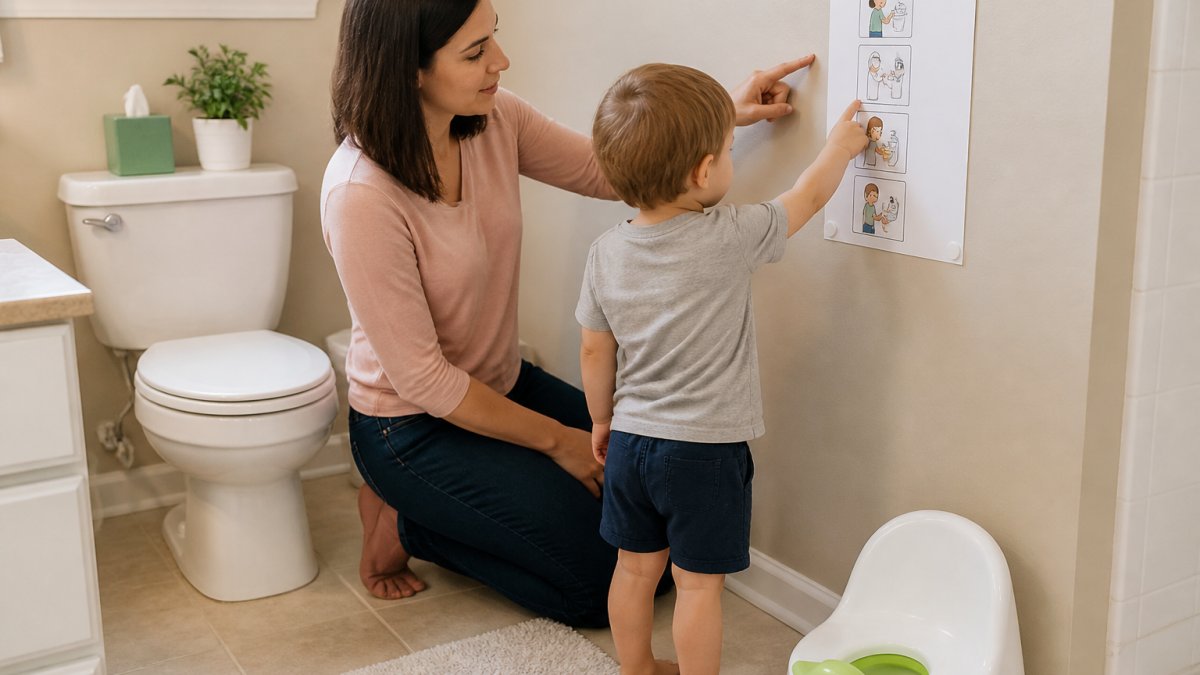
Tape it beside the potty or on the wall directly across from it.
Do this every time for the first week or two. Once your child points to the pictures without prompting, the routine is sinking in.
Troubleshooting Resistance, Accidents, and When to Seek Advice
Resistance and accidents are normal parts of learning, not proof the schedule failed. What matters is reading why the schedule is breaking down and responding to the cause rather than the behavior.
When Your Child Refuses the Schedule
Refusal usually has a function. Match the fix to the function.
- The routine is too long. Shrink it to two steps for a few days, walk to the bathroom, sit, and rebuild. A shorter routine your child completes beats a longer one they abandon.
- Your child wants control. Let them choose the order of the last two steps, or which card to remove first, small choices satisfy the need without breaking the sequence.
- The schedule has lost its novelty. Refresh it with new photos, a new sticker, or a new placement. Novelty is a legitimate motivator at this age.
Sensory Discomfort and Anxiety
Some children resist the bathroom because of how it feels, not what it asks. Common triggers include the cold seat, the echo of a flushing toilet, the sensation of wiping, the sound of a hand dryer, or a wet diaper being removed. A visual schedule can't fix a sensory problem, but it can be adapted around one. Adjusting the fit of a garment often reduces the discomfort that triggers resistance, a process that begins with preventing diaper leaks to ensure the child remains dry and settled before starting the routine.
- Add a comfort step to the schedule, such as sitting on a warmed seat cover or holding a preferred item.
- Use noise-reducing headphones for flushing and hand dryers, and make that step part of the chart.
- Offer flush-free days where the child sits and wipes but you handle the flush, then reintroduce it slowly.
Accidents and Constipation
Accidents often trace back to constipation, a common and treatable cause of potty setbacks. When a child is backed up, the rectum stays stretched and the signals that say "I need to go" become unreliable, the result looks like defiance but is a physical problem.
Watch for these signs:
- Straining, or hard, painful stools
- Avoiding the toilet, or hiding to poop
- Soiling between trips, especially after a period of being dry
If you see these, talk to your pediatrician rather than pushing harder on the schedule. The National Institute of Diabetes and Digestive and Kidney Diseases explains how constipation affects bladder and bowel control in children.
When to Seek Professional Advice
Most potty learning challenges resolve with time and consistency. Reach out to a pediatric professional if any of the following apply:
- Your child is in pain during urination or bowel movements
- Your child holds stool for several days, or has a distended belly
- There is blood in the stool or urine
Keeping the Schedule Working Across Settings
A routine that only works in one bathroom is not yet a routine. Keep the same sequence, photos, and words at home, at childcare, at grandparents' houses, and in public restrooms. A small laminated set that travels in a bag eases transitions and signals to every caregiver that the steps are not negotiable, consistency across settings turns a chart on a wall into a skill your child carries with them.
Fading Prompts and Measuring Progress
The goal of a visual schedule is to make itself unnecessary. Over time, fade your prompts so your child runs the routine on their own.
Start by pausing before each step. If your child does it without your cue, great. If not, point to the picture instead of saying the words. Then step back further. Eventually, your child checks the chart themselves, or doesn't need it at all.
Track progress simply:
- How many steps does your child do without a prompt?
- How many days in a row with no accidents?
- Can your child start the routine without being told?
Frequently Asked Questions
How do you use a visual schedule for potty training?
Post the schedule at your child's eye level in the bathroom. Before each bathroom trip, point to each picture and say the step out loud, then have your child follow along. Keep the same order every time: pull down pants, sit on the toilet, wipe, flush, wash hands. Review it before using the toilet, not after. Consistency matters more than perfection, so run the same sequence at home, at daycare, and at grandparents' houses.
What should be included in a potty training visual schedule?
Include the full bathroom routine in the order your child will do it: walk to the bathroom, pull down pants, sit on the toilet, wipe, flush, pull up pants, wash hands. Add a picture for recognizing the signal to go if your child is learning to notice body cues. Keep it to six to eight steps so it stays readable. For a free potty training visual schedule printable, look for one with simple line drawings or real photographs your child recognizes.
Are visual schedules helpful for autistic children during potty training?
Yes. An autism potty training visual schedule replaces spoken instructions with pictures, which reduces the language processing load and gives a predictable sequence. Many autistic children respond well to the same steps in the same order every time. Pair the schedule with a reward chart and keep sensory needs in mind, such as a toilet seat cushion or noise-reducing headphones. If progress stalls for weeks, talk to your pediatrician or an occupational therapist.
When should I stop using a potty training visual schedule?
Fade the schedule once your child completes the routine without prompting most of the time. Start by removing one picture at a time, or move the chart higher on the wall so it is less central. Keep it visible for a few more weeks as a backup. If accidents return during a big change, like a new sibling or a move, bring the schedule back at full strength. Most children need it for several months, not weeks.
Potty training takes patience, and the right tools make the daily routine smoother. At WowHaul, we curate practical finds for everyday living, including products that help you build stronger routines and support happy, healthy kids. Our collection focuses on items that simplify home life without adding clutter. Get started with WowHaul and find the everyday tools that make your family's routine easier to keep.