

Table of Contents
- Why Item-Specific Laundry Folding Hacks Beat One-Size-Fits-All Methods
- How to Fold Different Types of Clothing: A Quick Reference
- How to Fold T-Shirts So They Take Up Less Drawer Space
- How to Fold Jeans and Pants for Drawers and Travel
- The Japanese Folding Method: What It Is and When to Use It
- Hacks for Sweaters, Underwear, Socks, and Small Garments
- Common Folding Mistakes That Waste Drawer Space
- Conclusion
- Frequently Asked Questions
Last Updated: October 6, 2026
Why Item-Specific Laundry Folding Hacks Beat One-Size-Fits-All Methods
A drawer full of clothes that won't stay stacked is a daily annoyance, not a storage problem. That's the core idea behind laundry folding hacks for specific clothing items: one method can't fit a stiff pair of jeans, a stretchy knit, and a thin T-shirt at the same time.
Here's the throughline: match the fold to the fabric and the storage goal, and everything else falls into place.
How to Fold Different Types of Clothing: A Quick Reference
Different garments need different folds. A heavy sweater wants a soft, flat fold. A T-shirt wants speed and a compact shape. Jeans want structure. The table below sums up the whole article so you can pick a method in seconds.
| Garment | Best Fold | Main Goal | Avoid |
|---|---|---|---|
| T-shirt | Three-point flip | Speed, upright filing | Over-folding the collar |
| Jeans | Bottom-up fold | Stacking or packing | Creasing the knee area |
| Sweater | Flat fold | Shape retention | Hanging on a hanger |
| Underwear | Simple square fold | Neat stacking | Stretching the elastic |
| Socks | Pair-and-tuck | Loose pairing | Tight bundling |
| Delicates | Flat, tissue-lined | Preventing snags | Rolling tightly |
Match the Fold to the Storage Goal
The fold should serve the shelf, not the other way around. If you want to see every shirt at a glance, file them upright. If you're packing a suitcase, roll them. If you're storing off-season knits, fold them flat and stack them loosely.
A common mistake is folding everything the same way out of habit. In practice, changing the fold to match the goal saves the most space.
Fabric Care: When Not to Fold
Not every garment should be folded, and not every garment should be hung. Heavy knits stretch out of shape on a hanger, so they belong in a drawer. Structured jackets and dress shirts hold their shape better on a hanger.
For delicate fabrics, add a layer of tissue paper between folds to stop snags. And always make sure clothes are fully dry before they go in a drawer, since trapped moisture leads to musty smells and mildew.
How to Fold T-Shirts So They Take Up Less Drawer Space
The fastest way to shrink a T-shirt pile is the three-point flip, then filing the shirts upright. This combo cuts the space a stack takes and lets you grab any shirt without toppling the rest.
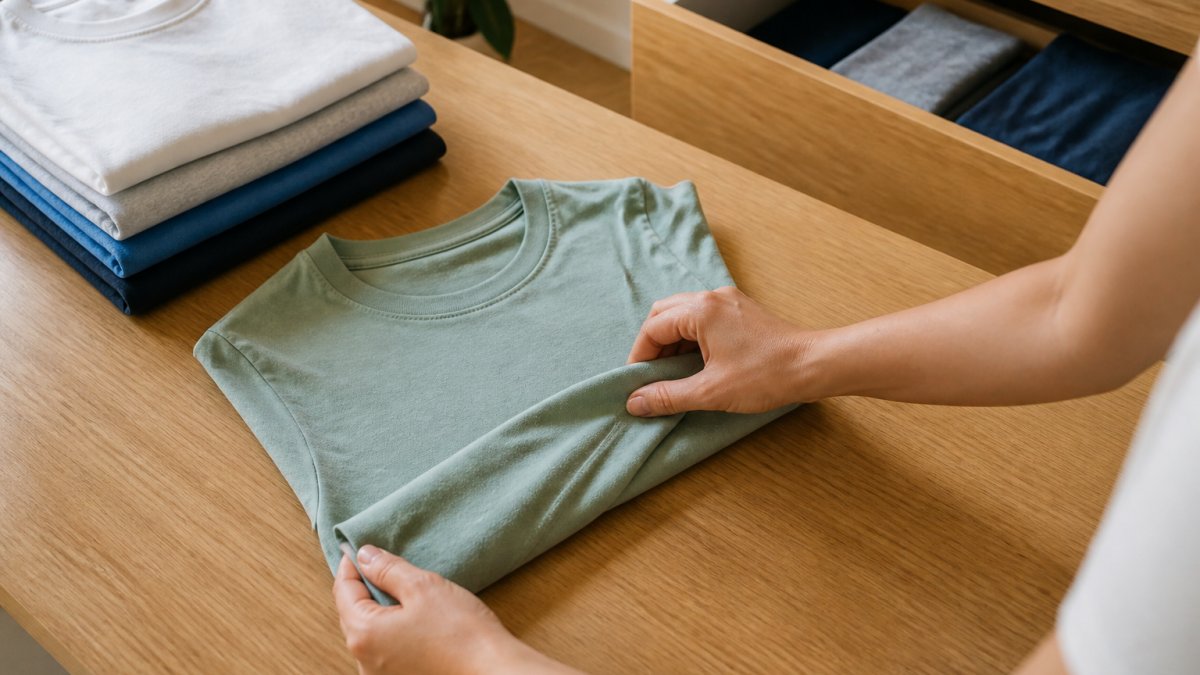
The Three-Point Flip (Fastest T-Shirt Fold)
- Lay the shirt flat, face down, and smooth out the wrinkles.
- Pinch the shoulder at one side and the center of the shirt.
- Cross the far sleeve over and flip the whole shirt in one motion.
- Fold the remaining side in and smooth the result.
This takes a few seconds once you've done it a few times.
Filing T-Shirts Upright in a Drawer
Instead of stacking shirts flat, stand them on their edges in a row. You can see every design at a glance. No more digging through a pile and messing up the whole stack.
How to Fold Jeans and Pants for Drawers and Travel
Jeans are bulky, so the fold you choose depends on whether they're going in a drawer or a suitcase. The bottom-up fold gives you a neat, stackable rectangle for drawers. Rolling works better for travel, since it saves space and reduces creases.
The Bottom-Up Fold for Jeans
- Lay the jeans flat and fold them in half lengthwise.
- Fold the legs up from the hem toward the waist.
- Fold the waistband over the legs to lock the bundle.
The result is a compact block that stacks without sliding.
Rolling Jeans for Packing
Roll from the hem up to the waist, then tuck the rolled bundle into your bag. Rolling keeps the fabric tight and cuts down on wrinkles during travel. Pack heavier denim at the bottom of the bag and lighter pants on top.
The Japanese Folding Method: What It Is and When to Use It
The Japanese folding method is a technique that folds garments into compact, self-standing rectangles so they can be filed upright. It's built around making every item visible and easy to grab.
Use it when you want a tidy drawer where nothing gets buried. It works best on T-shirts, light tops, and leggings.
The method pairs naturally with the filing approach: fold each item into a small rectangle, then stand them side by side.
Hacks for Sweaters, Underwear, Socks, and Small Garments
Small garments are where folding discipline pays off most, but the fold has to match the garment's construction, not just its size. A molded bra cup, a pair of leggings with a wide waistband, and a silk slip all need different handling. Here is the item-by-item breakdown that most folding guides skip.
Sweaters: Fold, Never Hang
Hanging a sweater stretches the shoulders and leaves hanger marks. Fold it flat instead:
- Lay the sweater face down and fold each sleeve toward the center.
- Fold the sweater in half from the bottom up.
- Store it flat or file it upright with the fold facing out.
For bulky cable knits, fold in thirds instead of halves so the bundle stays shallow enough to stack. For cashmere and other fine-gauge knits, slide a sheet of acid-free tissue between the front and back panels to prevent fiber abrasion.
Underwear and Socks Without Stretching
Fold underwear into a simple square and stack them on edge. For socks, pair them and tuck one cuff over the other instead of tying them in a knot. Knots stretch the elastic over time and wear out the cuffs. For athletic socks with cushioning, lay them heel-to-toe and fold in half once, repeated folding along the same line flattens the cushioning.
Bras: Keep the Cups
Never fold a molded-cup bra in half, that creases the cup and it will not recover. Stack bras with one cup nested inside the other, then fold the band and wings behind the cups. For underwire bras, keep the wires aligned so they do not press into the fabric of the bra below. Store them in a row or in a drawer divider so the cups stay upright.
Leggings and Activewear
Leggings fold like jeans but without the bulk. Fold in half lengthwise, then fold the legs up to the waistband in thirds. For compression fabric, avoid folding along the same line every time, rotate the fold point so the elastane does not develop a permanent crease. Moisture-wicking tops and shorts can be filed upright like T-shirts, but keep them away from velcro and zippers that snag the knit.
Dresses and Delicates
Long dresses and slips should be folded in half lengthwise, then folded in thirds from the hem up so the bodice sits on top. Line the fold with tissue paper for silk, satin, and anything with beading or lace. Do not hang heavy beaded dresses, the weight pulls the shoulders out of shape over time. For strapless or bias-cut dresses, roll them loosely around a tissue-paper core and store flat.
Button-Down Shirts
Button-downs can be folded for a drawer or a suitcase, but the collar is the part that shows. Button the shirt, lay it face down, fold each sleeve back at the shoulder seam, then fold the sides in so they meet at the center. Fold the shirt in half from the bottom up, or in thirds for a longer shirt.
Common Folding Mistakes That Waste Drawer Space
The biggest space-waster is folding everything the same way. A method that works for a T-shirt will crush a sweater or leave jeans sliding around.
Other mistakes we see often, and what actually causes the problem:
- Stacking shirts flat instead of filing them upright. A flat stack hides everything below the top two shirts, so you dig and re-fold. Filing shirts on edge lets you pull one out without disturbing the rest.
- Hanging heavy knits. Gravity pulls the shoulders down over weeks, and the hanger leaves a bump that does not steam out. Fold knits flat and reserve hangers for structured jackets and dress shirts.
- Tying socks in knots. The knot stretches the cuff elastic every time you pull a pair apart. Tucking one cuff over the other keeps the pair together without tension on the elastic.
- Folding clothes before they are fully dry. Trapped moisture in a closed drawer leads to mildew and a smell that is hard to remove from fabric. If a garment feels cool to the touch, it is not dry.
- Rolling delicate fabrics too tightly. Tight rolls press hard creases into silk and fine knits that a steamer may not lift. Roll loosely around tissue paper instead.
- Folding along the same line every time. Elastane and coated fabrics can take a permanent set along a repeated fold. Rotate the fold point on leggings, activewear, and anything with stretch.
- Ignoring the care label. If the label says hang to dry or dry flat, folding it into a drawer while damp defeats the point. Read the label before you choose a storage method.
A quick way to measure whether your changes are working: count how many items fit in a drawer before and after switching to upright filing, and time how long it takes to put away a load of laundry.
Fix these and you will reclaim real drawer space without buying a single organizer.
Conclusion
A messy drawer makes every morning harder than it needs to be. The fix isn't more storage, it's the right fold for each item. At WowHaul, we curate practical finds for everyday living, from home organization tools to care products that support stronger routines. Our collection is built to simplify daily tasks, not add clutter. Browse the WowHaul collection and build a routine that keeps your home running smoothly.
Frequently Asked Questions
What is the Japanese folding method?
The Japanese folding method, often called the KonMari fold, stands each garment upright so you can see every item at a glance. You fold the piece into a narrow rectangle, then fold it in thirds or quarters until it can stand on its own edge. This works especially well for T-shirts, jeans, and leggings. The goal is vertical storage: nothing gets buried at the bottom of a pile, so you skip the digging that unfolds everything above it.
How do you fold T-shirts so they take up less space?
Lay the shirt face down, fold one sleeve and a third of the body toward the center, repeat on the other side, then fold the shirt in half or thirds from the bottom up. For maximum space savings, file shirts upright in the drawer instead of stacking them. Using the vertical space in a drawer can help you fit more shirts.
How should you fold jeans for drawers?
Fold jeans in half lengthwise so the legs line up, then fold them in thirds from the hem up toward the waistband, or use the bottom-up fold. Stand them on edge in the drawer rather than laying them flat in a stack. Denim is heavy, so keep stacks short if you do stack them. For travel, roll jeans tightly from the hem to the waistband to save room and reduce creasing.
Is rolling or folding clothes better for saving space?
Rolling wins for travel and for soft, stretchy items like knit shirts, leggings, and pajamas. Folding wins for structured garments such as collared shirts, blazers, and sweaters that crease when compressed into a roll. For everyday drawer storage, folding and filing upright usually keeps clothes neater and easier to see. Many people use both: fold at home, roll when packing a suitcase or duffel bag.