

Table of Contents
- What Makes Artisan-Made Home Goods Different
- Handcrafted vs Mass-Produced Home Goods: Key Differences
- How to Tell If Something Is Handmade
- Questions to Ask When Buying Handmade Products
- Red Flags for Misleading Artisan Claims
- Artisan-Made Home Goods Buying Checklist
- Verifying Provenance and Authenticity
- Frequently Asked Questions
Last Updated: October 16, 2026
What Makes Artisan-Made Home Goods Different
Artisan-made home goods stand apart from mass-produced items in ways that shape durability, uniqueness, and the value you receive.
Handcrafted items are made by skilled artisans using traditional techniques and often limited production runs, with each piece reflecting the maker's expertise. Mass-produced goods prioritize speed and consistency through automated processes. A handmade ceramic bowl takes hours to throw, fire, and finish; a factory version takes minutes on an assembly line.
The key difference is intentionality. Artisans make decisions about materials, techniques, and finishing based on the specific piece in front of them, while factory workers follow standardized procedures for identical output, affecting how long a product lasts and whether it develops character.
Handcrafted vs Mass-Produced Home Goods: Key Differences
Understanding how handcrafted and mass-produced items differ helps you spot authentic artisan home goods when shopping.
Handcrafted products show variation. No two pieces are exactly alike, a hand-thrown mug varies in glaze color, wall thickness, and handle shape.
Materials matter more in artisan work. Skilled makers select specific wood types, clay bodies, or fabrics for how they behave and age; mass production chooses on cost and speed.
Construction methods differ significantly. Artisans use time-intensive techniques, hand-stitching, wood joinery, traditional firing, that create stronger, longer-lasting items.
Attention to detail shows in the final product. Hand-finished wood edges, careful glaze application, and precise stitching reveal maker care; mass-produced items have rough edges, uneven finishes, and visible seams.
How to Tell If Something Is Handmade
Spotting authentic handmade items requires knowing what to look for, but no single visual clue proves authenticity, factory equipment can mimic glaze pooling, hand-stitched seams, and distressed edges. Look for a cluster of signals that are expensive or impractical to fake at scale, checked differently by material.
Why One Clue Is Never Enough
A wobbling glaze line, a fingerprint in clay, or an uneven stitch can all be produced by machine or by a worker told to add "handmade" imperfections. What factories struggle to reproduce economically is inconsistency across a batch combined with tool-mark logic, marks that follow a human hand's direction, vary piece to piece, and appear where a mold cannot reach. Treat any single signal as a question, not a verdict.
Product-Specific Inspection Checks
Ceramics and pottery. Turn the piece over.
Textiles. Examine the back of the fabric. Hand-stitched hems show varied stitch length and a visible knot or backstitch; machine hems are uniform and often serged.
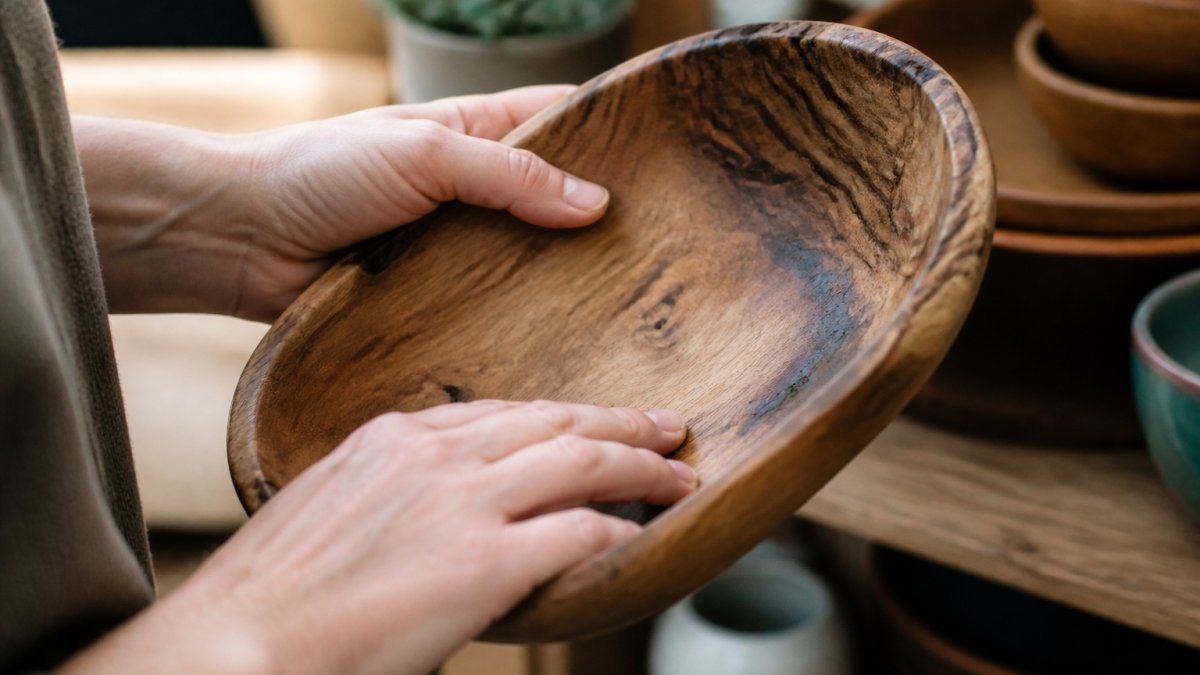
Woodwork. Look at the end grain and joints. Hand-cut dovetails are slightly irregular in spacing and angle; machine-cut ones are identical. Check for tool marks, plane tracks, chisel marks, spokeshave facets, that follow the grain.
Metalwork. Look for hammer marks, planishing texture, and forge-welded seams. Hand-forged pieces show slight thickness variation and tool marks a stamping press cannot replicate.
Woven goods. Baskets, rugs, and cane work reveal handwork in the tension. Hand-woven pieces vary slightly in warp spacing and weft density; machine-woven goods are uniform.
The Batch Test
When you can see more than one piece from the same maker, compare them. Authentic handwork shows related but non-identical variation, the same glaze recipe producing slightly different pooling, the same pattern with small alignment differences. Factory "handmade-style" goods show either perfect uniformity or randomized machine distressing that looks repetitive side by side.
Material Quality and Construction
Feel the weight and density. Handcrafted pieces often feel substantial. Solid wood is heavier than plywood, thick ceramics are denser than thin mass-produced versions, and genuine natural materials have texture and variation.
Inspect joints and connections. In wood items, look for traditional joinery, mortise and tenon joints, dovetails, or wood pegs, which indicates skilled craftsmanship. Factory items use dowels, screws, or glue only.
Check for finish quality. Handcrafted finishes, oil, wax, or hand-rubbed stains, develop patina over time, while factory finishes are often plastic coatings or cheap varnish that chips easily.
Examine how components fit together. Handmade items often have slight gaps or imperfections in assembly, which is normal.
Questions to Ask When Buying Handmade Products
Before purchasing, ask the maker or seller these questions. Their answers reveal whether you're getting authentic artisan home goods or factory items marketed as handmade.
"Can you tell me about your production process?" Authentic makers describe their methods in detail, techniques, tools, time invested, and specific decisions for each piece.
"How many of these do you make per month?" Small-batch artisans make dozens, not thousands.
"Do you make each piece individually, or do you use molds/templates?" Some handwork involves molds, that's acceptable.
"Can I see your workspace or studio?" Legitimate makers are proud of their setup. Many offer studio visits or share photos.
"What's your return or satisfaction policy?" Confident makers stand behind their work with returns or replacements.
Red Flags for Misleading Artisan Claims
Some sellers market factory goods as artisan-made.
Suspiciously low prices are a major red flag. Authentic handcrafted items require time and skill.
Identical inventory indicates factory production. Real artisans produce limited quantities with variations.
Generic maker stories without specific details are misleading. Phrases like "made by artisans in a small workshop" lack substance.
No visible maker mark or signature is suspicious. Most artisans sign or mark their work.
Perfect uniformity across multiple pieces contradicts handwork. Slight variations are proof of human creation.
Vague material descriptions like "quality materials" or "premium fabrics" hide cheap components.
Pressure to buy quickly or claims of "limited stock" are manipulation tactics. Factory goods can be restocked instantly.
Artisan-Made Home Goods Buying Checklist
Use this checklist when evaluating potential purchases. It helps you verify authenticity and ensure you're getting genuine handcrafted items.
- Examine the piece physically for variation, asymmetry, and hand-finishing marks
- Check the bottom and back for maker signatures, fingerprints, or tool marks
- Feel the weight and density to confirm quality materials
- Inspect joints and seams for handwork or traditional construction methods
- Ask the maker about their process and listen for detailed, specific answers
- Confirm production volume, authentic makers produce limited quantities
- Request material specifications and verify they're high-quality
- Look for visible maker marks or signatures on the piece
- Research the maker's background and verify their story
- Check return and satisfaction policies to ensure confidence in quality
- Compare pricing to similar factory items, handmade costs more
- Verify the maker's workspace through photos, videos, or studio visits when possible
Verifying Provenance and Authenticity
Provenance is the documented chain connecting an item to the person who made it and the place and tradition it comes from. Most buyers never verify it, which is exactly why vague provenance claims survive in the market. The practical skill is learning to separate a specific, checkable provenance story from a generic, unfalsifiable one.
What a Verifiable Provenance Story Contains
A strong provenance claim names four things: the maker (a full name or a named workshop), the place (a town, region, or studio address, not just a country), the method (a named technique or tradition), and the material source (a specific supplier, region, or type). If any of those four is missing, the claim is weaker than it looks. "Handmade by artisans in a small workshop" fails all four tests. "Thrown and wood-fired by [maker name] at [studio name] in [region], using clay from [named source]" passes all four and can be checked.
How to Verify a Maker
Search the maker's name independently. Look for the maker's own website, a studio address, exhibition or craft-fair records, and press coverage that predates the product listing. A maker with a real practice usually leaves a trail across multiple independent sources.
Look for a consistent body of work. Authentic makers usually have a recognizable style and a portfolio that spans years. A seller whose "artisan" produces wildly different styles across categories, ceramics, textiles, and metalwork under one maker name, is likely reselling.
How to Verify Place and Cultural Attribution
Cultural attribution deserves special care. A claim that a piece is "made in the tradition of" a specific craft region should be specific and respectful: name the region and the technique, and be clear whether the piece was made there by a maker from that tradition or made elsewhere in that style. Those are different claims, and only one of them is cultural provenance.
Ask directly: Where was this piece made, and who made it? Then check whether the answer is consistent with the maker's public footprint and the item's material logic. A piece described as made in a cold-climate region but using a tropical hardwood, for example, needs an explanation.
Supply-Chain Verification in Practice
Direct-from-maker is the strongest signal because the maker is accountable for every claim. Buying from an artisan's own site, studio, or a craft fair you attend in person lets you ask questions and see the work.
Curated marketplaces add a layer of verification but are not a substitute for it. A platform that vets makers can reduce risk, but the vetting standard matters. Ask what the platform actually checks, maker identity, studio visits, production volume, material sourcing, and whether that verification is documented.
Certifications and fair-trade labels can help, but treat them as one input, not proof. Certification schemes vary in what they audit, and a label on a product page is not the same as a current certification you can look up.
Documentation you can request from a legitimate maker:
- Full name and studio location
- Process photos or video showing the specific piece being made
- Material specifications (species, clay body, fiber content, finish type)
- Production volume and lead time
- A written return or satisfaction policy
Red flags in provenance claims:
- A maker story with no name, no place, and no method
- Process photos that are clearly stock images or reused across unrelated products
- A "certification" with no certifying body named
- Cultural claims that name a country but not a region or tradition
- A seller who cannot say where the materials came from
A Quick Provenance Check
Before you buy, write down the maker's name, the place of production, the named technique, and the material source. Then spend five minutes searching each one independently. If three of the four check out against outside sources, you have reasonable confidence. If none do, you are relying on the seller's word alone, which is exactly the position misleading artisan claims are designed to put you in.
Frequently Asked Questions
How can I tell if a home decor item is genuinely handmade?
Genuine handmade items show natural variation in color, texture, and size, no two pieces are identical. Look for visible hand marks, uneven glazing on ceramics, slight asymmetry in woodwork, and tool marks that suggest individual craftsmanship. Ask the seller for production details and photos of the maker at work. Mass-produced items designed to look handmade often have suspiciously uniform 'imperfections' or visible mold lines.
What's the difference between handcrafted and mass-produced home goods?
Handcrafted goods are made by skilled artisans using traditional techniques, with each piece receiving individual attention. Mass-produced items are manufactured in factories using standardized molds, machines, and assembly lines. Handcrafted pieces typically cost more but offer durability, unique character, and support for makers. They feature natural material variations and visible craftsmanship. Mass-produced goods prioritize consistency and lower cost, often using cheaper materials and faster production methods.
What questions should I ask a seller about an artisan-made product?
Ask: Who made this and where? What materials were used and why? How long did production take? Can you see photos or videos of the maker? Is there a maker story or artist bio? What's your return policy? How do you verify authenticity? Are materials ethically sourced? Legitimate artisans and sellers answer these directly and provide documentation. Vague responses or refusal to share details suggests the item may not be genuinely handmade.
Are small variations a sign that an item is handmade?
Yes, natural variations in color, size, texture, and finish are strong indicators of authentic handmade work. Skilled artisans intentionally preserve these variations as proof of individual craftsmanship. However, some factories now deliberately introduce 'distressing' or uneven finishes to fake the handmade look. True handmade variation feels organic and appears throughout the piece, while factory-created variation is often uniform or concentrated in specific areas. Check the maker's story and production process to confirm authenticity.