

Table of Contents
- Start With a Clean Slate: Wash Every Stitch of Clothing First
- How to Build a Family Laundry Routine That Sticks
- How Many Clothes Does a Child Need? A Count Framework by Season and Activity
- Build a Kids Laundry System They Can Run Themselves
- Laundry Folding Alternatives That Save Real Time
- Stain Treatment, Hygiene, and When Clothes Actually Need Washing
- Laundry Systems for Renters, Small Apartments, and Shared Machines
- Common Mistakes That Sabotage Minimizing Laundry for Minimalist Families
- Frequently Asked Questions
Last Updated: October 4, 2026
Start With a Clean Slate: Wash Every Stitch of Clothing First
Minimizing laundry for minimalist families starts with one counterintuitive move: wash everything you own before deciding what stays. You cannot judge what your family actually wears until every piece is clean and visible in one place.
Most families skip this step, declutter a dirty closet, keep things that "might fit someday," and end up back where they started.
Here is how the clean slate works:
- Gather every piece of clothing from closets, drawers, under beds, and the car
- Sort into lights, darks, and delicates
- Run full loads until everything is clean
That pile is your real wardrobe, usually two to three times bigger than anyone thought.
This reset takes a weekend, but it changes how you think about clothing. For more on household routines that reduce daily friction, the U.S. Department of Agriculture's home management resources offer practical guidance on simplifying household tasks.
How to Build a Family Laundry Routine That Sticks
A family laundry routine works on a fixed schedule, not mood. Pick two or three laundry days per week, assign each person a basket, and never let a load sit overnight in the washer.
Families that wash on demand do more loads, not fewer; those that batch by type and day cut total loads by a third or more.
A Realistic Weekly Schedule by Household Size and Age
Match your schedule to your household, not to an ideal:
| Household Size | Laundry Days | Loads per Week | Who Runs It |
|---|---|---|---|
| 1-2 adults | 1-2 days | 2-3 loads | Adults |
| 2 adults + 1 child | 2 days | 3-4 loads | Adults, child helps fold |
| 2 adults + 2-3 kids | 3 days | 5-6 loads | Whole family |
| 4+ kids or teens | 3-4 days | 7-9 loads | Rotating chore chart |
The rule: one load per person per week, plus one for towels and one for bedding.
How Many Clothes Does a Child Need? A Count Framework by Season and Activity
A child needs roughly 8-10 everyday outfits, 2-3 dress outfits, and 4-6 activity-specific items per season. Anything beyond that sits unworn and adds to your laundry pile.
Kids wear the same five shirts on repeat anyway, so ten options just means eight stay clean and two get washed constantly.
The 3-3-3 Rule and Other Clothing Counts That Work
The 3-3-3 rule gives each child three outfits for school, three for play, and three for sleep per season. Rotate as seasons change, and store off-season items out of sight.
Other counts that hold up in practice:
- Socks and underwear: 10-14 pairs each, so you can stretch between washes
- Pajamas: 3-4 sets, washed weekly
- Outerwear: 1-2 jackets per season, one pair of everyday shoes, one pair of dress shoes
Fewer items mean smaller piles, quicker sorting, and less to put away. The American Cleaning Institute's laundry guidance confirms that washing full loads, not partial ones, saves both water and time.
Build a Kids Laundry System They Can Run Themselves
A kids laundry system works when children own their clothes from dirty basket to drawer. Give each child one labeled basket, one low shelf, and one rule: if it is on the floor, it goes in the basket.
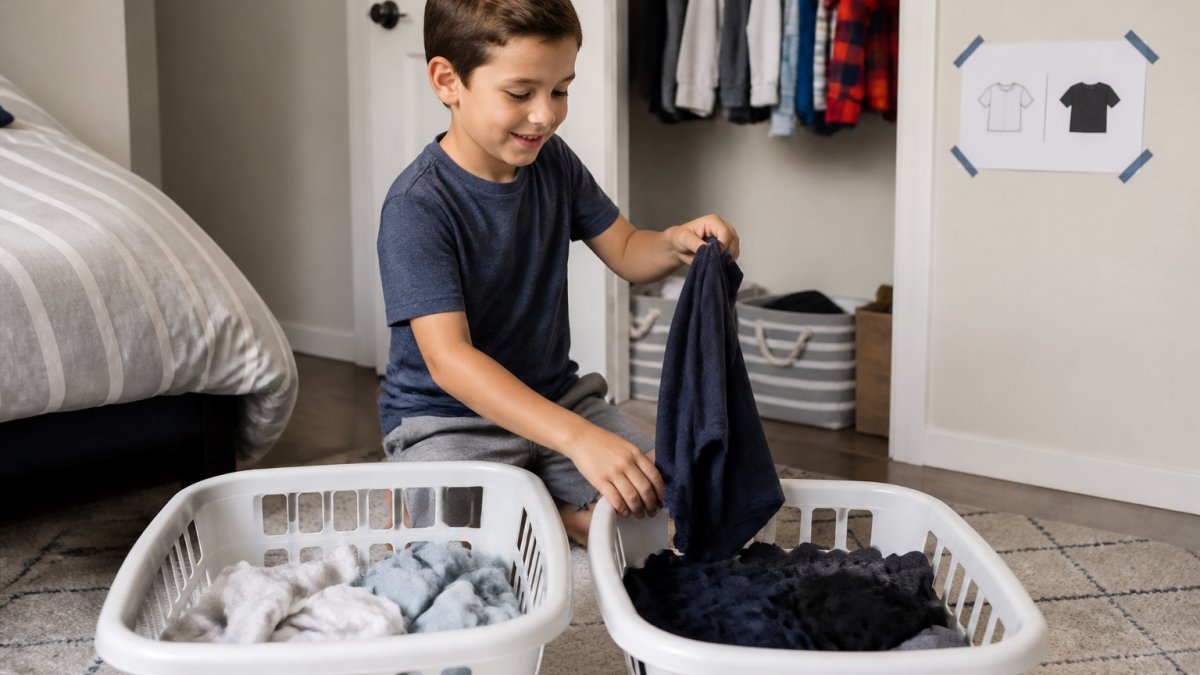
Start small. A four-year-old can put dirty socks in a basket. A seven-year-old can sort lights from darks. By ten, most kids can run a washer with supervision.
Age-Appropriate Chores From Toddler to Teen
Match the task to the age:
- Ages 2-4: Put dirty clothes in the basket
- Ages 5-7: Sort lights, darks, and towels
- Ages 8-10: Fold and put away their own clothes
This ladder builds real skills and cuts your workload, the single biggest time saver in minimizing laundry for minimalist families.
Laundry Folding Alternatives That Save Real Time
Folding is where laundry routines die. Most families spend more minutes folding than washing and drying combined, and a clean pile left unfolded for two days often gets re-washed out of frustration. The fix is not a faster fold, it is removing the fold from as many items as possible and building a put-away path under ten minutes per load.
Start by deciding which items never need a fold at all:
- Hang, don't fold: Button-downs, blouses, dresses, slacks, and anything with a wrinkle risk. Hang them on a shower rod or a rolling rack directly beside the dryer so they go from drum to hanger in one motion.
- Roll, don't fold: Socks, underwear, pajamas, workout clothes, and kids' play clothes. Rolling takes about half the time of folding and lets you drop items straight into a drawer or open bin.
- Bin, don't stack: Give each child one open bin for play clothes. No stacking, no matching, no drawer Tetris.
The Put-Away Workflow That Prevents Pileup
The real time sink is the gap between "dry" and "in the drawer." Close it with a fixed sequence:
- Clear the landing zone first. Before you start a load, make sure the bed, couch, or table where clean clothes land is empty. A full landing zone is why clean laundry becomes a pile.
- Sort by owner at the dryer, not at the couch. Pull each person's items into their own basket as you unload. This eliminates a second sorting pass later.
- Hang or bin immediately. Items that hang go on hangers before they touch a surface. Items that roll go into bins before they touch a surface. Only true fold-only items (towels, sheets) hit a flat surface.
- Set a ten-minute timer. Most loads can be fully put away in under ten minutes once hanging and rolling replace folding. If it is taking longer, you are folding things that do not need it.
- Deliver baskets, don't stack them. Each person's basket goes to their room the same day. A basket that sits in the hallway becomes tomorrow's re-wash.
A Realistic Time Comparison
A common pattern among families who switch to hang-and-roll:
| Task | Traditional Fold-and-Stack | Hang-and-Roll |
|---|---|---|
| Unload dryer | 3-5 min | 3-5 min |
| Sort by owner | 5-8 min | 0 min (done at dryer) |
| Fold | 15-25 min | 0-5 min |
| Put away | 10-15 min | 5-8 min |
| Total per load | 33-53 min | 8-18 min |
That difference compounds: at five loads a week, hang-and-roll saves two to three hours weekly, the largest time recovery in minimizing laundry for minimalist families.
What Still Needs a Real Fold
Do not eliminate folding everywhere, just where it does not matter:
- Towels: Fold or roll, but store in one stack per bathroom. No decorative folding.
- Sheets: One folded set per bed, stored inside its matching pillowcase. This keeps sets together and eliminates the linen-closet search.
- Knit sweaters: Fold flat to prevent shoulder stretch. Hang-and-roll does not apply here.
The goal is not a perfect fold but a put-away path short enough that nobody dreads starting the next load.
Stain Treatment, Hygiene, and When Clothes Actually Need Washing
Most clothes need washing after two to three wears, not every wear.
Washing less often is the quiet secret behind minimizing laundry: over-washing wears out fabric, wastes water, and creates piles you did not need to make.
Quick rules that keep clothes clean and fresh:
- One wear: Underwear, socks, t-shirts worn to sweat, workout clothes
- Two to three wears: Shirts, blouses, dresses, kids' school clothes
- Five or more wears: Jeans, sweaters, jackets, skirts
Treat stains fast. The Environmental Protection Agency's WaterSense program notes that standard washing machines use a significant amount of water per load, so washing full loads only makes a real difference.
Laundry Systems for Renters, Small Apartments, and Shared Machines
Renters and small-apartment families face constraints in-home laundry advice ignores: shared machines, coin-op costs, no dryer, and limited drying space. A system built for a dedicated laundry room fails in a 600-square-foot apartment. Design around the constraint, not against it.
If You Have a Shared Laundry Room in the Building
Shared machines change the math: you cannot start a load on a whim or leave clothes sitting.
- Pick a low-traffic time slot and own it. Early morning or late evening on a weekday usually has the least competition. A fixed weekly slot prevents the pileup that comes from "I'll do it when a machine is free."
- Bring one rolling hamper, not three baskets. A three-section rolling hamper lets you sort at the machine instead of at home, so you make one trip instead of three.
- Set a phone timer for the wash cycle. Shared machines get emptied by other tenants if you are late. A timer prevents the awkward pile-on-the-table situation and the re-wash that follows.
If You Use a Laundromat
Laundromat trips are the highest-friction laundry situation, so minimize trips and maximize each one.
- Batch by load type, not by person. Lights, darks, towels, and bedding each get one machine. Sorting by person wastes machine capacity.
- Use the largest machines for bulky items. Bedding and towels belong in the biggest drum available. Small machines waste money on partial loads.
- Bring your own detergent in a small container. Many laundromats charge a premium for single-use detergent, and the per-load cost adds up fast.
If You Have a Washer but No Dryer
A washer without a dryer is common in older apartments and small rentals. The system is about drying capacity, not washing capacity.
- Hang-dry the majority of items. Most shirts, pants, dresses, and delicates air-dry well. Reserve the dryer (if you have access to one) for towels, bedding, and socks.
- Use a ceiling-mounted or wall-mounted drying rack. Floor racks eat square footage you do not have. Wall-mounted racks fold flat when not in use.
- Dry in the bathroom with the door closed and a fan running. This concentrates humidity and speeds drying without adding moisture to living spaces.
If Paid Laundry Is Your Only Option
When every load costs money, the goal is fewer, fuller loads.
- Combine loads that can safely wash together. Lights and towels can often share a warm cycle. Darks and jeans can share a cold cycle. Check care labels before combining.
- Wear items more than once when safe. Jeans, sweaters, and outer layers can go several wears between washes. Underwear, socks, and workout gear cannot.
- Air out between wears. Hanging worn-but-not-dirty clothes on a hook or chair overnight extends wear time and reduces load frequency.
A Renter-Friendly Setup That Fits in a Closet
A complete small-space laundry kit fits on one closet shelf:
- One three-section rolling hamper
- One mesh delicates bag
- One small bottle of detergent and one stain pen
That kit handles washing, drying, and put-away without a dedicated laundry room. The constraint is space, not capability, and a system built around it is what makes minimizing laundry for minimalist families work in a rental.
Common Mistakes That Sabotage Minimizing Laundry for Minimalist Families
The biggest mistake is buying more storage instead of owning less. Baskets, bins, and organizers hide the problem instead of solving it.
Watch for these traps:
- Too many baskets. One per person, plus one for towels. That is it.
- Keeping "someday" clothes. If it has not been worn in a year, it goes.
- No fixed schedule. Laundry without a routine always piles up.
Fix these and the pile shrinks on its own. The goal is not a perfect system but a simple one your family can keep.
Minimizing laundry for minimalist families comes down to owning less, washing on a schedule, and letting everyone help. At WowHaul, we curate practical finds for everyday living, from pet care essentials to home organization products built for stronger daily routines.
Frequently Asked Questions
How many clothes does a minimalist family need?
A workable starting point is 7 to 10 outfits per person for daily wear, plus 3 to 5 items for specific activities like sports or school uniforms. Children may need slightly more because they outgrow sizes mid-season. Count what one typical week actually requires, then add a small buffer for sick days and spills. If you can finish a full wash cycle weekly without running out, your count is right. Adjust after one month based on what sits unworn.
How often should a family do laundry?
Once or twice a week works for most households of four. A family of four typically generates 6 to 8 loads weekly when you separate whites, darks, towels, and bedding. Running one load per day keeps the pile from growing, but batching two or three loads on set days often saves more time overall. The goal is a predictable family laundry routine, not a perfect one. Pick days that match your schedule and stick to them.
Do kids need their laundry folded?
No, and skipping it saves hours each week. Children can pull clean clothes from a bin or drawer without wrinkles mattering for play clothes. Reserve folding for items that crease, like school uniforms or dress clothes. Everything else can go straight into labeled bins by category: tops, bottoms, socks, and underwear. This is one of the most effective laundry folding alternatives for busy families, and kids as young as five can sort their own bin.
Does decluttering your closet reduce how much laundry you do?
Yes, though indirectly. Fewer clothes means smaller loads, faster sorting, and less time deciding what to wear. A pared-down wardrobe also makes it obvious when something is dirty, so clothes get washed when needed instead of piling up. Start by removing anything unworn for a year, then set a fixed count per category. Most families find that cutting clothing volume by a third reduces weekly laundry time noticeably.