

Table of Contents
- What Decibel Levels for Household Vacuums Actually Mean
- Quiet Vacuum Cleaners for Daily Use: What to Look For
- The Best Lightweight Vacuum for Daily Cleaning
- Suction Power vs. Noise: The Trade-Off Nobody Explains
- Cordless vs. Corded Quiet Vacuums: Which Fits Your Routine?
- Vacuum Maintenance Tips for Optimal Performance
- Sensory-Friendly Cleaning: When Noise Matters Most
- Conclusion
- Frequently Asked Questions
Last Updated: September 22, 2026
What Decibel Levels for Household Vacuums Actually Mean
A vacuum rated at 70 dB is roughly twice as loud to your ears as one rated at 60 dB, even though the numbers look close. That gap matters when you run a vacuum every day. This guide from WowHaul breaks down what quiet vacuum cleaners for daily use actually deliver, and where the marketing numbers fall short.
Decibels measure sound pressure on a logarithmic scale, not a linear one. Every 10 dB increase doubles perceived loudness. Normal conversation sits around 60 dB, while a typical vacuum runs between 70 and 85 dB. For context, the CDC's noise exposure guidance notes that prolonged exposure above 85 dB can damage hearing over time.
Manufacturers test at different distances, which skews comparisons. A "quiet" rating taken from three feet away tells you little about how the machine sounds in a hallway.
Quiet Vacuum Cleaners for Daily Use: What to Look For
The best quiet vacuum cleaners for daily use balance three things: a sound rating under 70 dB, enough suction for your floor type, and a weight you can carry up stairs without dread. Skip any model that only publishes a "low noise" claim with no number attached.
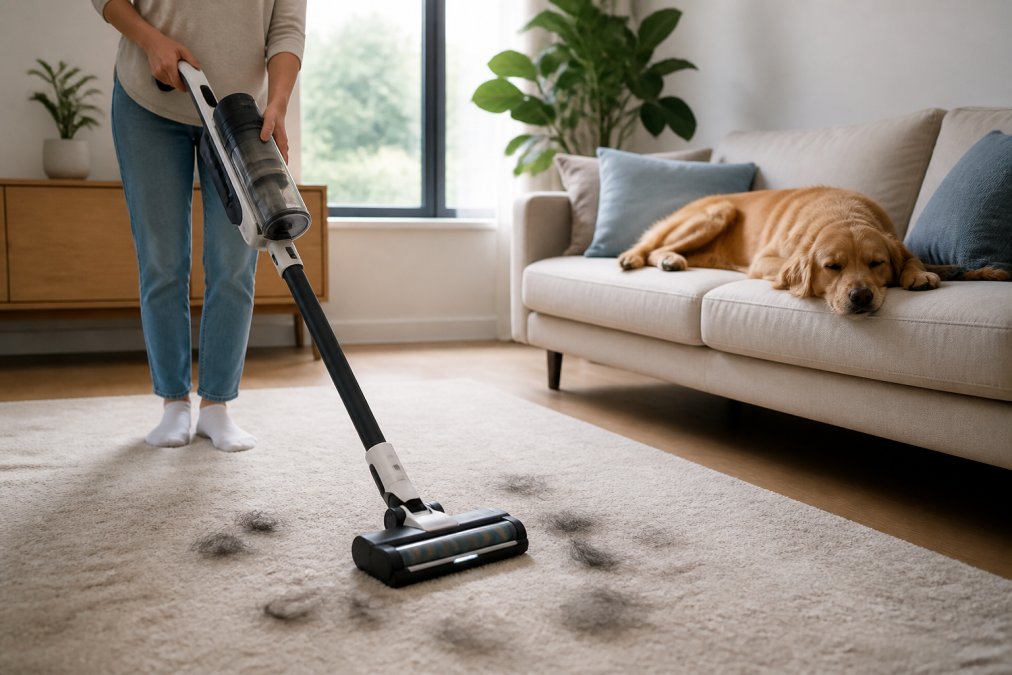
Here is what actually separates a vacuum you will use every day from one that sits in a closet:
- Published dB rating at a stated distance, not a vague "quiet" badge
- Weight under 4 kilograms (about 8.8 pounds) for stick models
- Sealed HEPA filtration to keep fine dust from recirculating
- Runtime of at least 30 minutes on a rechargeable battery
- Brush roll control so you can switch between carpet and hardwood floors
A common mistake is buying on suction alone. The loudest machines often win the spec sheet and lose the daily-use test.
The Best Lightweight Vacuum for Daily Cleaning
A lightweight vacuum earns its place when you can grab it, run it for five minutes, and put it back without a second thought. Stick and cordless models under 4 kilograms win here, especially for quick passes on hardwood floors and low-pile carpet.
Weight matters more than most buyers expect. A vacuum you have to haul with two hands turns a daily habit into a weekly chore. Look for a balanced handle and a low center of gravity, since these reduce wrist strain during longer sessions.
For pet owners, the brush roll design does more work than raw suction power. A tangle-resistant roll handles pet hair removal without the mid-cleanup scissors session. WowHaul curates practical home tools with this kind of daily-routine thinking in mind, focusing on items that reduce friction rather than add it.
Suction Power vs. Noise: The Trade-Off Nobody Explains
Higher suction usually means more noise, but the relationship is not fixed. Motor efficiency and airflow design decide how much of that power turns into sound versus cleaning performance. A well-engineered motor can move more air with less noise than a cheaper one running at the same power.
The key variable is airflow, measured in cubic feet per minute (CFM), not sealed suction. Sealed suction is measured in inches of water lift with the intake blocked, a static number that tells you how hard the motor pulls, not how much debris it actually moves. Manufacturers quote peak suction because it photographs well on a box.
Where the noise actually comes from
Vacuum sound is not one tone, it is several sources stacked on top of each other:
- Motor and impeller whine, the high-pitched component, typically the loudest single source, driven by RPM
- Airflow turbulence, the whoosh through the hose, wand, and nozzle, which rises with velocity and narrows at bends
- Brush roll contact, the mechanical grind of bristles on carpet and debris rattling through the intake
- Casing resonance, plastic shells that vibrate at the motor's frequency and amplify it
The noise-to-performance ratio
Instead of comparing raw dB, compare CFM per decibel. Take the airflow figure and divide it by the sound rating at the manufacturer's stated distance. A vacuum moving 85 CFM at 68 dB scores about 1.25 CFM/dB. One moving 60 CFM at 62 dB scores about 0.97. The first machine cleans more per unit of noise, even though it is louder on paper.
| Factor | Raises Noise | Lowers Noise |
|---|---|---|
| Motor speed | Higher RPM | Optimized RPM |
| Airflow path | Turbulent, narrow | Smooth, wide |
| Casing | Open plastic shell | Damped, sealed housing |
| Maintenance | Clogged filter | Clean filter |
| Brush roll | Worn or tangled | Clean, balanced |
Cordless vs. Corded Quiet Vacuums: Which Fits Your Routine?
Cordless vacuums win for daily touch-ups, while corded models still lead for deep cleaning sessions and larger homes. The right pick depends on how you clean, not which one sounds quieter on paper.
Vacuum Maintenance Tips for Optimal Performance
A clean vacuum runs quieter and lasts longer, which is why maintenance belongs in any daily-use routine. Most noise complaints trace back to a clogged filter or a tangled brush roll, not a failing motor.
Follow this simple schedule to protect performance:
- Empty the dust bin after each use
- Rinse or replace the filter every one to two months
- Cut hair and string off the brush roll monthly
- Check the hose and intake for blockages every few weeks
- Inspect seals and gaskets for cracks twice a year
- Replace worn filters with the manufacturer's specified part
Why vacuums get louder over time
Long-term noise degradation is real, and it is gradual. Three mechanisms drive it:
- Filter loading, as pores clog, the motor pulls harder against resistance, spinning faster and louder. This is the fastest and most reversible cause.
- Bearing wear, motor and brush-roll bearings lose lubrication and develop play, adding a grinding or whining tone that was not there when new.
- Seal and gasket hardening, rubber seals dry out and crack, letting air escape and creating a whistle or rattle that no amount of cleaning will fix.
How to tell fixable noise from terminal noise
Run this quick diagnostic before assuming you need a new vacuum:
- Clean or replace the filter, then listen. If the sound drops back to normal, you solved it.
- Remove the brush roll and run the motor briefly. If the whine disappears, the roll or its bearings are the culprit.
- Check the hose and wand for blockages. A partial clog raises pitch and reduces pickup at the same time.
- Inspect seals around the bin and nozzle. Cracked gaskets leak air and create a persistent whistle.
Sensory-Friendly Cleaning: When Noise Matters Most
For households with sensory sensitivities, autism, or noise-triggered anxiety, the sound of a vacuum is not a minor annoyance. It can make daily cleaning genuinely difficult, which is why a quiet vacuum is a practical tool, not a luxury.
A sensory-friendly cleaning routine starts with timing and preparation:
- Vacuum when the household is calm, not during a meltdown-prone hour
- Give advance warning so no one is caught off guard
- Offer noise-cancelling headphones or ear defenders during cleaning
- Start in a distant room and work toward occupied spaces
- Keep sessions short and consistent rather than rare and intense
Conclusion
Choosing quiet vacuum cleaners for daily use comes down to matching sound output, suction, and weight to how you actually clean. A machine that cleans well but sounds like a jet engine will sit unused, no matter how good its specs look on paper.
Frequently Asked Questions
What is considered a quiet vacuum in decibels?
Most standard vacuums run between 70 and 80 decibels, which is roughly as loud as a busy street or a blender. A vacuum is generally considered quiet when it operates below 70 decibels. The quietest models on the market reach the mid-60s, comparable to normal conversation. For daily use in apartments or homes with light sleepers, aim for a model rated under 70 decibels.
Do quiet vacuum cleaners sacrifice suction power?
Not necessarily. Modern quiet vacuum cleaners use motor efficiency improvements and sound-dampening materials to reduce noise without losing suction. The key is airflow design: a well-sealed system with cyclonic technology can maintain strong suction at lower decibels. However, some ultra-quiet budget models do trade power for silence, so check both the decibel rating and the airflow or suction specs before buying.
How do I maintain a quiet vacuum for optimal performance?
Clean or replace filters regularly, typically every three to six months depending on use. Empty the dustbin after each session to prevent airflow blockage. Check the brush roll for tangled hair and debris weekly. Inspect seals and hoses for cracks that can cause whistling noises. These vacuum maintenance tips for optimal performance keep noise levels stable and prevent the motor from working harder, which increases sound output over time.
Is there a completely silent vacuum cleaner available?
No vacuum cleaner is completely silent because moving air and a spinning motor always produce some sound. The quietest models reach the mid-60 decibel range, which is about as loud as a normal conversation. For the lowest noise, look for models with acoustic insulation, sealed motor housings, and variable speed settings. Using a lower power mode on hard floors also reduces sound output.