

Table of Contents
- Why a Smooth Morning Routine for Kids Matters
- Prepare the Night Before to Reduce Morning Stress
- Create a Morning Routine Checklist for Kids
- How to Get Kids Ready for School on Time
- Visual Morning Routine for Toddlers and Younger Children
- Build Independence and Self-Regulation
- Handle Morning Meltdowns and Transitions
- Strategies for Single Parents and High-Stress Households
- Frequently Asked Questions
Last Updated: September 3, 2026
Why a Smooth Morning Routine for Kids Matters
A smooth morning routine sets the tone for the entire day. When children know what to expect and move through tasks predictably, they experience less anxiety and stress. The difference between chaotic and organized mornings isn't about being a "perfect parent", it's about reducing friction.
Mornings are inherently challenging. Kids are transitioning from sleep while being asked to complete multiple tasks in a limited window. Parents manage their own morning while coordinating everyone else's. Without structure, this becomes a collision of competing needs.
At WowHaul, we understand that parents need practical tools to simplify daily routines. A well-designed morning routine checklist and visual schedule remove the constant reminding and redirecting that drains everyone's energy. When kids can see what comes next, they develop self-regulation skills that extend far beyond the morning hour.
Rushed, stressful mornings are linked to increased behavioral challenges, reduced academic readiness, and higher parental stress (peer-reviewed research). Children who follow consistent routines sleep better, manage transitions more smoothly, and develop stronger executive function skills over time.
Prepare the Night Before to Reduce Morning Stress
The most effective way to smooth morning chaos is to eliminate decisions and tasks that don't need to happen in the morning. Night-before preparation moves the burden to a calmer time.
Lay out clothes the evening before to eliminate outfit negotiations. Let older kids choose between two options; younger children benefit from you selecting weather-appropriate clothing. Store everything in one accessible spot.
Prepare breakfast items ahead of time. Set out bowls, spoons, and cereal, or pre-portion items into containers. This removes decision-making while managing multiple children.
Pack backpacks and bags the night before. Create a designated drop-off zone near the door where everything waits. This prevents frantic searches that derail even the best-planned morning.
Set a consistent bedtime and wake-up time, even on weekends. Children's bodies regulate better with predictability. A child with a consistent sleep schedule will be more alert and cooperative than one whose schedule shifts daily.
Prepare a transition activity for the first 15 minutes. Some families use snuggle time; others allow screen time or a quiet activity. This buffer gives kids time to fully wake up before expecting compliance with tasks.
Create a Morning Routine Checklist for Kids
A morning routine checklist is the centerpiece of a stress-free morning. It replaces constant parental reminding with a visual, self-directed guide that kids can follow independently. The checklist becomes the authority, not you.
What to Include in Your Checklist
A comprehensive morning routine checklist includes essential tasks every child needs to complete before school:
- Wake up and get out of bed
- Use the bathroom
- Get dressed
- Eat breakfast
- Brush teeth
- Wash face and hands
- Pack backpack
- Put on shoes
- Get in the car (or walk to school)
For younger children, add snuggle time or a calming activity at the start. For older kids, include shower time, checking the weather, or reviewing the day's schedule. Keep the language simple and action-oriented. Instead of "Get ready," write "Get dressed in clothes from yesterday." Specific language removes ambiguity and reduces back-and-forth.
Making the Checklist Visual and Repeatable
A visual morning routine works because it meets children where they are developmentally. Young children can't manage abstract time or remember multi-step sequences reliably. A visual checklist externalizes the plan so kids can see what comes next without asking.
For children ages 2-5, use pictures instead of words. Simple line drawings or photos help pre-readers understand the sequence. Laminate the checklist and use dry-erase markers so it's reusable.
For children ages 6-10, combine pictures with simple words. Use checkboxes that kids can mark as they complete each task. The physical act of checking off an item provides satisfaction and motivation.
For children 11 and older, a text-based list with checkboxes works well. Some respond to a digital checklist on a shared family app or a whiteboard in their room.
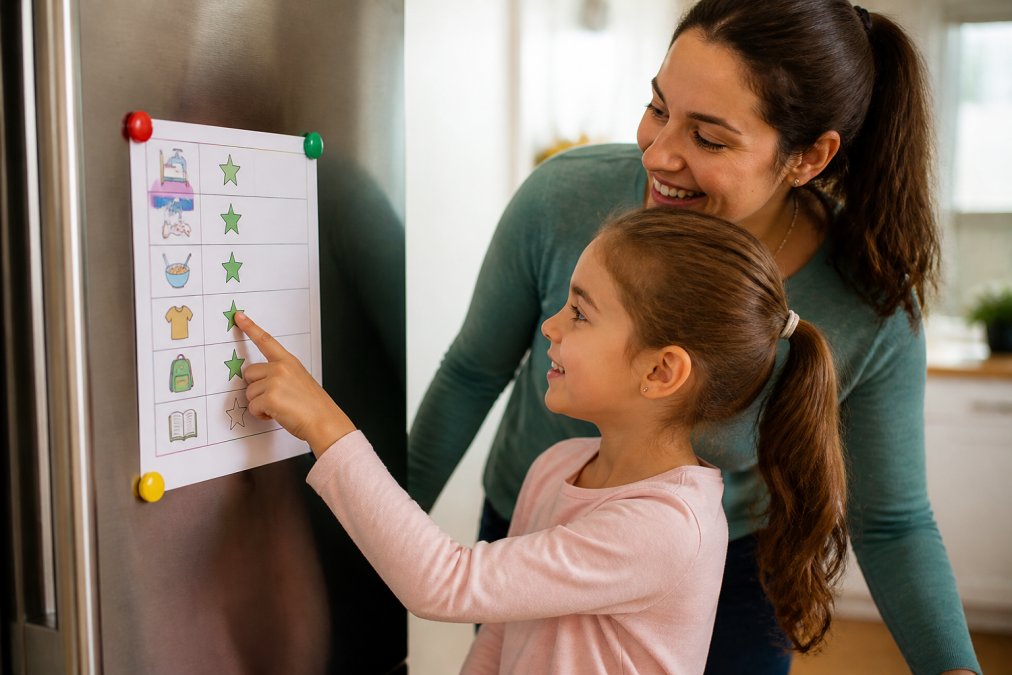
Place the checklist where your child sees it every morning, on the bedroom door, bathroom mirror, or kitchen wall. A checklist at eye level in a high-traffic area becomes part of the routine. Laminate it or use a wipeable surface so kids can check off tasks without damaging the original.
How to Get Kids Ready for School on Time
Getting kids ready on time requires clear wake-up times, time awareness, and structured transitions. Many families struggle because children have limited time awareness and parents underestimate how long tasks take.
Set a Wake-Up Time and Stick to It
A consistent wake-up time is non-negotiable. A child who wakes at 6:45 AM every day will be more alert and move more quickly than one whose wake-up time varies daily.
Set a wake-up time that gives your child enough time to complete the routine without rushing. Most elementary-age children need 45-60 minutes from wake-up to being ready to leave (apa.org). Work backward from your departure time to determine the wake-up time.
Use an alarm clock your child can see and hear. Many children respond well to a visual timer or sunrise alarm clock. These tools help kids understand that wake-up time is determined by the clock, not parental preference. Wake your child once. Repeated wake-up calls teach kids they don't need to respond to the first alert.
Use Time Blocks and Visual Schedules
A time block schedule breaks the morning into chunks and assigns tasks to each block. Instead of asking "Are you ready?" repeatedly, you point to the schedule: "It's 7:00, that's breakfast time."
Create a visual schedule that shows time in blocks. For young children, divide the morning into five blocks: Wake-up, Bathroom, Breakfast, Get Dressed, Leave. For older children, use specific times: 6:45 Wake-up, 7:00 Breakfast, 7:15 Get Dressed, 7:30 Leave.
Use a visual timer to show elapsed time within each block. A timer that shows time visually helps children understand how much time remains. Post the schedule where your child can see it, on the fridge, a whiteboard, or in their room.
Visual Morning Routine for Toddlers and Younger Children
Toddlers and preschoolers operate differently than school-age children. They have shorter attention spans, less impulse control, and limited ability to understand abstract concepts. A visual morning routine for toddlers needs to be simpler and more concrete.
Use large, clear pictures for each task. Photographs of your own child completing each task are more effective than generic clip art. Keep the routine to 4-6 main tasks maximum: wake-up, bathroom, breakfast, get dressed, shoes, go.
Use physical prompts and hand-over-hand guidance. Toddlers learn through doing. Guide your child through each task while pointing to the picture. Celebrate completion enthusiastically. When your child completes a task, acknowledge it immediately: "You got dressed! I see you in your shirt and pants!"
Use a reward system cautiously. Some toddlers respond well to earning a sticker for each completed task; others become focused only on the reward. If you use stickers, keep them simple and make sure the routine is the primary focus.
Build Independence and Self-Regulation
One of the most valuable outcomes of a consistent morning routine is increased independence. When kids know what to expect and can follow a checklist, they develop the ability to manage tasks without constant parental guidance.
Identify which tasks your child can complete with minimal help. Most children can get dressed by age 4, brush their teeth by age 5, and eat breakfast independently by age 4 (the CDC).
Use the "I do, we do, you do" framework. First, you complete the task while your child watches. Then, you do the task together. Finally, your child does the task independently while you observe.
Resist the urge to correct or redo tasks. If your child gets dressed in mismatched clothes, that's fine. Perfect execution is less important than building the habit and confidence that comes with independence.
Create opportunities for choice within the routine. "Do you want to eat breakfast first or get dressed first?" These choices build autonomy while keeping the overall structure intact.
Use natural consequences when appropriate. If your child dawdles during breakfast and runs out of time, they eat breakfast in the car. If they don't pack their backpack, they experience the natural consequence of forgetting something at school.
Handle Morning Meltdowns and Transitions
Even with the best-planned routine, morning meltdowns happen. Understanding what triggers them helps you prevent or manage them more effectively.
Common triggers include hunger, tiredness, sensory overwhelm, loss of control, and transitions themselves. Address the root cause rather than the behavior. If your child melts down during breakfast, the issue might be hunger or the specific food offered. If they melt down while getting dressed, the problem might be clothing sensations or feeling rushed.
Build in transition warnings. Instead of announcing "Time to get dressed!" abruptly, give a five-minute warning, then a two-minute warning. This helps children's brains shift gears rather than feeling ambushed.
Use calming strategies before meltdowns escalate. Identify what helps your child regulate, deep breathing, quiet time, or physical activity, and build it into the routine proactively.
Stay calm when meltdowns occur. A child in distress needs a calm, regulated adult. Your calm presence helps them regulate their own nervous system. Offer choices to restore a sense of control. "Do you want to walk to the car or hop to the car?" These small choices can shift a child from resistant to cooperative.
Strategies for Single Parents and High-Stress Households
Single parents and families managing high stress face unique morning challenges. The logistics of managing one or multiple children alone, often while preparing for work, require specific strategies and a different mindset about what "smooth" actually means.
Accept that your version of a smooth morning routine might look different. Smooth doesn't mean perfect or stress-free; it means functional and sustainable. A morning where kids get to school fed, dressed, and with their backpacks is a successful morning.
Simplify ruthlessly. Eliminate tasks that aren't essential. If breakfast is a source of daily conflict, switch to grab-and-go options. If getting dressed takes forever, limit clothing choices to three pre-selected outfits.
Build in extra time. Add 15-20 minutes of buffer time to your timeline. This removes the pressure that comes from being behind schedule before you even start.
Use technology strategically. Visual timers, reminder apps, or a shared family calendar can help manage the routine without adding another task to your mental load.
Ask for help when possible. If a family member, friend, or neighbor can help with drop-off some mornings, take it. You don't have to do this alone every single day.
Create a "good enough" standard for your household. Matching socks aren't required. A breakfast of cereal is fine. These small concessions reduce stress significantly while maintaining the core routine.
Connect with other parents managing similar situations. Knowing that other single parents also experience morning chaos provides perspective and reduces shame.
A smooth morning routine for kids isn't about achieving perfection. It's about creating predictability, reducing stress, and building independence. When you establish a consistent routine with clear expectations, visual supports, and realistic timelines, mornings become manageable.
WowHaul offers practical products designed to support stronger routines, including organizational tools and household items that simplify daily life. When your physical environment is organized and your systems are clear, the morning routine becomes easier for everyone. Start with one change, prepare the night before, create a checklist, or set a consistent wake-up time, and build from there. Small adjustments compound into significantly less stressful mornings.
Frequently Asked Questions
What is the best morning routine checklist for kids?
A morning routine checklist for kids should include wake-up time, bathroom tasks, getting dressed, eating breakfast, and preparing backpacks or bags. Keep it simple with 5-7 core tasks. Use pictures for younger children and words for older kids. Post it where they see it daily, on the refrigerator, bedroom door, or bathroom mirror. The most effective checklists are visual, repeatable, and achievable within your actual timeline.
How can I get my kids ready for school on time consistently?
Set a fixed wake-up time and maintain it every day, even weekends, to build consistency. Use time blocks: assign 15 minutes for bathroom, 10 for breakfast, 10 for getting dressed. Create a visual schedule so kids see how much time remains. Build in a 10-minute buffer before you need to leave. Prepare clothes, backpacks, and breakfast items the night before to reduce morning decision-making.
What is the 5-5-5-30 morning routine?
The 5-5-5-30 routine breaks the morning into four time blocks: 5 minutes to wake up and use the bathroom, 5 minutes to get dressed, 5 minutes to eat breakfast, and 30 minutes for buffer time or additional tasks. This structure gives kids clear expectations and helps parents manage the morning flow. Adjust times based on your children's ages and your household needs.
Are there digital tools that help kids stick to a morning routine?
Yes. Habit tracker apps like Habitica gamify routines with rewards, while visual timer apps help kids understand how much time remains for each task. Some families use smart speakers to announce time reminders. For neurodivergent children, apps with customizable alerts and step-by-step breakdowns work well. Experiment to find what motivates your child, some respond to timers, others to reward systems.
This article was written using GrandRanker