

Table of Contents
- What Actually Matters in a Car Detailing Handheld Vacuum
- Car Detailing Vacuum Attachments That Earn Their Space
- How to Clean Car Interior Like a Pro: A Step-by-Step Routine
- Best Portable Vacuum for Pet Hair in Cars: What to Look For
- Battery Degradation, Noise, and Ergonomics: The Angles Most Reviews Skip
- How to Choose the Best Handheld Vacuum for Car Detailing
- Conclusion
- Frequently Asked Questions
Last Updated: September 20, 2026
What Actually Matters in a Car Detailing Handheld Vacuum
Most shoppers chase the biggest suction number. The best handheld vacuum for car detailing instead matches three things to your routine: reach, runtime, and how often you empty it.
Suction Power, Airflow, and Why Both Matter
Suction power is the strength of the pull, measured in air watts or pascals. Airflow is how much air moves through the nozzle, measured in cubic feet per minute. A vacuum can have strong pull but weak flow, gripping a mat but struggling to lift scattered sand.
Runtime, Charging Time, and Battery Longevity
Runtime decides whether you finish the job. Most handhelds run 10 to 30 minutes on a full charge, and that shrinks fast under heavy use.
| Spec | Why It Matters | What to Aim For |
|---|---|---|
| Airflow | Lifts loose debris and pet hair | High, even if suction is moderate |
| Suction power | Grips embedded grit in carpet | Balanced with airflow |
| Runtime | Determines if you finish one session | 20+ minutes for full interiors |
| Charge time | Affects how you schedule cleaning | Under 3 hours, or swappable battery |
| Dust cup capacity | Fewer empty stops | Larger cup for pet owners |
Car Detailing Vacuum Attachments That Earn Their Space
Attachments do more for detailing results than raw power. A crevice tool reaches seat rails and console gaps; a brush attachment lifts pet hair from upholstery without grinding it deeper into the weave.
The ones worth keeping:
- Crevice tool: seat gaps, vents, and door pockets
- Soft brush: upholstery, dash, and delicate trim
- Wide nozzle: floor mats and trunk liners
- Extension wand: under seats and into the footwell
How to Clean Car Interior Like a Pro: A Step-by-Step Routine
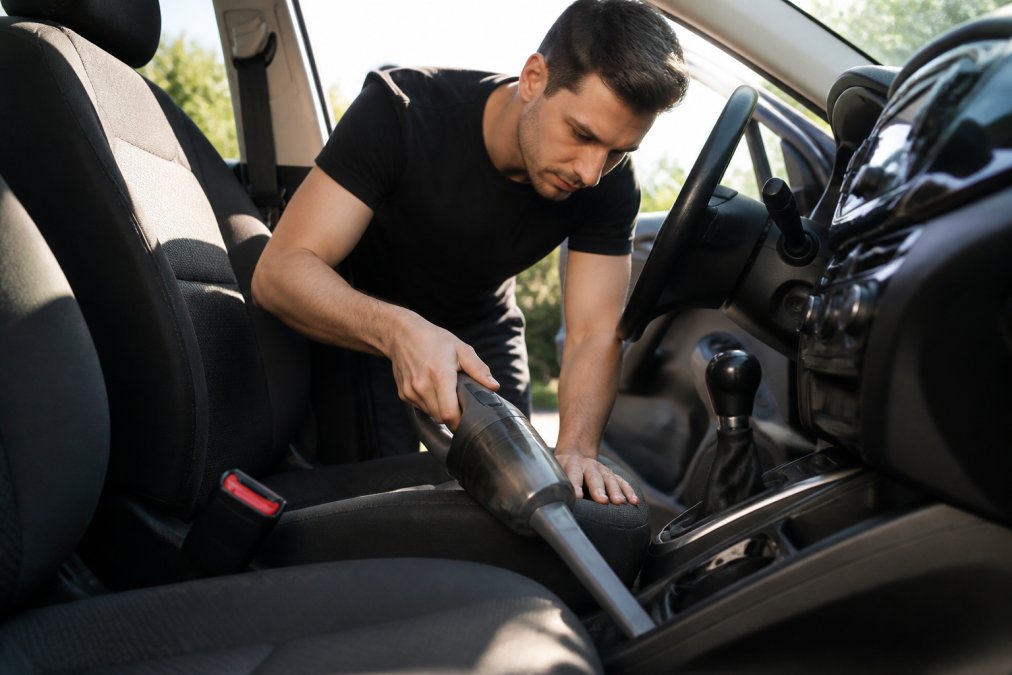
A pro-level interior clean takes about 30 minutes and follows a fixed order. Work top to bottom and dry to wet, so you never vacuum a surface you are about to dirty again.
- Remove floor mats and shake them out.
- Vacuum the mats with the wide nozzle.
- Switch to the crevice tool for seat rails and console gaps.
- Use the brush attachment on upholstery and pet hair.
- Vacuum the trunk and door pockets last.
- Wipe hard surfaces after vacuuming, not before.
Best Portable Vacuum for Pet Hair in Cars: What to Look For
Pet hair is the hardest debris to remove because it weaves into fabric. A portable vacuum for pet hair needs a motorized brush attachment, strong airflow, and a washable filter, but whether it removes hair or just pushes it around depends on how those elements interact with your car's carpet texture.
Why Carpet Texture Changes the Result
The same vacuum behaves differently across automotive carpet types:
- Loop-pile carpet (floor mats, lower door panels): Tight, low loops hold hair at the surface. A motorized brush with stiff bristles releases it quickly; airflow carries it away. Easiest texture to clean.
- Cut-pile carpet (seat cushions, console sides): Taller, denser fibers wrap around hair. Soft bristles mat it deeper, so use medium-stiff bristles plus sustained airflow to lift hair out of the pile.
- Needle-felt or synthetic felt (trunk liners, cargo areas): Hair clings via static and friction. A rubber-tipped or silicone brush grabs it without adding static; follow with a wide nozzle to pull loosened hair into the dust cup.
- Woven upholstery or cloth seats (older vehicles): The loose weave lets hair migrate into the padding. A crevice tool with a brush collar concentrates airflow at the contact point and often beats a full brush head.
Detailers keep two brush attachments on hand: a stiff one for mats and a soft or rubber one for seats and felt. Using the wrong brush on the wrong texture is the biggest reason pet hair removal fails.
The Mechanism: Why Brush Plus Airflow Beats Suction Alone
Pet hair removal is a two-step process. The brush breaks the mechanical bond between hair and fiber. Airflow then transports the loosened hair into the dust cup. If either step is weak, hair stays behind.
- Brush does the agitation. Without it, hair clings to the carpet and clogs the nozzle.
- Airflow does the transport. Strong suction with low airflow pins hair to the surface instead of lifting it. Look for high cubic feet per minute, not just high air watts.
- Cyclonic action keeps performance steady. It separates hair from the airflow before the filter, and since pet hair is long and fibrous, it wraps around filter pleats and chokes airflow faster than fine dust. Without cyclonic separation, suction drops within minutes on a heavy-shedding dog.
Filter Maintenance for Pet Owners
A washable filter saves money and keeps airflow strong. Clogged filters are the leading cause of lost suction in handhelds, and pet owners hit that wall fastest. Rinse until the water runs clear, then air-dry at least 24 hours before reinstalling; a damp filter promotes mold and restricts airflow. Most manufacturers still recommend replacing it every three to six months, because pet oils and dander degrade the media.
Pet owners with one or two heavy-shedding animals who clean their car weekly and need a brush attachment matched to their carpet texture plus a washable filter and cyclonic separation.
Battery Degradation, Noise, and Ergonomics: The Angles Most Reviews Skip
Three things almost no review covers: how the battery ages, how loud the unit runs, and how it feels after ten minutes. These determine whether you still like the vacuum six months in.
Long-Term Battery Degradation: What Actually Happens
Lithium-ion packs lose capacity with every charge cycle, and heat accelerates that loss. A vacuum that runs 25 minutes when new may run 15 after two years, as each cycle deposits lithium plating on the anode and heat speeds the chemistry behind it.
What this means in practice:
- Storing the vacuum in a hot car is the worst thing you can do. Cabin temperatures can exceed 140°F in summer, and sustained heat above 86°F dramatically accelerates capacity fade. If you park outside, bring it inside or store it in a shaded, ventilated area.
- Avoid full drains. Running to zero stresses cells more than partial discharges; recharge at about 20 percent.
- Charge to 80 percent for storage. Leaving it at 80 rather than 100 percent for weeks reduces cell stress.
- Expect 20 to 30 percent capacity loss over two to three years under normal use. If runtime is critical, a swappable battery system or corded backup is the practical hedge.
Noise Level: What the Decibels Mean in a Closed Cabin
Handheld vacuums commonly run 70 to 85 decibels. Normal conversation is about 60, a gas lawn mower about 90. In a closed cabin, sound reflects off glass and hard surfaces, so a 75-decibel vacuum can feel louder than it measures.
- Below 70 decibels: Quiet enough for sleeping pets or an apartment. These units typically trade some airflow for noise reduction.
- 70 to 80 decibels: The typical handheld range. Prolonged exposure causes fatigue; use hearing protection past 15 minutes.
- Above 80 decibels: Prolonged exposure risks hearing damage (Noise-Induced Hearing Loss (NIHL)). If kids or pets are nearby, a quieter model is worth the trade-off in raw power.
Ergonomics for Tight Spaces: The Maneuverability Test
Ergonomics decide whether you finish the job. A compact, lightweight unit with a balanced grip reaches under seats and into footwells without strain; a heavy vacuum with a top-mounted battery tires your wrist fast.
- Between the seat and center console: Typically 2 to 4 inches wide and 12 to 18 inches deep. A slim crevice tool and a body held at a 45-degree angle work here; a bulky top-mounted battery forces your wrist into an awkward angle and limits reach.
- Under the seat: The seat rail creates a low, narrow channel. An extension wand or flexible hose reaches the back without removing the seat, and a bottom-mounted battery with a low center of gravity is easier to guide along the floor.
- Footwells and pedal area: The dead pedal and space behind the brake pedal are hardest to reach. A pivoting nozzle or swivel joint lets you change angle without repositioning your whole arm.
- Trunk and cargo area: Larger surfaces favor a wide nozzle and longer runtime. A vacuum comfortable for a 5-minute crevice job may fatigue you over a 15-minute trunk clean.
How to Choose the Best Handheld Vacuum for Car Detailing
Match the vacuum to your car and habits, not the biggest number on the box. Start with how often you clean and what you are cleaning up.
Use this decision framework:
| If You... | Prioritize | Because |
|---|---|---|
| Have pets | Brush attachment, washable filter | Hair needs agitation and clear airflow |
| Clean weekly | Runtime 20+ min, fast charge | You need to finish in one pass |
| Have a large SUV or van | Larger dust cup, extension wand | More surface means more debris |
| Park outside | Corded option or spare battery | Heat degrades lithium-ion packs |
| Have limited storage | Compact, wall-mountable design | Fits a small apartment or trunk |
Conclusion
Choosing a car detailing vacuum comes down to fit, not raw power. The right airflow, runtime, and attachments turn a chore into a ten-minute task. The wrong ones leave you halfway through a minivan with a dead battery.
Frequently Asked Questions
What vacuum do professional car detailers use?
Detailers typically rely on a two-vacuum setup: a corded shop vac or canister vacuum for deep extraction on carpets and trunk cleaning, paired with a cordless handheld vacuum for quick touch-ups, crevice work, and upholstery. The handheld needs strong suction power, a HEPA or washable filter, and a crevice tool that reaches seat rails. Many detailers also keep a soft brush attachment for delicate surfaces and a motorized pet hair tool for fabric seats.
Is a cordless or corded vacuum better for car detailing?
It depends on the job. Cordless handheld vacuums win on maneuverability and reach into tight spaces like under seats and between console gaps, and they are easier to store. Corded models usually deliver more consistent suction power and unlimited runtime, which helps on large floor mats and trunk cleaning. For most owners, a cordless handheld for weekly upkeep plus access to a corded unit for deep cleans covers both needs.
Are handheld vacuums powerful enough to remove pet hair from car upholstery?
Yes, if you pick the right tool. Look for a handheld with strong airflow, a motorized or rubber brush attachment, and a HEPA or washable filter that traps fine hair and dander instead of blowing it back into the cabin. Rubber bristle attachments are especially effective at lifting embedded pet hair from fabric seats and floor mats. For heavy shedding, run the brush attachment first, then follow with a crevice tool along seams.
What suction power is needed for effective car interior cleaning?
There is no single number that guarantees results, since airflow, seal quality, and attachment design matter as much as suction. For car interiors, prioritize a handheld that maintains strong airflow through a sealed system, has a cyclonic action or multi-stage filtration system, and holds enough dust cup capacity to finish a full interior without constant emptying. A washable filter and a brush attachment round out what you need for debris, crumbs, and pet hair.